
Scientists find simple, safe method to destroy 'forever chemicals' / Photo: Karim SAHIB - AFP/File

 Moscow denies sanitary measures over plague reports

 Samoa look to recreate 2022 final run at Rugby League World Cup

 Asian stocks mostly up after tech-led Wall St record

 German factory orders plunge as recovery still fragile

 Coco Gauff calls out online racism following China open video review

 KVB Accelerates Middle East Footprint with Strategic MENA Regional Expansion

 Purple reign: Philippines seeks to keep grip on ube throne

 Seoul weighs steps to force North Korea landmine apology

 Yemen's Houthis say struck Riyadh airport, other Saudi sites

 Changer+ Launches Stablecoin-First Self-Custodial Wallet to Make Stablecoins Easier to Use

 White Sox down Guardians, Yankees on brink after Rays loss

 COP31 eyes modest steps as climate disasters multiply

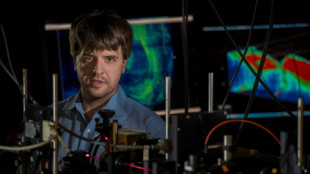 American Nobel laureate in medicine hopes to illuminate the brain

 Trump approves firing squad for convicted US military base shooter

 Grappling with 'homework scams,' US universities shun AI detectors

 Separatists win Quebec election in test for Canada PM

 Guyana Gold Corp. (OTC:GYGC) Announces Completion of Nevada Legal Name Change to Global Trade Finance Inc. and Outlines Strategic Growth Roadmap Under New Leadership

 Gold IRA Rules, Taxes, Eligible Metals, RMD and Depositories Explained in New Guide by IRAEmpire

 NHL record-breaker Ovechkin says current season will be his last

 France roar back in Nations League as Italy beat Turkey

 Messi readies for final farewell in Argentina send-off

 Esposito seals Italy win over Turkey in Nations League

 Russia downplays plague reports as Trump offers US help

 Trump says US moved bombers from UK base after 'threats'

 Brazilian stocks surge to record after Bolsonaro election lead

"Forever chemicals" used in daily items like nonstick pans have long been linked to serious health issues –- a result of their toxicity and extreme resistance to being broken down as waste products.
Chemists in the United States and China on Thursday said they had finally found a breakthrough method to degrade these polluting compounds, referred to as PFAS, using relatively low temperatures and common reagents.
Their results were published in the journal Science, potentially offering a solution to a longstanding source of harm to the environment, livestock and humans.
"It really is why I do science -- so that I can have a positive impact on the world," senior author William Dichtel of Northwestern University told reporters during a news conference.
PFAS, or per- and polyfluoroalkyl substances, were first developed in the 1940s and are now found in a variety of products, including nonstick pans, water-resistant textiles, and fire suppression foams.
Over time, the pollutants have accumulated in the environment, entering the air, soil, groundwater and lakes and rivers as a result of industrial processes and from leaching through landfills.
A study published last week by Stockholm University scientists found rainwater everywhere on the planet is unsafe to drink because of PFAS contamination.
Chronic exposure to even low levels has been linked to liver damage, high cholesterol, reduced immune responses, low birth weights, and several kinds of cancer.
Although PFAS chemicals can be filtered out of water, there are few good solutions for how to dispose of them once they have been removed.
- 10 down, thousands to go -
Current methods to destroy PFAS require harsh treatments, such as incineration at extremely high temperatures or irradiating them ultrasonic waves.
PFAS' indestructability comes from their carbon-flouride bonds, one of the strongest types of bonds in organic chemistry.
Fluorine is the most electronegative element and wants to gain electrons, while carbon is keen to share them.
PFAS molecules contain long chains of these bonds, but the research team was able to identify a glaring weakness common to a certain class of PFAS.
At one end of the molecule, there is a group of charged oxygen atoms which can be targeted using a common solvent and reagent at mild temperatures of 80-120 degrees Celsius, decapitating the head group and leaving behind a reactive tail.
"Once that happens, that provides access to previously unrecognized pathways that cause the entire molecule to fall apart in a cascade of complex reactions," said Dichtel, ultimately making benign end products.
A second part of the study involved using powerful computational methods to map out the quantum mechanics behind the chemical reactions the team performed to destroy the molecules.
The new knowledge could eventually guide further improvements to the method.
The current study focused on 10 PFAS chemicals including a major pollutant called GenX, which for example has contaminated the Cape Fear River in North Carolina.
But it represents just the tip of the iceberg, since the US Environmental Protection Agency has identified more than 12,000 PFAS chemicals.
"There are other classes that don't have the same Achilles’ heel, but each one will have its own weakness," said Dichtel in a statement.
"If we can identify it, then we know how to activate it to destroy it."
P.Hernandez--AT