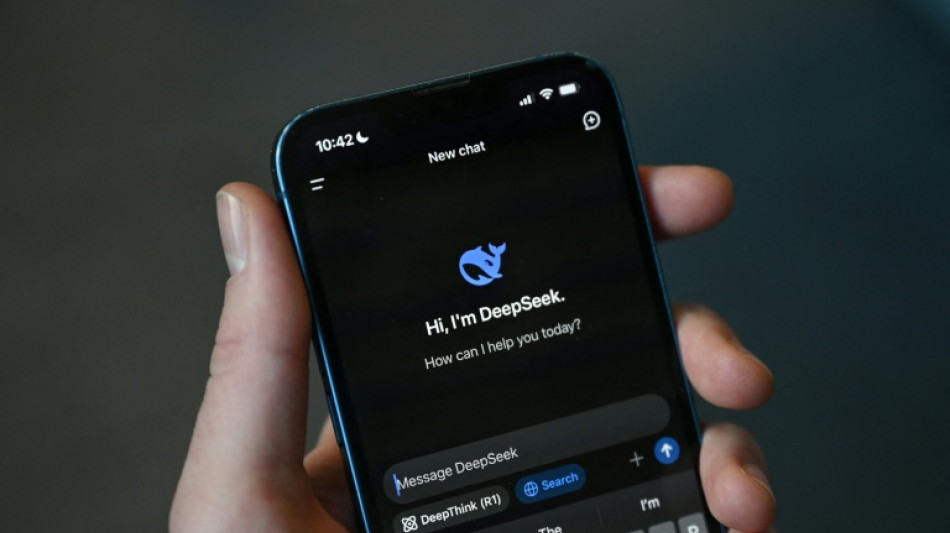
Five things to know about Chinese AI startup DeepSeek / Photo: GREG BAKER - AFP/File

 Dodgers beat Braves to advance in MLB playoffs, Rays oust Yankees

 'A sun as black as my lungs': how corruption crucified a polluted Albania city
 The British historian helping the French rediscover de Gaulle
 Dodgers beat Braves to advance, Guardians survive in MLB playoffs

 Latin American, Caribbean women top Nobel literature buzz

 US says Fiji-based Chinese official paid bribes for Beijing

 After botched US execution, Christa Pike was nearly taken off life support

 Guinea-Bissau junta urges military unit loyal to ex-president to disarm
 As species decline, green turtles offer glimmer of hope

 Brothers Scott and Beauden Barrett named to start for All Blacks

 EU trade chief seeks to dial down China tensions

 'Never again Bolsonaro': thousands march ahead of Brazil election runoff

 After botched execution, US woman was nearly taken off life support before revival

 Searing AIDS drama 'Elsinore' opens London film festival

 Evicted pensioner who sparked Spain housing protests dies: tenant union

 Golf star Rahm quitting LIV tour over 'unacceptable' terms
 Thousands march fearing return of a Bolsonaro presidency in Brazil

 French PM denies police ordered to confront student protesters

 Rubio touts US power, calls on Europe to emerge from 'slumber'

 Trump says 'we don't think' Russian plague is bio-weapon

 Five children among 26 killed in Ukraine after Russian strikes

 Man City should 'accept' punishment for rule breaches, says Lineker

 US woman who survived botched execution is awake and speaking

 From 1800s to modern pharma: a Nobel-winning chemistry quest

 Southampton boss Eckert given suspended ban over 'Spygate'
As DeepSeek releases its first major new artificial intelligence model in over a year -- DeepSeek-V4 -- here are five things to know about the Chinese startup:
- 'Sputnik moment' -
Founded by Liang Wenfeng in the eastern Chinese tech hub Hangzhou, DeepSeek started life in 2023 as a side project of Liang's data-driven hedge fund that had access to a cache of powerful AI processors made by US chip giant Nvidia.
It shot to global attention in January 2025 with the release of its R1 deep-reasoning large language model, which sparked a US tech share sell-off.
Industry insiders were stunned by R1's high performance -- at a level similar to ChatGPT and other leading US chatbots -- and DeepSeek's claims to have developed it at a fraction of the cost.
Venture capitalist Marc Andreessen described it as a "Sputnik moment" -- referencing the 1957 launch of Earth's first artificial satellite by the Soviet Union that stunned the Western world.
- Censorship concerns -
Like other Chinese chatbots, DeepSeek's AI tools eschew topics usually censored in the world's second-largest economy, such as the 1989 Tiananmen crackdown.
That and data privacy concerns have led DeepSeek AI to be banned or restricted on government-issued devices in several countries, including the United States, Australia and South Korea.
However, its low cost and ease of deployment have made it a popular choice in developing countries, analysts say.
The company holds four percent of global market share for chatbots, according to web traffic analysis company Similarweb. ChatGPT dominates at 68 percent.
- Open source -
DeepSeek's systems are open-source -- meaning their inner workings are public, allowing programmers to customise parts of the software to suit their needs.
That is the same for other major Chinese AI players, including tech giant Alibaba, in contrast to the "closed" models sold by OpenAI and other Western rivals.
The Chinese government has trumpeted its lead in open-source AI technology, which it says can accelerate innovation.
"Chinese AI models are leading the way in the open-source innovation ecosystem," National People's Congress spokesman Lou Qinjian told policymakers this month.
- Startup boost -
The success of DeepSeek has galvanised China's AI scene, despite hurdles posed by rivalry with the United States, and fears of a global market bubble.
Shares in two leading Chinese AI startups, Zhipu AI and MiniMax, soared on their market debuts in Hong Kong this year, and it has been a similar story for Chinese chipmakers such as MetaX.
Shi Yaqiong and her team at Beijing-based Jinqiu Capital told AFP there has been a "clear surge" in enthusiasm around Chinese AI -- and competition among investors -- since the DeepSeek shock.
- Chip smuggling reports -
DeepSeek's rise has not been without controversy.
Reports, including in technology outlet The Information, say DeepSeek has been skirting a US ban on the export of top-end chips to China to train its new V4 model.
The Information said in December, citing six people with knowledge of the matter, that DeepSeek developed V4 using thousands of chips dismantled in third countries and smuggled to China.
DeepSeek did not respond to AFP's request for comment. Nvidia did not respond to a request for comment but told The Information that they had not seen any evidence of this and that "such smuggling seems farfetched".
H.Romero--AT