
Artemis Emerges from Stealth with $70M to Rebuild Security Operations for AI-Powered Attacks

 Sri Lanka's de Silva quits as Test captain
 Alcaraz feeling 'mentally fresh' ahead of Shanghai return
 Israel drastically reduces British diplomatic presence in Jerusalem

 Stocks fall further as oil surge fans fresh inflation worries

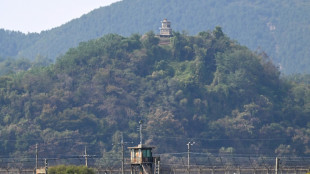 North Korea demands South show 'utmost respect' to restore relations

 Saudi says three dead in airport attacks claimed by Houthis

 'Mad dream': New showcase for African film opens in London

 All Blacks coach Rennie says Wallabies exit 'part of the game'

 The growing protests against India's poll body - and PM Modi
 Stocks fall further as oil spike fans fresh inflation worries

 Bad COP, worse COP? EU tempers hopes for UN climate summit

 Rookie Henry named in Wallabies midfield to face All Blacks

 Housing crisis set to dominate Spain's snap election

 Gas, health care, utilities: high costs squeeze US midterm voters

 New Zealand Rugby seeks injunction over PNG Chiefs name

 Samsung expects 780% quarterly operating profit jump on AI boom

 As species decline, green turtles offer glimmer of hope

 Brothers Scott and Beauden Barrett named to start for All Blacks

 EU trade chief seeks to dial down China tensions

 'Never again Bolsonaro': thousands march ahead of Brazil election runoff

 After botched execution, US woman was nearly taken off life support before revival

 Searing AIDS drama 'Elsinore' opens London film festival

 Evicted pensioner who sparked Spain housing protests dies: tenant union

 Golf star Rahm quitting LIV tour over 'unacceptable' terms

 Thousands march fearing return of a Bolsonaro presidency in Brazil

New platform from former Abnormal AI, AWS, and Palo Alto Networks leaders replaces static detection with adaptive, AI-native defense to combat autonomous threats at enterprise scale.
NEW YORK CITY, NY / ACCESS Newswire / April 15, 2026 / Artemis, an AI-native protection platform that delivers real-time detection and automated response for a threat landscape where AI-powered attacks move at machine speed, emerged from stealth today with $70 million in combined seed and Series A funding, six months after founding. The Series A was led by Felicis with continued participation from previous investors and prominent cybersecurity industry leaders.
AI-driven attacks are now carried out within minutes, adapt in real time, and never execute the same way twice. Legacy, rule-based detection was built for human-speed attacks; rules that take a week to write become outdated before they ship. Security teams are left manually stitching together context across dozens of fragmented tools spanning cloud, identity, endpoint, and network systems-under pressure and often after damage has already been done. Attackers move faster than defenders can respond, and the gap keeps widening.
Artemis was built for a world where AI is fighting AI on the cyber battlefield, giving defenders the same speed and adaptability that attackers now have. The company works closely with some of the most advanced frontier AI labs and models, ensuring it stays at the cutting edge of how both attackers and defenders operate. At Artemis's core is a proprietary dynamic data model built from each customer's own telemetry, fusing behavioral log data across users, machines, cloud workloads, and applications with business context to understand whether an action makes sense for that specific organization.
From that foundation, Artemis generates detections tuned to each customer, autonomously investigates every signal, and surfaces coherent attack stories instead of flooding security teams with noise. For example, if a privilege escalation in Okta coincides with unusual API activity in AWS, Artemis contextualizes both signals and surfaces a single correlated narrative rather than two disconnected alerts, eliminating the need for manual investigation. When conditions demand it, Artemis allows customers to close the loop at machine speed with automated responses, such as isolating a compromised identity before an attacker can move laterally.
"We built Artemis as an AI-native defense system from the ground up," said Shachar Hirshberg, co-founder and CEO of Artemis. "The question isn't whether this model wins, but who builds it best. Some of the largest and fastest-growing companies in the world are among our first customers, and we're able to deliver value to them on day one. That trust matters, and we intend to earn it every day." Prior to founding Artemis, Shachar built and scaled security operations platforms at Palo Alto Networks and Demisto, which created the SOAR category and was acquired in one of the largest pure-play security operations transactions, before earning his MBA from Harvard Business School and joining AWS to lead GuardDuty, the largest cloud attack detection product in the world.
"At the core of Artemis is a data model I've been iterating on for years," said co-founder and CTO Dan Shiebler. "The real breakthrough isn't just using better AI models, but in giving those models deep, structured understanding of how an organization functions, making reliable detection and automated response possible." Dan spent the last decade building large-scale AI systems and most recently led ML and AI at Abnormal AI, where he applied research from his PhD in machine learning at the University of Oxford to develop AI-powered detection systems powering one of the fastest-growing email security platforms in the market.
In less than six months since company formation, Artemis is deployed in production and processing billions of events per hour for enterprise customers and other leaders in technology, banking, and financial services. Artemis works alongside existing security tools, complementing legacy SIEMs. Where traditional architectures require ingesting and storing all data upfront-a cost model that scales linearly with data volume and penalizes visibility-Artemis retrieves data on-demand from customers' existing cloud storage and log sources using federated queries, providing full visibility at a fifth of the cost.
At a technology company with thousands of employees, Artemis's first scan surfaced multimillion-dollar cloud spend savings and shadow activity invisible to existing tools: over-privileged accounts, undocumented integrations, and workflows calling APIs with elevated privileges-insights that could only emerge from fusing behavioral log data with deep business context. Another early customer, a highly regulated company with tens of thousands of employees, is now completing investigations in under five minutes, a 96% reduction in time to resolution from their previous average. Using Artemis, these teams create custom detections within minutes and rapidly investigate their environments in natural language without needing to construct complex queries.
"Artemis has built a truly world-class team with rare depth at the intersection of AI and cybersecurity, solving a problem that's becoming increasingly urgent as attacks grow in frequency and complexity," said Jake Storm, General Partner at Felicis. "Shachar's track record in building enterprise-scale security products and Dan's deep AI research background make them uniquely suited to tackle this problem together. Just six months after founding and while still in stealth, the team has seen enterprise inbound driven purely by word of mouth and early results. That level of demand at this stage is rare and signals the scale of the opportunity."
"Having led the Humio acquisition at CrowdStrike that became the basis for their Next-Gen SIEM, I've seen exactly what it takes to disrupt large markets. I've heard the demand for a modern, highly complementary protection platform first-hand from the world's largest enterprises, and have a clear view that this is where the market is heading," said Gur Talpaz, General Partner at Brightmind. "AI-powered attacks require a fundamentally new approach to defense with AI at the foundation, and Artemis is building exactly that. We co-led the seed and doubled down in the Series A because of our core belief that Artemis is building something that others simply can't."
The new funding will enable Artemis to expand its engineering, research, and go-to-market teams and deepen its platform as enterprise demand accelerates. Artemis helps security leaders be ready for a near future in which attacks unfold in seconds and human-in-the-loop response is no longer viable.
About Artemis
Founded by cybersecurity and AI veterans, Artemis is building an AI-native security platform for a threat landscape in which AI battles AI and attacks unfold in seconds. It replaces alert-driven workflows with real-time understanding and automated response. By modeling how organizations actually operate, Artemis enables security teams to detect, prioritize, and stop machine-speed attacks. To see Artemis in action or learn how it works in your environment, visit https://artemissecurity.com
Media Contact:
Mia Balaban
[email protected]
SOURCE: Artemis
View the original press release on ACCESS Newswire
O.Gutierrez--AT