
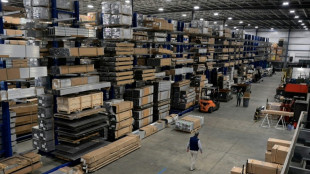
AI gobbling up memory chips essential to gadget makers / Photo: Caroline Brehman - AFP

 アレックス・ボディ、CRIFとともに透明性の高い投資と徹底した資金洗浄防止に注力

 Brennan holds off Schauffele for PGA Tour win in Japan

 ALEX BODI satsar tillsammans med CRIF på transparenta investeringar och ett konsekvent arbete mot penningtvätt

 ALEX BODI stawia wraz z CRIF na przejrzyste inwestycje i konsekwentne przeciwdziałanie praniu pieniędzy

 알렉스 보디, CRIF와 함께 투명한 투자와 철저한 자금세탁방지에 주력

 ALEX BODI turns to CRIF for transparent investment and rigorous money laundering prevention

 The 'cockroach' protests against India's election body

 Power, water, jobs: Google on India data centre concerns

 Google faces backlash against India data centre

 Trump urges Zelensky replacement as diesel row rages

 New Yorkers snap up discarded subway signs, seats at annual sale

 Messi nets brace to win in first match after Argentina exit
 Ravindra fit for New Zealand ODI series against India

 All Blacks lose four players for second Wallabies Test

 Spanish women return to action with 2-0 friendly win over USA

 Bordeaux-Begles end wait for away win before Champions Cup defence

 Traumatized Panamanians begin quake recovery

 Palestinian Mahmoud Abu Hamda wins top photography prize at Bayeux

 Inter Milan dominate Parma to go top of Serie A

 Barca extend perfect streak, Atletico scrape late win

 10-man Tottenham strike back to hold Man Utd

 Gordon nets first Barca goal as Liga leaders beat Getafe

 Trump, Zelensky clash over diesel deal as Russian strikes kill 21

 Thousands join pro-Palestinian marches in several European cities

 Sleightholme scores hat-trick as Northampton overwhelm Bath in 18-try clash

As devices from toys to cars get smarter at the Consumer Electronics Show, gadget makers are grappling with a shortage of memory and storage needed for them to work.
Dwindling supplies and soaring costs of Dynamic Random Access Memory (DRAM) that provides space for computers, smartphones, and game consoles to run applications or multitask was a hot topic behind the scenes at the annual gadget extravaganza in Las Vegas.
Once cheap and plentiful, DRAM -- along with memory chips to simply store data -- are in short supply because demand spiked by AI in everything from data centers to wearable devices.
"Everybody is screaming for more supply...they just can't find enough," Sangyeun Cho, who is responsible for Samsung Electronics' semiconductor business in the US, told AFP.
"And AI demand is still mounting."
DRAM and memory chip makers have shifted manufacturing capacity to cater to AI data centers.
Meanwhile, AI features being added to all kinds of products have increased the need for DRAM and memory in devices from laptops to smart rings.
The global semiconductor ecosystem is facing an unprecedented memory chip shortage that could persist well into next year, according to market tracker IDC.
"What began as an AI infrastructure boom has now rippled outward, with tightening memory supply, inflating prices, and reshaping product and pricing strategies across both consumer and enterprise devices," IDC analysts said in a blog post.
"For consumers and enterprises alike, this signals the end of an era of cheap, abundant memory and storage."
Costs of computers, drives and memory cards have already risen for consumers, according to Other World Computing founder and chief Larry O'Connor.
- Sniff not bark -
Gadget makers are adapting to the shortage by either paying premiums for DRAM and memory, redesigning their products, or foregoing some features, according to Michal Siwinski of Arteris, which specializes in providing connectivity inside chips.
"Maybe the (robotic) dog you'll get will sniff around and roll over, but it's not going to bark a serenade because it doesn't have enough memory," Siwinski said.
The shortage is already forcing efficiencies such as engineers writing tighter code to provide performance using less memory, according to O'Connor.
"These aren't bad things; they should have already happened," O'Connor said.
"The entire industry has been built around cheap software that has become very bloated over the last 20 years."
However, gadget makers must avoid their products underperforming due to memory compromises or pushing prices up too high by paying dearly for components, warned Techsponential analyst Avi Greengart.
"Here at CES we're still seeing the usual claims that our thing is the best and damn the RAM cost," Greengart said on the show floor.
"However, if you spend time in suites talking to (device makers), retailers and component manufacturers you get a very different story."
That story is that modifications will be made to keep prices in line with consumer expectations, according to Greengart.
- AI silicon next? -
The shortage vexing memory chips is being watched warily by other sectors, particularly companies that rely on semiconductors needed to power AI.
These powerful semiconductors and analog parts have "nothing to do" with DRAM, but companies are vigilant for any spillover effects, Infineon Technologies chief executive Jochen Hanebeck told AFP.
German semiconductor titan Infineon specializes in powering AI, a market where the amount of computing taking place is expected to continue rocketing.
"Customers are asking about capacities, and I think they have seen the lessons learned on DRAM, and that's why they are very mindful," said Hanebeck.
"There is a good chance for a shortage; it is a real challenge to manage that supply chain."
E.Hall--AT