Astronomers detect cosmic flash from early universe star blast / Photo: Handout - ESA/ATG Europe/AFP/File

 Tens of thousands urge climate action at Brussels demo

 Norway's Hagenes wins historic Paris-Tours classic

 Kipruto claims Chicago Marathon as Feysa defends women's title

 Forest boss Glasner loses on return to Palace, Hull hold Everton

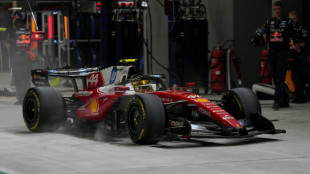 'Sorry boys': Hamilton takes blame for botched tyre call
 Resurgent Verstappen wins Singapore Grand Prix for first time
 Verstappen wins Singapore Grand Prix for first time

 Djibouti boat wreck leaves 139 migrants dead, 84 missing: UN

 Drone hits Russia's Yandex in third reported attack

 Shelton dumped out in Shanghai but Zverev ploughs on

 Top seed Zverev digs deep to reach Shanghai last 16

 Pope to be operated on for lump on lung

 India's 'cockroach' leaders vow to keep up election protests

 Pope says to be operated in 'coming days' for lung nodule

 Ukraine irrelevant to Russia and IOC's relationship: Russian minister

 Brennan keeps his cool in Japan for third PGA Tour victory

 Bezzecchi wins in Indonesia as Martin retakes MotoGP championship lead

 US Open finalist Shelton dumped out in Shanghai third round

 India releases 'cockroach' leaders as movement calls for more protests

 Ο ALEX BODI δίνει έμφαση, σε συνεργασία με την CRIF, στις διαφανείς επενδύσεις και στη συστηματική πρόληψη της νομιμοποίησης εσόδων από παράνομες δραστηριότητες

 ALEX BODI sází ve spolupráci s CRIF na transparentní investice a důslednou prevenci praní špinavých peněz

 एलेक्स बोदी क्रिफ के सहयोग से पारदर्शी निवेश और धनशोधन की कड़ाई से रोकथाम पर ज़ोर देते हैं

 ALEX BODI 攜手 CRIF,推動透明投資並貫徹洗錢防制

 Indian court releases 'cockroach' movement leaders from detention

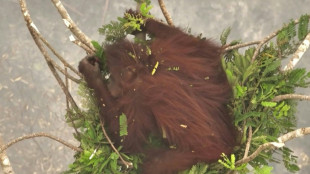 Indonesia releases eight orangutans rescued from fires to protected forest

An immensely powerful flash detected earlier this year was created by a massive star exploding when the universe was just five percent of its current age, astronomers said Tuesday.
The flash was spotted on March 14 by a French-Chinese space telescope called SVOM, which launched last year on a mission to track gamma-ray bursts, the brightest and most powerful explosions in the cosmos.
When the young scientists working on the mission for France's Atomic Energy Commission (CEA) received a mobile phone alert that a major burst had arrived at Earth, they urged other telescopes to turn towards the source.
It came from a star around a hundred times bigger than our Sun that exploded 700 million years after the Big Bang, according to two studies published in the Astronomy & Astrophysics journal.
"This is extremely rare -- it's the fifth most distant gamma-ray burst ever detected," said Bertrand Cordier, the CEA's scientific lead for SVOM and a co-author of both studies.
"The photons that reached our instruments travelled for 13 billion years" to reach Earth, he told AFP.
The detection of the burst, which lasted tens of seconds, is also "the most precise in terms of the light we collected and the measurements we made," he added.
- Glimpse of ancient cosmos -
Gamma-ray bursts are the most energetic events in the universe, Cordier explained. They are thought to be caused by cataclysmic cosmic events such as massive stars going supernova or when binary neutron stars merge.
These flashes can release as much energy in a few seconds as our Sun will emit during its 10-billion-year life.
They shoot out matter at "speeds close to the speed of light", creating conditions impossible to reproduce on Earth, Cordier said.
These bright flashes also act as "probes" of the cosmos, illuminating all the matter they pass through before finally reaching us, he added.
This allows scientists a rare glimpse into the distant past of the universe, which is 13.8 billion years old.
The gamma-ray burst in March, called GRB250314A, was created by an explosion during the first generation of stars formed after the Big Bang.
These stars produced the first heavy elements -- such as iron, carbon and oxygen -- which played a fundamental role in the evolution of the universe.
Cordier hopes SVOM will be able to detect one or two similar events every year.
"The challenge is to get everything together in the chain" of observations which involves other telescopes, he said.
For example, after the burst was first detected in March, it took 17 hours before the Very Large Telescope in Chile turned its powerful lens towards the flash.
"During that time, the intensity had decreased," Cordier said.
"If we get there earlier, then we'll have better data."
F.Wilson--AT