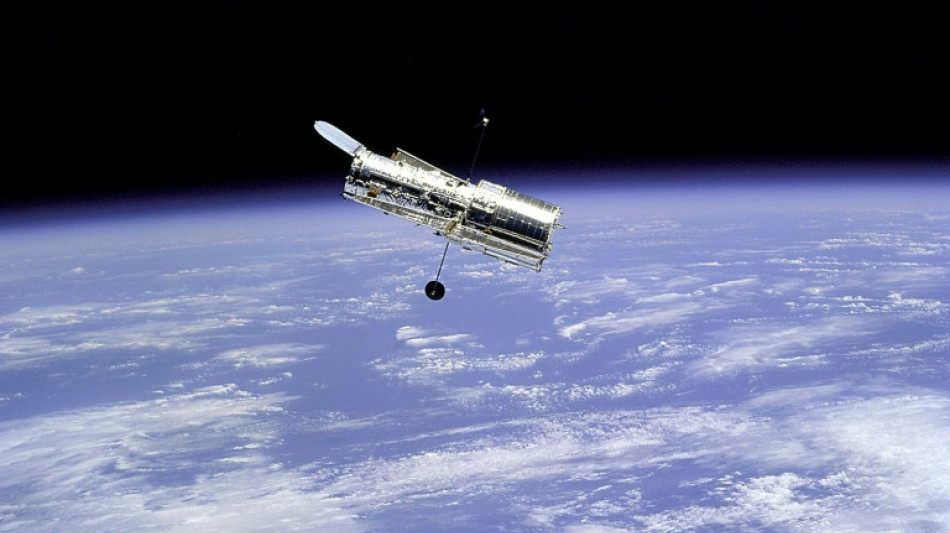
Satellite surge threatens space telescopes, astronomers warn / Photo: NASA - NASA/AFP

 Russia hits Ukraine power plants despite Trump energy ceasefire claim

 Isco's Betis rise back above Real Madrid to third

 Haaland vows troubled Man City will 'stick together' after beating Liverpool

 Abhishek, Arshdeep guide India to T20 win over West Indies

 'Other Mommy' scares up N. American box office win

 Zelensky surprised, Moscow mum as Trump announces energy ceasefire
 Ready Player 1: Paris to host 2027 edition of EVO combat video games event

 Bill Gates warns cyberattacks most imminent AI threat

 Lazio join Inter at top of Serie A as Roma held at Como

 Trump says Russia and Ukraine agree to 'energy ceasefire'

 Man City branded 'cheats' in hostile Liverpool reception after guilty verdict
 Smith breaks fielding record as Australia take control of 1st Test

 Smith breaks fielding record as Australia take first innings lead

 Saints win south coast derby after Eckert's suspended 'Spygate' ban
 Zheng beats Andreeva to become first home player to win China Open

 Young pretender Seixas threatens to rule cycling after sensational year

 Serie A stalemate as Roma held by Como

 Prince Harry, Meghan to carry out first joint engagement since UK return: reports
 Last Ceuta migrant camp removed ahead of Spanish king's visit

 Ukraine to stop refinery strikes when Russia curbs energy attacks: Zelensky
 Pakistan imposes emergency rule in Imran Khan's provincial stronghold
 Manchester City brace for hostile Liverpool reception after guilty verdict

 Brazil's Lula accuses Meta of election interference

 South Korea completes trial of Arctic shipping route

 アレックス・ボディ、CRIFとともに透明性の高い投資と徹底した資金洗浄防止に注力

Light from the half a million satellites that humanity is planning to launch into Earth's orbit in the coming years could contaminate almost all the images taken by space telescopes, NASA astronomers warned Wednesday.
Scientists have already been sounding the alarm about how light pollution from increasingly massive satellites threaten the future of dark skies seen from the ground.
Now, a study published in the journal Nature is the first to estimate how the immense number of satellites planned for the future could stray into the view of nearby telescopes attempting to probe the universe.
Since 2019, the number of satellites in low-Earth orbit has skyrocketed from roughly 2,000 to 15,000, according to the study -- many of them part of billionaire Elon Musk's Starlink internet constellation.
But that is a drop in the bucket compared to what is coming.
If all of the plans currently filed to regulators launch into space, there will be 560,000 satellites orbiting Earth by the end of the 2030s, the study said.
This poses "a very severe threat" to space telescopes, the study's lead author, Alejandro Borlaff of the NASA Ames Research Center in California, told AFP.
For the research, the astronomers simulated how the 560,000 satellites would impact four space telescopes.
Reflected light from the satellites would affect 96 percent of all images taken by NASA's SPHEREx telescope, the European Space Agency's planned ARRAKIHS telescope and China's planned Xuntian telescope, the study found.
The Hubble Space Telescope, which is less likely to snap a satellite as it takes in a narrower view of the universe, would have a third of its images tainted.
This could have an impact on all sorts of scientific endeavours.
"Imagine that you are trying to find asteroids that may be potentially harmful for Earth," Borlaff said.
An asteroid streaking through the sky "looks exactly like a satellite... it's really hard to figure out which one is the bad one," he added.
Some space telescopes, such as the famous James Webb, are unaffected because they are hovering at a stable spot 1.5 million kilometres (932,000 miles) from Earth called the second Lagrange point.
- 'As bright as the brightest star' -
One solution could be to deploy satellites at lower altitudes than space telescopes -- but that could potentially deplete Earth's ozone layer, the study said.
The most straightforward solution may just be to launch fewer satellites.
But competition from rival satellite internet companies -- and the surging needs of the artificial intelligence boom -- make that unlikely.
Nearly three-quarters of the satellites currently in orbit are part of Musk's Starlink network, Borlaff said.
But Starlink is expected to represent just 10 percent of all satellites in a couple of decades as competition blasts off, according to the study.
For now, companies could help by providing the location, orientation and colour of their satellites to those operating space telescopes, Borlaff said.
Another problem is that satellites are getting much bigger.
To the naked eye, satellites that are 100 square metres (more than 1,000 square feet) in size are "as bright as the brightest star that you can see in the sky", Borlaff said.
However, to handle AI's data requirements, there are now plans to build ones 3,000 square metres wide.
These giants could be "as bright as a planet", Borlaff added.
N.Walker--AT