Astronomers spot storm on another star for first time / Photo: Sanka VIDANAGAMA - AFP

 Unbeaten 49ers edge Seahawks while Vikings stay perfect
 Trump's 'energy ceasefire' sparks confusion as Russia strikes Ukraine

 Dupont double helps Toulouse avoid Bayonne slip-up in Top 14

 Marseille snap losing skid with win at Troyes

 Lula stages mass rally ahead of Brazil's presidential run-off

 Poland holds suspect in alleged assassination plot against PM Tusk

 Russia hits Ukraine power plants despite Trump energy ceasefire claim

 Isco's Betis rise back above Real Madrid to third

 Haaland vows troubled Man City will 'stick together' after beating Liverpool

 Abhishek, Arshdeep guide India to T20 win over West Indies

 'Other Mommy' scares up N. American box office win

 Zelensky surprised, Moscow mum as Trump announces energy ceasefire

 Ready Player 1: Paris to host 2027 edition of EVO combat video games event

 Bill Gates warns cyberattacks most imminent AI threat

 Lazio join Inter at top of Serie A as Roma held at Como

 Trump says Russia and Ukraine agree to 'energy ceasefire'

 Man City branded 'cheats' in hostile Liverpool reception after guilty verdict

 Smith breaks fielding record as Australia take control of 1st Test

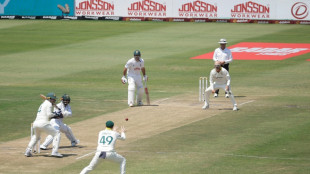 Smith breaks fielding record as Australia take first innings lead

 Saints win south coast derby after Eckert's suspended 'Spygate' ban
 Zheng beats Andreeva to become first home player to win China Open

 Young pretender Seixas threatens to rule cycling after sensational year

 Serie A stalemate as Roma held by Como

 Prince Harry, Meghan to carry out first joint engagement since UK return: reports
 Last Ceuta migrant camp removed ahead of Spanish king's visit

Astronomers revealed Wednesday they have detected a storm on a star other than our Sun for the first time, discovering an explosion so violent it could have stripped away the atmosphere of any planets unlucky enough to be nearby.
Solar storms on the Sun sometimes shoot out huge eruptions known as coronal mass ejections, which can disrupt satellites when they arrive at Earth -- and create colourful auroras that dance across the sky.
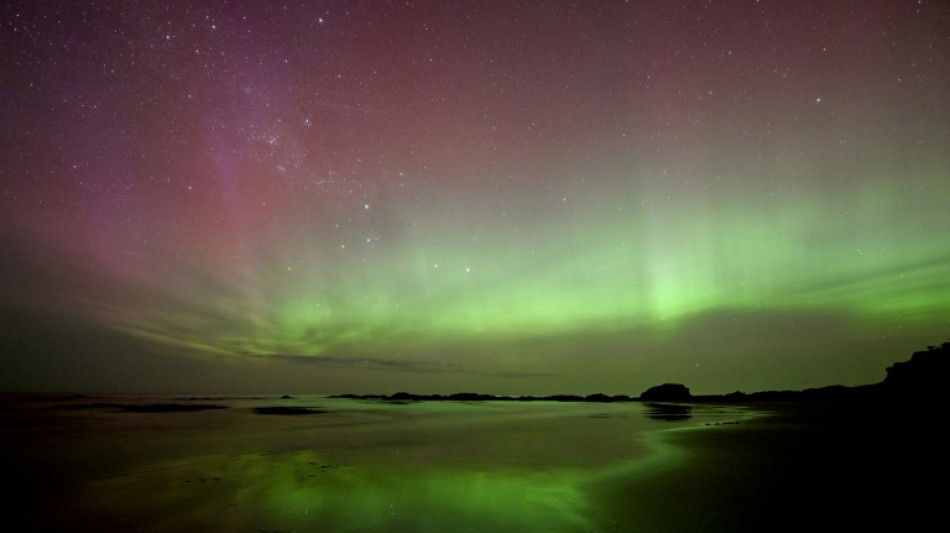
In fact, a particularly powerful solar storm caused auroras as far south as the US city of Tennessee on Wednesday, according to the National Oceanic and Atmospheric Administration.
Auroras were also visible in the skies above New Zealand, AFP images showed, with more expected into Wednesday night.
However, observing such a storm on a distant star had proven difficult for astronomers.
New research, published in the journal Nature on Wednesday, revealed that an international team of researchers has finally achieved the feat.
The discovery used data from a European network of telescopes called LOFAR.
The team of astronomers has been using LOFAR since 2016 to detect the most extreme and violent events in the universe -- such as black holes -- which emit relatively stable radio signals over time.
"We always have stars in the telescope's field of view but generally we're not interested in them," Cyril Tasse, a Paris Observatory astronomer and the study's co-author, told AFP.
However, the researchers have set up a data processing system that also records what is going on with the stars behind the behemoths they are chasing.
In 2022, the team decided to find out "what had been caught in this net", Tasse said.
They found that there was a huge explosion which only lasted a minute on May 16, 2016. It came from a red dwarf star called StKM 1-1262 more than 133 light years away.
The team then determined it was a coronal mass ejection -- a stellar storm.
"It's the first time we have detected one" on a star other than our own, Tasse said.
But this coronal mass ejection was "at least 10,000 times more violent than known solar storms" on the Sun, he added.
- Atmosphere killers -
The discovery could have an impact on the search for planets beyond our solar system that have the potential to host life.
Red dwarfs, which have a mass of between 10 and 50 percent that of our Sun, have proven to be the most likely stars in the universe to host planets that are roughly the size of Earth.
"The first radio detection inaugurates a new era for space weather applied to other star systems," said Philippe Zarka, research director at the Paris Observatory and a study co-author.
"This emerging field opens up major perspectives for how the magnetic activity of stars influence the habitability of the planets that surround them."
Tasse said that it appears that red dwarf stars have "much more erratic and violent" behaviour than the Sun.
"The implication is that these stars can be rather inhospitable when it comes to life and exoplanets," because they have storms so powerful they could destroy the atmospheres of planets nearby, he added.
R.Chavez--AT