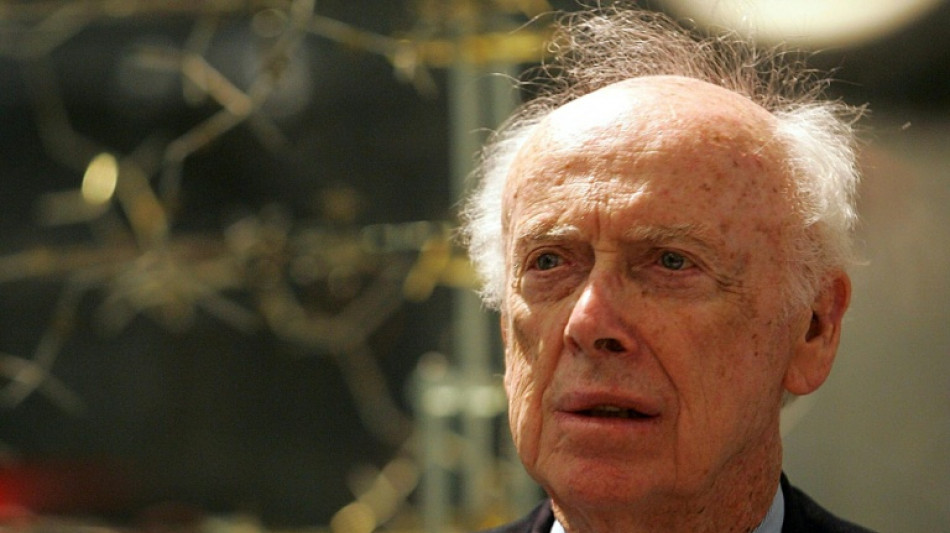
James Watson, Nobel prize-winning DNA pioneer, dead at 97 / Photo: ODD ANDERSEN - AFP

 Unbeaten 49ers edge Seahawks while Vikings stay perfect

 Trump's 'energy ceasefire' sparks confusion as Russia strikes Ukraine
 Dupont double helps Toulouse avoid Bayonne slip-up in Top 14

 Marseille snap losing skid with win at Troyes

 Lula stages mass rally ahead of Brazil's presidential run-off

 Poland holds suspect in alleged assassination plot against PM Tusk

 Russia hits Ukraine power plants despite Trump energy ceasefire claim

 Isco's Betis rise back above Real Madrid to third

 Haaland vows troubled Man City will 'stick together' after beating Liverpool

 Abhishek, Arshdeep guide India to T20 win over West Indies

 'Other Mommy' scares up N. American box office win

 Zelensky surprised, Moscow mum as Trump announces energy ceasefire

 Ready Player 1: Paris to host 2027 edition of EVO combat video games event

 Bill Gates warns cyberattacks most imminent AI threat

 Lazio join Inter at top of Serie A as Roma held at Como
 Trump says Russia and Ukraine agree to 'energy ceasefire'

 Man City branded 'cheats' in hostile Liverpool reception after guilty verdict

 Smith breaks fielding record as Australia take control of 1st Test

 Smith breaks fielding record as Australia take first innings lead

 Saints win south coast derby after Eckert's suspended 'Spygate' ban

 Zheng beats Andreeva to become first home player to win China Open

 Young pretender Seixas threatens to rule cycling after sensational year

 Serie A stalemate as Roma held by Como

 Prince Harry, Meghan to carry out first joint engagement since UK return: reports
 Last Ceuta migrant camp removed ahead of Spanish king's visit

James Watson -- the Nobel laureate co-credited with the pivotal discovery of DNA's double-helix structure, but whose career was later tainted by his repeated racist remarks -- has died, his former lab said Friday. He was 97.
The eminent biologist died Thursday in hospice care on Long Island in New York, announced the Cold Spring Harbor Laboratory, where he was based for much of his career.
Watson became among the 20th century's most storied scientists for his 1953 breakthrough discovery of the double helix with researcher partner Francis Crick.
Along with Crick and Maurice Wilkins, he shared the 1962 Nobel Prize for their work -- momentous research that gave rise to modern biology and opened the door to new insights including on genetic code and protein synthesis.
That marked a new era of modern life, allowing for revolutionary technologies in medicine, forensics and genetics -- ranging from criminal DNA testing or genetically manipulated plants.
Watson went on to do groundbreaking work in cancer research and mapping the human genome.
But he later came under fire and bowed out of public view for controversial remarks, including that Africans were not as smart as white people.
Watson told the British weekly The Sunday Times he was "inherently gloomy about the prospect of Africa" because "all our social policies are based on the fact that their intelligence is the same as ours -- whereas all the testing says not really."
- Twisting ladder -
Born on April 6, 1928 in Chicago, Illinois, at the aqe of 15 James Dewey Watson won a scholarship to the University of Chicago.
In 1947 he received a degree in zoology before attending Indiana University in Bloomington, where he received his Ph.D in zoology in 1950.
He became interested in the work of scientists working at the University of Cambridge in England with photographic patterns made by X-rays.
After moving to the University of Copenhagen, Watson began his investigation of the structure of DNA.
In 1951 he went to the Zoological Station at Naples, where he met researcher Maurice Wilkins and saw for the first time crystalline DNA's X-ray diffraction pattern.
Before long he'd met Francis Crick and started what would go down as a celebrated partnership.
Working with X-ray images obtained by Rosalind Franklin and Wilkins, researchers at King's College in London, Watson and Crick had started their historic work of puzzling out the double helix.
Their first serious effort came up short.
But their second attempt resulted in the pair presenting the double-helical configuration, a now iconic image that resembles a twisting ladder.
Their model also showed how the DNA molecule could duplicate itself, thus answering a fundamental question in the field of genetics.
Watson and Crick published their findings in the British journal "Nature" in April-May 1953 to great acclaim.
Watson taught at Harvard for 15 years before becoming director of what today is known as the Cold Spring Harbor Laboratory, which he transformed into a global hub of molecular biology research.
From 1988 to 1992, Watson was one of the directors of the Human Genome Project at the National Institutes of Health, where he oversaw the mapping of the genes in the human chromosomes.
But his comments on race and obesity -- he was also known to make sexist remarks -- triggered his retirement in 2007.
The lab severed all ties with him in 2020, including his emeritus status, after he once again made similar statements.
A.Anderson--AT