Oldest known lizard ancestor discovered in England / Photo: Marty MELVILLE - POOL/AFP/File

 'Devastating' waves leave California beach homes on brink of collapse

 Meta says its new AI models on par with OpenAI, Anthropic

 Talarico rejects mental health conspiracy theory after return from flu

 Brazil presidential candidate Flavio Bolsonaro to visit jailed father

 Brazil's patron saint reappears in polarized election campaign

 US Open champ Zverev to become tennis world number one

 Migrant crisis wounds unhealed in Ceuta as Spanish royals visit

 Brazilian judge allows Flavio Bolsonaro to visit jailed father

 France braces for fresh student demonstrations as Macron calls for 'respect'
 Zelensky doubtful on Russian acceptance of Trump's 'energy ceasefire'

 Federal agents search home of Trump critic Ilhan Omar: government

 Pakistan detains hundreds from ex-PM Khan's party as protests falter

 Australia's Smith off field after being struck on helmet

 UK retains early access to test latest US AI models

 Top NATO commander warns Russia any attack would be 'futile'

 Stolen Renoir paintings found behind wall in France: prosecutor

 UNHCR sounds alarm on funding crisis

 French supermarket chains say cyberattack forced refrigerator shutdown

 Minister's resignation rocks German coalition

 Hurricane Simon lashes Mexico's Pacific coast, threatens landfall

 France schools protest rumbles on as Macron urges 'respect'

 Americans Hall and Woodford win economics Nobel for stabilisation models

 MEXC Brings AI, TradFi and the Future of Trading to Life at TOKEN2049 Singapore

 Italian rice farmer beats heat with biodiversity haven

 Stocks mixed as oil prices slip after Trump hails 'energy ceasefire'
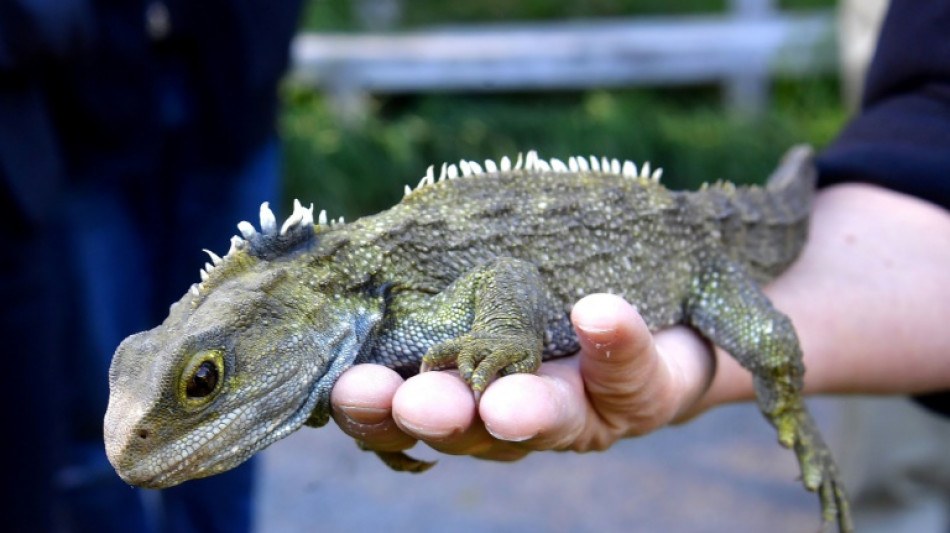
Scientists announced Wednesday they have discovered the oldest-known member of the lizard family in southwest England, a tiny creature that used its surprisingly large teeth to hunt cockroaches 242 million years ago.
The ancient reptile, which lived during the Middle Triassic epoch shortly before the rise of the dinosaurs, was so small its entire body could fit in the palm of a human hand.
"The new animal is unlike anything yet discovered and has made us all think again about the evolution of the lizard, snakes and the tuatara," the latter of which is a New Zealand reptile, Dan Marke of the University of Bristol said in a statement.
The skeleton of the oldest known member of the lepidosauria order, a family of reptiles, was found at a fossil-rich beach in Devon, southwest England, in 2015.
But figuring out what it actually was took the scientists years, and the discovery was announced in a study in the journal Nature on Wednesday.
"The new fossil shows almost none of what we expected," said Marke, the study's lead author.
Modern lizards and snakes have a partially hinged skull and plenty of teeth on the roof of their mouth -- but this ancient ancestor had neither.
"Not only this but it possesses some spectacularly large teeth compared to its closest relatives," the palaeobiologist said.
It also has a bone running from cheek to jaw, a feature it shares only with the unique tuatara that is often referred to as a "living fossil".
"The new beast" used these teeth "to pierce and shear the hard cuticles of its insect prey, pretty much as the tuatara does today," said study co-author Michael Benton, also from Bristol University.
The fossil was difficult to study because it is so small -- the skull is just 1.5 centimetres (0.6 of an inch) wide -- and was preserved in a large rock.
So the British researchers scanned it using the European Synchrotron Radiation Facility, which works as a kind of huge microscope producing X-rays 100 billion times brighter than those used in hospitals.
The Synchrotron allowed the scientists to "zoom in on large objects and obtain very high-resolution images," said Vincent Fernandez, a palaeontologist at the facility in France.
The scientists named the lizard ancestor Agriodontosaurus helsbypetrae, after the Helsby Sandstone Formation where it was discovered.
F.Wilson--AT