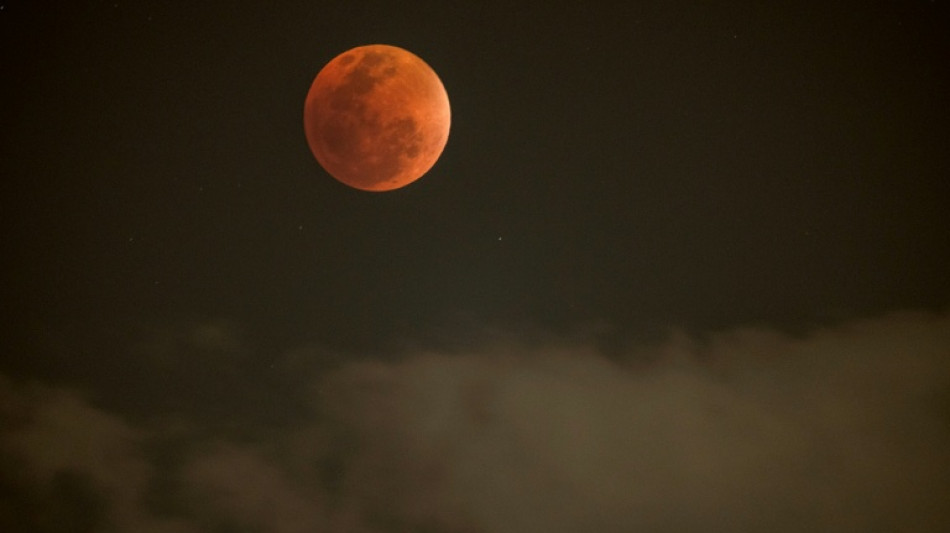
'Blood Moon' rises during total lunar eclipse / Photo: Wikus de Wet - AFP

 'Breaking Bad' actor RJ Mitte dead: representatives

 Former DR Congo president Kabila forms new force with M23 armed group
 Tom Cruise's 'Digger' tanks, leaving studio with $250 mn hole

 US actress Selma Blair arrested after flight altercation

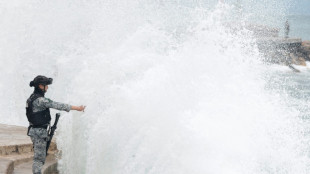
 One dead as Hurricane Simon creeps along Mexico's Pacific coast

 Carrick's Man United 'hungry and eager' to fix worst start in decades

 Fury as US federal agents search anti-Trump lawmaker's home

 One goal enough for Flick as Barca enter Galatasaray cauldron

 A7 to unveil a service that will re-invent the international payments market

 'Status quo' with EU 'not good enough', UK PM says as summit date set
 Stolen Renoir paintings found behind wall in France

 French supermarkets suffer refrigerator shutdown after 'unprecedented' cyberattack

 Arsenal lose Hincapie and Zubimendi in freak double blow

 Saudi says resilience tested, vows response after deadly airport attacks

 Alcaraz exits Shanghai Masters in straight-sets loss

 Pope to enter hospital on Tuesday for lung operation

 Renshaw shines again before Australia declaration

 Atletico's Simeone encourages goalless Alvarez improvement
 FXGLOBE Rebuilds Its Copy Trading and PAMM Business With B2BROKER's B2COPY

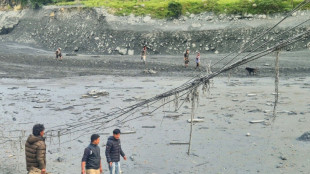 Nepal rescuers search for missing after flash flood

 Oil rises as Trump comments roil energy markets
 Premier League in limbo as Manchester City soar

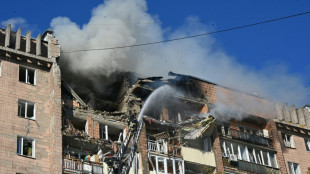 Zelensky vows to respond as Moscow silent on 'energy ceasefire'

 Thousands march in India's capital to demand election chief resign

 African players in Europe: Mbeumo ends goal drought as United draw
Stargazers enjoyed a "Blood Moon" Sunday night during a total lunar eclipse visible across Asia and swathes of Europe and Africa.
When the Sun, Earth and Moon line up, the shadow cast by the planet on its satellite makes it appear an eerie, deep red colour that has astounded humans for millennia.
People in Asia, including India and China, were best placed to see Sunday's total eclipse, which was also be visible on the eastern edge of Africa as well as in western Australia.
The total lunar eclipse lasted from 1730 GMT to 1852 GMT.
Stargazers in Europe and Africa also got a brief chance to see a partial eclipse just as the Moon rose during the early evening, but the Americas missed out.
The Moon appears red during lunar eclipses because the only sunlight reaching it is "reflected and scattered through the Earth's atmosphere", said Ryan Milligan, an astrophysicist at Queen's University Belfast, Northern Ireland.
Blue wavelengths of light are shorter than red ones, so are more easily dispersed as they travel through Earth's atmosphere, he told AFP.
"That's what gives the Moon its red, bloody colour."
While special glasses or pinhole projectors are needed to safely observe solar eclipses, all that is required to see a lunar eclipse is clear weather -- and being in the right spot.
The last total lunar eclipse was in March this year, while the one before that was in 2022.
Next year's totality -- the first in mainland Europe since 2006 -- will be visible only in Spain and Iceland, though other countries will be able to see a significant partial eclipse.
In Spain, the totality will be visible in a roughly 160-kilometre (100-mile) band between Madrid and Barcelona, but neither city will see the full phenomenon, Milligan said.
It will be the first total solar eclipse since one swept across North America in April 2024.
Ch.P.Lewis--AT