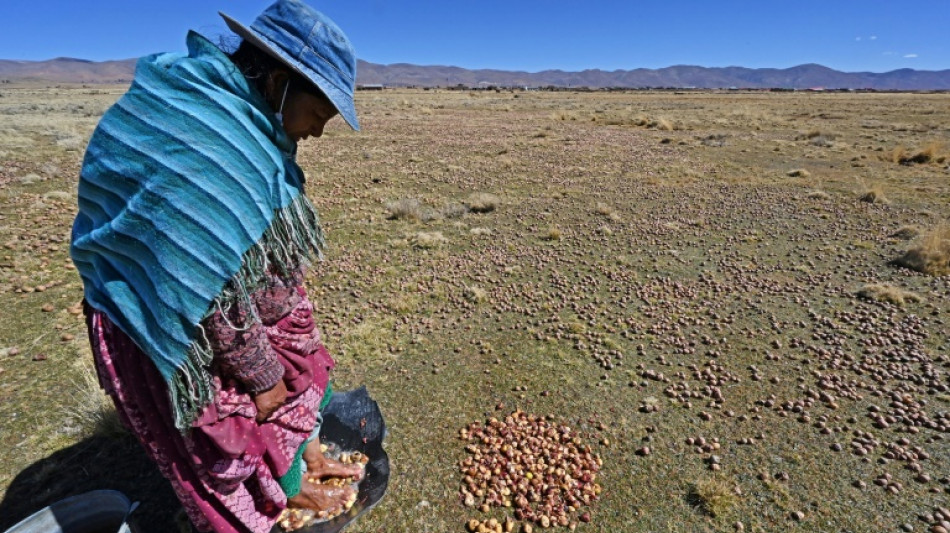
Study reveals potato's secret tomato past / Photo: AIZAR RALDES - AFP/File

 Activist Thunberg joins France student rally after violence at protests

 Archer and Bethell in England squad for Australia ODI series

 Formula One to return to Africa in 'early 2030s' in Rwanda

 US actor Selma Blair charged with assault after alleged flight altercation

 Hungary cuts anti-LGBTQ legislation from Orban-era law

 'Our future is being robbed': Greta Thunberg joins France student protests

 Late superstar Anita Mui's ashes missing in Hong Kong

 'No choice': IMF says developing countries must cut spending despite war shock

 Boasting South Korea footballers spark rethink of military service exemptions

 Five dead as Hurricane Simon, Rachel pummel Mexico's Pacific coast

 Seoul, Tokyo stocks plunge as Asia suffers fresh tech rout

 Damaged and drained, Indonesia's peatlands go up in smoke

 Dominant Australia wary of Pacific threat at Rugby League World Cup

 Pope to be admitted to hospital for lung operation

 Samoa's McFarland welcomes 'massive' arrival of ex-All Blacks for World Cup run-in

 Brewers beat Dodgers 7-4 to extend MLB playoff lead

 Teenager shoots headmaster, teacher at French school

 Caledonia Files NI 43-101 Technical Reports on SEDAR+ Supporting August 28, 2026 Mineral Resource Announcements

 BioChromato Supports U.S. Market Expansion with Bioz Badges and Globally Published Research

 RAEK Secures 26 SI Domains to Support Its Vision for the Super Intelligence Economy

 CoTec Holdings Corp. Notes EU Strategic Project Designation for HyproMag GmbH

 INEO Reports 47% Fiscal 2026 Revenue Growth as Q4 Revenue Reaches Record $1.03 Million

 'Breaking Bad' actor RJ Mitte dead: representatives

 Former DR Congo president Kabila forms new force with M23 armed group

 Tom Cruise's 'Digger' tanks, leaving studio with $250 mn hole

You say potato, I say tomato?
Turns out one helped create the other: Natural interbreeding between wild tomatoes and potato-like plants in South America gave rise to the modern day spud around nine million years ago, according to a new study published Thursday in the journal Cell.
Co-author Loren Rieseberg, a professor at the University of British Columbia, told AFP the findings point to a "profound shift" in evolutionary biology, as scientists increasingly recognize the role of ancient hybridization events in shaping the Tree of Life.
While it was once thought that random mutations were by far the biggest driver of new species, "we now agree that the creative role of hybridization has been underestimated," he said.
Simple, affordable and versatile, the humble potato is now one of the world's most important crops. But its origins have long puzzled scientists.
Modern potato plants closely resemble three species from Chile known as Etuberosum. However, these plants do not produce tubers -- the large underground structures, like those found in potatoes and yams, that store nutrients and are the parts we eat.
On the other hand, genetic analysis has revealed a surprising closeness to tomatoes.
"This is known as discordance, and indicates something interesting is going on!" co-author Sandra Knapp, a research botanist at Britain's Natural History Museum, told AFP.
To solve the mystery, an international team of researchers analyzed 450 genomes from cultivated potatoes and 56 wild potato species.
Lead author Zhiyang Zhang, of the Agricultural Genomics Institute at Shenzhen, said in a statement: "Wild potatoes are very difficult to sample, so this dataset represents the most comprehensive collection of wild potato genomic data ever analysed."
- 'Wow' moment -
The analysis revealed that modern potatoes carry a balanced genetic legacy from two ancestral species -- roughly 60 percent from Etuberosum and 40 percent from tomatoes.
"My wow moment was when the Chinese team showed that ALL potatoes, wild species as well as land races, had basically the same proportion of tomato genes and Etuberosum genes," said Knapp.
"That really points to an ancient hybridization event rather than various events of gene exchange later on," she added. "It is so clear cut! Beautiful."
One gene called SP6A, a signal for tuberization, came from the tomato lineage. But it only enabled tuber formation when paired with the IT1 gene from Etuberosum, which controls underground stem growth.
The divergence between Etuberosum and tomatoes is thought to have begun 14 million years ago -- possibly due to off-target pollination by insects -- and completed nine million years ago.
This evolutionary event coincided with the rapid uplift of the Andes mountain range, providing ideal conditions for the emergence of tuber-bearing plants that could store nutrients underground.
Another key feature of tubers is their ability to reproduce asexually, sprouting new buds without the need for seeds or pollination -- a trait that helped them spread across South America, and through later human exchange, around the globe.
Co-author Sanwen Huang, a professor at the Agricultural Genomics Institute at Shenzhen, told AFP that his lab is now working on a new hybrid potato that can be reproduced by seeds to accelerate breeding.
This study suggests that using the tomato "as a chassis of synthetic biology" is a promising route for creating this new potato, he said.
E.Flores--AT