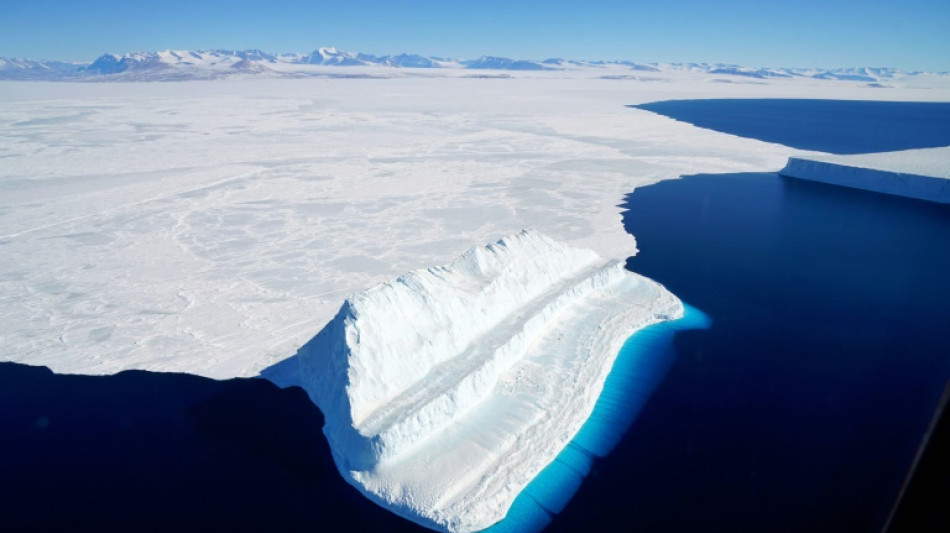
How did life survive 'Snowball Earth'? In ponds, study suggests / Photo: Chris LARSEN - NASA/AFP/File

 Trump, White House post video of UK man killed by tiger

 Saudi employee arrested for allegedly bugging OpenAI office

 Atletico sink Man Utd as Viking deny Bayern in Champions League

 Man United's Martinez blasts board's lack of investment

 Meet A7 International, an Innovative Global Platform Designed to Reinvent the International Payments Market

 Shakhtar hope London move a reminder of Ukraine conflict

 Tresoldi hat-trick fires Brugge past Inter Milan

 Rams axe kicker Mevis after misses cost victory over Bills: reports

 Yamal stays cool at boiling Galatasaray to lift Barcelona to victory

 Arsenal cruise past Lille into share of Champions League lead

 Trump ousts Greece ambassador over ethics scandal

 Reese Witherspoon, France's Mediawan to buy Hello Sunshine

 Bipartisan US senators urge Trump to scrap Russian diesel deal

 Ex-gang leader sentenced to minimum 40 years for Tupac murder

 Cornell suspends frat parties after alleged gang rape

 Man City deserve to keep titles, says PSG's Luis Enrique

 Regulator 'will resign' if any political interference in Man City case

 Microsoft's Brad Smith calls for 'real and effective' AI safety standards

 Anthropic warns of AI 'worms' spreading across smart gadgets

 Big US banks report strong earnings and stay bullish on AI

 Iraola backs Barcola, Wirtz to come good for Liverpool

 In a first, AI helps UK lawmaker find her voice in parliament

 Pope Leo in Rome hospital for lung operation

 EU watchdog says smart glasses must give 'clear warnings' when recording

 Houthis say Saudi Arabia strikes oil site in Yemen's capital

Earth has not always been so hospitable to live. During several ice ages, the planet's surface was almost completely frozen over, creating what has been dubbed "Snowball Earth".
Liquid water appears to be the most important ingredient for life on any planet, raising the question: how did anything survive such frosty, brutal times?
A group of scientists said Thursday that they had found an astonishing diversity of micro-organisms in tiny pools of melted ice in Antarctica, suggesting that life could have ridden out Snowball Earth in similar ponds.
During the Cryogenian Period between 635 and 720 million years ago, the average global temperature did not rise above -50 degrees Celsius (-58 Fahrenheit). The climate near the equator at the time resembled modern-day Antarctica.
Yet even in such extreme conditions, life found a way to keep evolving.
Fatima Husain, the lead author of a new study published in Nature Communications, told AFP there was evidence of complex life forms "before and after the Cryogenian in the fossil record".
"There are multiple hypotheses regarding possible places life may have persisted," said Husain, a graduate student at the Massachusetts Institute of Technology.
Perhaps it found shelter in patches of open ocean, or in deep-sea hydrothermal vents, or under vast sheets of ice.
The tiny melted ice pools that dotted the equator were another proposed refuge.
These ponds could have been oases for eukaryotes, complex organisms that eventually evolved into multicellular life forms that would rise to dominate Earth, including humans.
- Could aliens be hiding in ponds? -
Melted ice ponds still exist today in Antarctica, at the edges of ice sheets.
In 2018, members of a New Zealand research team visited the McMurdo ice shelf in east Antarctica, home to several such pools, which are only a few metres wide and less a metre deep.
The bottom of the ponds are lined with a mat of microbes that have accumulated over the years to form slimy layers.
"These mats can be a few centimetres thick, colourful, and they can be very clearly layered," Husain said.
They are made up of single-celled organisms called cyanobacteria that are known to be able to survive extreme conditions.
But the researchers also found signs indicating there were eukaryotes such as algae or microscopic animals.
This suggests there was surprising diversity in the ponds, which appears to have been influenced by the amount of salt each contained.
"No two ponds were alike," Husain said. "We found diverse assemblages of eukaryotes from all the major groups in all the ponds studied."
"They demonstrate that these unique environments are capable of sheltering diverse assemblages of life, even in close proximity," she added.
This could have implications in the search for extraterrestrial life.
"Studies of life within these special environments on Earth can help inform our understanding of potential habitable environments on icy worlds, including icy moons in our Solar System," Husain said.
Saturn's moon Enceladus and Jupiter's Europa are covered in ice, but scientists increasingly suspect they could be home to simple forms of life, and several space missions have been launched to find out more about them.
E.Rodriguez--AT