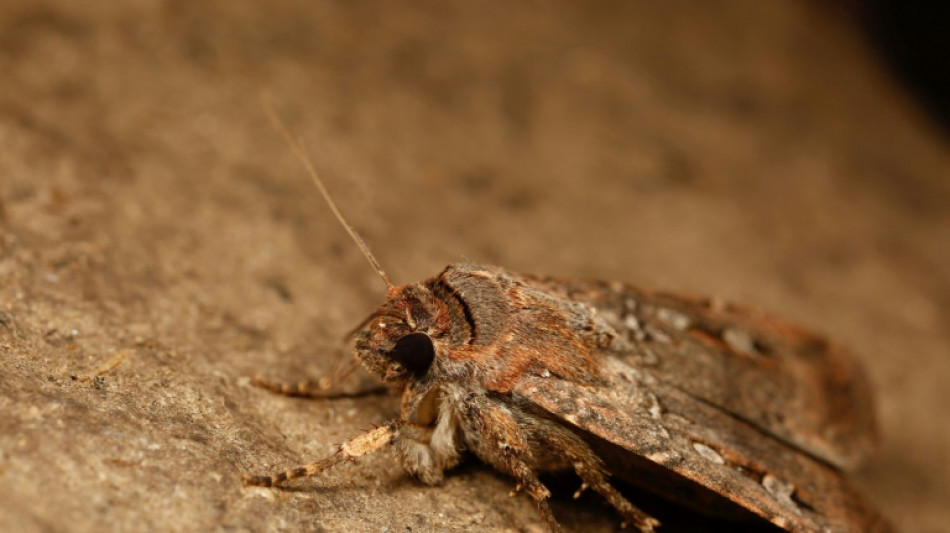
Moth uses stars to navigate long distances, scientists discover / Photo: Ajay Narendra - Macquarie University/AFP

 Trump, White House post video of UK man killed by tiger

 Saudi employee arrested for allegedly bugging OpenAI office

 Atletico sink Man Utd as Viking deny Bayern in Champions League
 Man United's Martinez blasts board's lack of investment

 Meet A7 International, an Innovative Global Platform Designed to Reinvent the International Payments Market

 Shakhtar hope London move a reminder of Ukraine conflict

 Tresoldi hat-trick fires Brugge past Inter Milan

 Rams axe kicker Mevis after misses cost victory over Bills: reports

 Yamal stays cool at boiling Galatasaray to lift Barcelona to victory

 Arsenal cruise past Lille into share of Champions League lead

 Trump ousts Greece ambassador over ethics scandal

 Reese Witherspoon, France's Mediawan to buy Hello Sunshine

 Bipartisan US senators urge Trump to scrap Russian diesel deal

 Ex-gang leader sentenced to minimum 40 years for Tupac murder

 Cornell suspends frat parties after alleged gang rape

 Man City deserve to keep titles, says PSG's Luis Enrique

 Regulator 'will resign' if any political interference in Man City case

 Microsoft's Brad Smith calls for 'real and effective' AI safety standards

 Anthropic warns of AI 'worms' spreading across smart gadgets

 Big US banks report strong earnings and stay bullish on AI

 Iraola backs Barcola, Wirtz to come good for Liverpool

 In a first, AI helps UK lawmaker find her voice in parliament

 Pope Leo in Rome hospital for lung operation

 EU watchdog says smart glasses must give 'clear warnings' when recording

 Houthis say Saudi Arabia strikes oil site in Yemen's capital

A species of Australian moth travels up to a thousand kilometres every summer using the stars to navigate, scientists said Wednesday, the first time this talent has been discovered in an invertebrate covering vast distances.
When temperatures start rising every year, Bogong moths embark on the long night-time flight from their home on the country's eastern coast to the cool inland shelter of caves in the Australian Alps.
It has recently been discovered that they can use Earth's magnetic field like a compass to stay on track during their trip of up to 1,000 kilometres (620 miles).
Now, a study published in the journal Nature has found that the moths can also use the light from the stars and the Milky Way to find their way through the dark.
"This is the first invertebrate that's known to be able to use the stars for that purpose," study co-author Eric Warrant of Sweden's Lund University told AFP.
The only other invertebrate known to use stars for orientation are dung beetles -- but that is over very short distances, Warrant said.
Out of all the animal kingdom, only some birds, possibly seals and of course humans can use starlight to navigate long distance.
Bogong moths, which are around three centimetres long and are named after the Indigenous Australian word for brown, now join that list.
- 'Flight simulator' -
To study this phenomenon, the international team of researchers put some Bogong moths in a small enclosure and projected different maps of the night sky onto its ceiling.
The moth was tethered to a rod connected to the top of the enclosure, which precisely recorded which directions it tried to fly in.
This "flight simulator" first confirmed that Bogong moths can in fact navigate using their internal magnetic compass, lead study author David Dreyer, also of Lund University, told AFP.
Then the researchers removed the effect of Earth's magnetic field in the enclosure.
"To our surprise," the moths were still able to find the right direction, Dreyer said.
When they rotated the sky 180 degrees, the moths changed their flight to follow along.
And when the researchers projected weird, incorrect maps of the night sky, the moths became erratic and lost.
This reinforced that the insects can not only navigate by the sky, but can follow along during the night when the relative positions of the stars shift along with Earth's rotation.
- Mysteries abound -
No one knows exactly how the Bogong moth manages this feat.
One theory is that they sometimes "cross-check" their direction with their magnetic compass, Dreyer said.
Another question is exactly which stars the moths are using to navigate.
In the lab, the researchers monitored 30 neurons involved in the moth's vision, coordination and navigation.
Developing the system of non-magnetic electrodes "cost me a fortune but it was worth the investment," Warrant said.
The neurons became particularly active at the sight of the long, bright stripe of the Milky Way, as well as the Carina Nebula.
The Milky Way is brighter in the Southern Hemisphere than in the north, Warrant pointed out.
"The intensity of that stripe grows as you go from the northern part of the sky to the southern part," which could offer a clue as to how the moths use it to navigate south, Warrant said.
Another mystery is how the moths know when to head south when summer arrives.
Warrant, who is supervising further research on this subject, said one option is that this knowledge was simply "something that the parents hand to their children".
The researchers believe that near the end of the moth's long migration, they start noticing clues they are getting close to their mountain refuge.
Warrant said he has identified a specific "odour compound" which emanates from the caves.
This smell "seems to act as a navigational beacon right at the very end of the journey," he added.
After the moths have seen out the sweltering summer, they return to their coastal birthplace to reproduce before dying.
A.Clark--AT