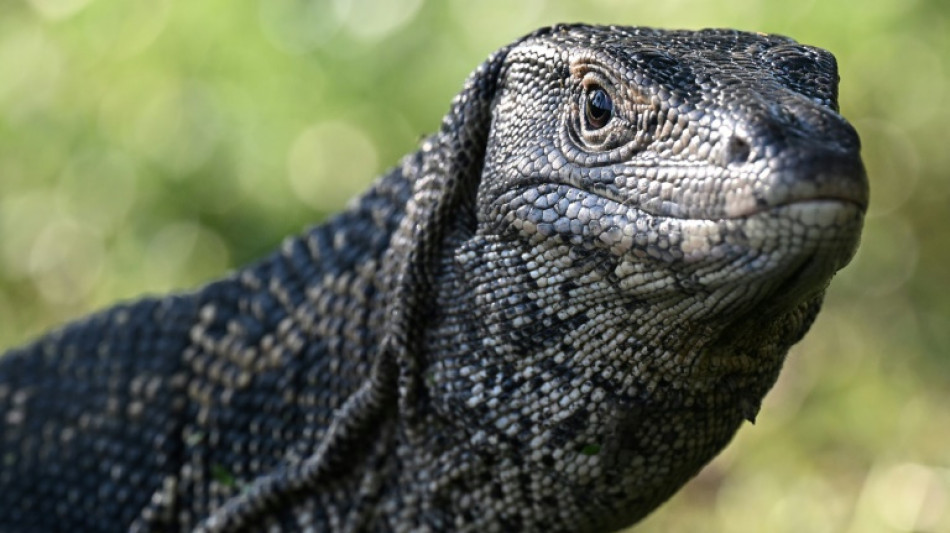
Ancient reptile tracks rewrite when animals conquered land / Photo: Lillian SUWANRUMPHA - AFP/File

 Ukraine accuses US of helping Russia as missiles hit Kyiv

 Drone hits data centre of Russia's largest bank

 Bivial AG Brings Its Complete Dashboard to Mobile

 Mont Blanc nearly two metres taller than in 2023: French surveyors

 Pope recovering after lung cancer operation that rattles Church

 Indonesia haze spikes Singapore pollution, shuts East Timor schools

 Higher borrowing costs an 'alarm signal' for France: finance minister

 Zelensky accuses Putin of disrespecting Trump after latest attacks

 Japan PM says housework makes her busier than male predecessors

 Top Indian 'cockroach' leaders sent to jail after protest

 Ukraine ex-military officer to stand trial over Nord Stream sabotage

 IMF chief says Saudi attacks could have negative spillover 'everywhere'

 Premier League move a Sage decision for new Palace boss

 South Korean FA condemns 'personal attacks' as rift rumours grow

 Japan urges 'impartial treatment' of journalist arrested in Russia

 What we know about Pope Leo XIV's lung cancer operation

 Advanced economies must 'act now' to lower debt as bond yields spike: IMF

 Deluge by design: Thai villages flooded to protect capital

 Ivan Deforge, the French 'bison tamer' in Moscow

 Indonesians on fire-ravaged island sue state for clean air

 Trump, White House post video of UK man killed by tiger
 CruxOCM and Client Present Closed-Loop Pipeline Automation Results at AVEVA Pipeline Summit 2026

 American Resources Corporation Appoints Datuk Wira Mark Ling as CEO of Newly Formed American Resources Indo Pacific to Lead Rare Earth Supply Chain Development in Malaysia

 FireFox Gold Hits 16.6m at 5.83 g/t Gold in 200m Step-Out at New Lammas Zone, Mustajärvi Project, Lapland, Finland

 Saudi says Houthi attacks sparked Aramco fire, wounded 4 in Riyadh

After a brief rain in part of the ancient supercontinent of Gondwana 350 million years ago, a reptile pressed its small claws into the still-wet ground.
Its tracks, which have been discovered in Australia, mean it is the oldest-known vertebrate animal to have permanently abandoned the oceans for dry land, a study suggested on Wednesday.
It also significantly pushes back the date for when these four-limbed pioneers made this important evolutionary step that would eventually lead to humans conquering the globe.
The tracks were found by amateur archaeologists on a 30-centimetre-wide sandstone slab in a mountainous area of the southeastern Australian state of Victoria.
First there was a single footprint of an unknown animal which has "raindrop pockmarks all over it," Per Ahlberg, a palaeontologist at Sweden's Uppsala University, told AFP.
This suggests it was made before the brief shower, said the senior author of a new Nature study describing the discovery.
Then there were two sets of tracks from after the rain.
The second set of tracks suggest this reptile ancestor "was in more of a hurry", he added.
"You see the claws making long scratches on the ground."
- 'Keyholes' into 'lost world' -
The researchers cannot determine whether both sets of tracks were made by the same individual animal, but Ahlberg thinks this is unlikely.
The animal was 60-80 centimetres long and would have looked "quite lizard-like", he added.
That the animal had claws is a clear sign it was an amniote, a group of animals which today includes mammals, birds and reptiles.
Its ancestor tetrapods -- notable for their four limbs -- split into two groups, amniotes and amphibians.
While amphibians had to return to water to lay their eggs, amniotes evolved to have eggs strong enough to survive on land, shedding its last connection to water life.
The discovery indicates that amniotes existed 35 to 40 million years earlier than previously thought, during the turn of the Devonian and Carboniferous periods, the study said.
This suggests the "water-to-land-dwelling transition" may have taken place in just 50 million years, much quicker than had been believed, Stuart Sumida of California State University commented in Nature.
That would be just the latest twist in the tale of how animals rose from the ocean to dominate the land.
"The only way to ever understand it is to look through these tiny little keyholes that we find into this strange, dark, lost world," Ahlberg said.
O.Gutierrez--AT