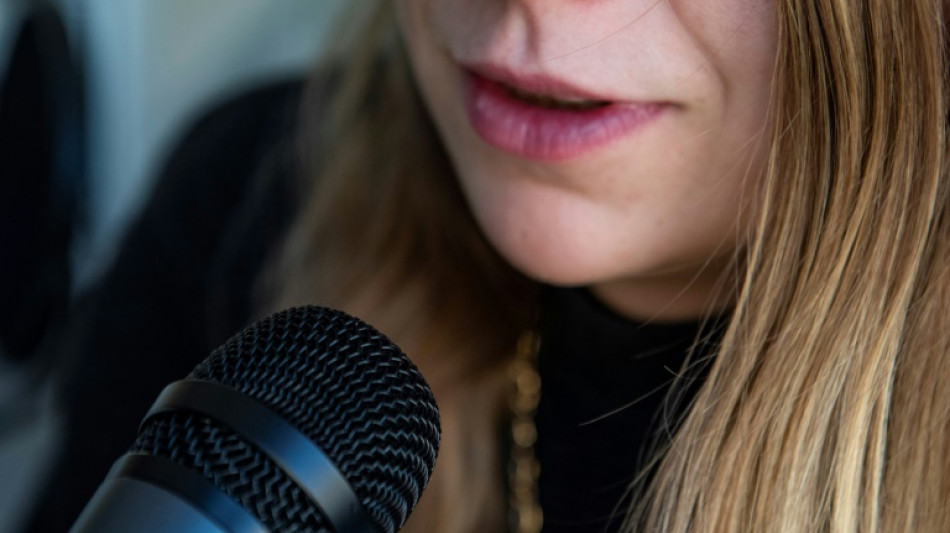
'I don't have a voice in my head': Life with no inner monologue / Photo: Eric BARADAT - AFP/File

 Tech stock lead rout after US inflation fuels rate hike bets

 Al-Fayed survivors say UK police missing 'bigger picture'

 Online 'witch hunt' sweeps up Asians misidentified as US rape accused

 Prospect of Bolsonaro win looms large over Brazil's Indigenous

 Freed from Belarus, founder of Lady Gaga's biggest fan site tells his story

 Behind AI's carbon footprint, a potential climate tool

 Trump's new press secretary faces scrutiny over credentials

 PSG 'got lucky' to win Man City thriller, says Luis Enrique

 Real Madrid comeback stuns Roma as Mourinho enjoys happy reunion

 Shakhtar make winning start at new Champions League 'home'

 Hat-trick hero Barcola primed to shine for Liverpool: Iraola

 Villa put six past Fenerbahce in record rout

 US stocks fall after hot inflation report as leading AI shares tumble

 Government buildings torched in violent Albanian protests

 Wall Street grills Bank of America over money laundering fine

 Mekies extends contract as Red Bull team principal until 2031

 Indonesia rescues starved orangutan from fires: officials

 Real Madrid's Vinicius banned for Clasico after red card

 Restrictions expose Ukraine's Starlink dependency in Russia war: observers

 Espada out as Astros manager while Mattingly stays with Phillies

 Houthis say targeted Saudi oil giant Aramco, vow more attacks

 Govt takes control of Turkey's most-watched news channel

 FIFA to offer members $6.35-billion development fund windfall

 US consumer inflation hotter than expected as midterms loom

 INmune Bio Inc. and Quantum Computing Inc. Partner to Apply Quantum Optimization and AI to Advance Alzheimer’s Drug Research and Explore New Applications for XPro

Mel May only realised she was different while reading a news article one day.
"Wait, what? Some people hear a voice in their head?" she thought at the time.
She was stunned to discover that this was not just a figure of speech -- her friends were actually chatting to themselves in their minds.
May, a 30-year-old Australian video producer who lives in New York, remembers trying to explain to her family: "I don't have a voice in my head."
"My dad was like, 'You are lying'," she told AFP.
But her father came around once May started working with psychologists who agreed -- she is one of the very rare people who lack inner speech.
The idea that some people might not experience this phenomenon is so new that a clinical name, anendophasia, was only proposed for it in a paper last year.
The inner monologue has proven extremely difficult to study because it relies on people being able to describe how they think -- and it turns out we are unreliable narrators.
"People are ignorant about the characteristics of their own inner experience," Russell Hurlburt, a psychology professor at the University of Nevada, Las Vegas, told AFP.
"And it doesn't matter how confident you are," added Hurlburt, a pioneer in the field who has studied people with a range of inner experiences, including May.
Most people assume their inner voice is speaking all the time but it is actually just one of several phenomena of our inner experience, Hurlburt said.
Others include visual imagery, "unsymbolised thinking", feelings and sensory awareness.
- Only a quarter of the time? -
To study these phenomena, Hurlburt conducted research that would have a beeper go off at random while study participants were reading Franz Kafka's "The Metamorphosis" and describe what was in their head.
Rather than speaking the words in their inner voice, they were actually creating visual images -- "their own video" -- of the book, he said.
People also have different kinds of inner speech. Some have multiple voices, while bilingual people can switch languages.
Giordon Stark, a California-based particle physicist who was born deaf, has a mix of inner speech and visual images.
"I don't think of the word 'bed' in my head but I rather visualise the idea of my head hitting the pillow," which is similar to the sign language gesture for the word, the 34-year-old told AFP.
Pressed to estimate how often people are hearing an inner voice, Hurlburt emphasised that much more research is needed on the subject.
But a ballpark figure could be that people are "inner speaking" 20 to 25 percent of the time, he said.
That average includes people who have far more frequent speech and those with none, such as May.
"Her inner experience is close to being nothing but she's the exception rather than the rule," Hurlburt said.
Helene Loevenbruck, a leading inner voice researcher at France's Universite Grenoble Alpes, has had to change her mind on whether people like May could even exist.
"I thought everyone had an inner voice until very recently," she told AFP.
The idea ran counter to her previous work, which suggested inner speech was an important part of speaking out loud, serving as an "internal simulation".
But the work of Hurlburt -- and the discovery that some people cannot create mental images, a condition called aphantasia -- changed her mind.
- 'Pros and cons' -
May believes her lack of an inner voice is why she has never been an anxious person -- and why meditation is very easy for her.
Daniel Gregory, a philosopher specialising in inner speech at the University of Barcelona, said a potential disadvantage of having more inner speech is "a vulnerability to negative thought patterns, to rumination".
But we can also "use inner speech to encourage ourselves, to give ourselves positive messages", he told AFP.
May said a common response to hearing that she has no inner monologue is: "Wow, that must be amazing."
"I'm really quick to push back on that because I think certainly there are pros and cons," she said.
"I reflect a lot about what aspects of the lived experience I'm missing out on."
As well as not stressing about the future, May has a hard time remembering the past.
Loevenbruck said the people she had studied with aphantasia reported having "weird" autobiographical memories "because they have no sensory way of reliving a memory".
May emphasised that lacking an inner voice did not mean she was incapable of thought.
"I'm not dead inside. I know stuff and I feel stuff," said May, who plans to make a documentary about her experience.
Asked what was running through her head, she responded simply.
"Well, I'm sitting here, I'm listening to you and then I just automatically respond. And that's it.
"Isn't that how this happens for everyone?"
W.Nelson--AT