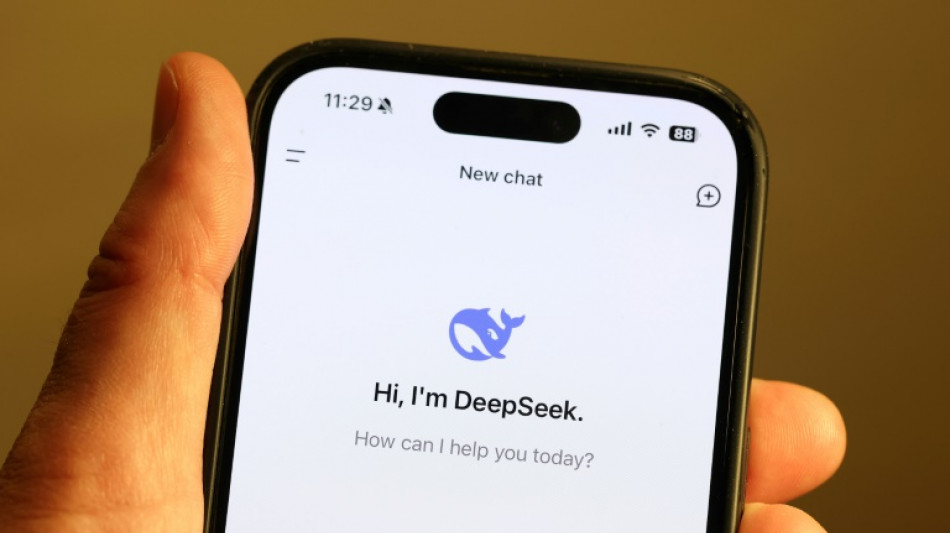
DeepSeek, Chinese AI startup roiling US tech giants / Photo: JUSTIN SULLIVAN - GETTY IMAGES NORTH AMERICA/AFP

 Broncos top Super Bowl champion Seahawks in overtime

 Brilliant Brewers sweep Dodgers to reach World Series

 Brewers complete Dodgers sweep to reach World Series
 High-flying Freiburg try to shut out the noise as fairytale run continues

 Flamengo secure 0-0 draw in La Plata in Copa Libertadores semi

 The final lap? Two days on the campaign trail with Trump

 Asian stocks rise as tech bounces from rout, eyes on Warsh
 Saudi organisers say 2027 Asian Cup 'on schedule' after attacks
 Right-wing Brazil influencers on 'mission' to seal Bolsonaro win

 Using AI to help find Mexico's legions of missing children

 Fiji to deploy solar-powered Australian military drones at sea

 'Multiple victims' in Oregon elementary school shooting, police say

 'Multiple victims' in Oregon elementary school shooting: police

 ChangeNOW Announces NOW AI After Resolving Website Integration Vulnerability

 Argentine demonstration over education cuts ends in clashes

 Argentine protesters, police clash at demo over university funding

 US stocks end higher as AI shares stabilize

 School roof collapse kills 32 children, teacher in Pakistan
 Lyon down Palace in Europa League, Sunderland leave it late

 UniCredit says receives ECB green light for Commerzbank takeover

 New York City pension fund asks Anthropic to delay IPO

 Venezuela's Maduro denies US torture charges as 'false accusations'

 Somalia sets May presidential election despite insecurity

 Chelsea's Caicedo eager to be more of a leader

 Rahm reaches separation deal with LIV in bankruptcy court

Chinese startup DeepSeek, which has sparked panic on Wall Street with its powerful new chatbot developed at a fraction of the cost of its competitors, was founded by a hedgefund whizz-kid who believes AI can change the world.
Based out of the eastern Chinese city of Hangzhou -- sometimes known as "China's Silicon Valley" -- DeepSeek has come seemingly out of nowhere to release a cutting-edge product.
But in China it was already making waves, last year dubbed the "Pinduoduo of AI" -- a reference to a popular online shopping app that steamrolled big players like Alibaba with its low prices.
DeepSeek has won plaudits for its cost-effectiveness and praise in China for its seeming ability to navigate US sanctions that have aimed to prevent access to the high-tech chips needed to power the AI revolution.
AFP paid visits to the firm's offices in both Hangzhou and the capital Beijing on Tuesday, but offices appeared closed for the Lunar New Year holidays.
The firm is the child of tech and business prodigy Liang Wenfeng, born in 1985 and an engineering graduate of Hangzhou's prestigious Zhejiang University, where he has said he became convinced "artificial intelligence would change the world".
He spent years trying to work out how to apply AI to a number of different fields, according to an interview with Chinese investment news outlet Waves last year.
But he eventually struck gold with High-Flyer, a quantitative investing firm specialising in using AI to analyse stock market patterns.
That technique brought in tens of billions of yuan in assets managed, and made it one of China's top quantitative hedge funds.
"We just do things according to our own pace, then calculate costs and prices," Liang told Waves.
"Our principle is to not subsidise or make a huge profit."
- 'More a geek than a boss' -
For Liang, DeepSeek was always a passion project.
In 2021, the Financial Times reported, he began purchasing Nvidia graphic processing units for a side project -- an account also featured in a local media report on the firm.
Associates told Waves he is "not at all like a boss and much more like a geek", with a "terrifying ability to learn".
And his passion project has now shocked industry experts and triggered a plummet in the shares of US chip-making giant Nvidia.
It also brought Liang right into the corridors of power.
Last week, he appeared in a lineup of other key business representatives meeting with China's second-ranking leader, Premier Li Qiang, at a seminar to solicit opinions on the government's economic work for the year ahead.
Footage of the meeting from Chinese state broadcaster CCTV showed a moppy-haired Liang wearing thick-rimmed glasses addressing Li, who sat listening intently from his chair opposite.
- 'Wake-up call' -
Beijing has good reason to be pleased: DeepSeek's success called into question the vast sums of money funnelled by tech giants into developing advanced generative AI, as well as the ability of Western sanctions to prevent Chinese competitors from keeping up -- or even winning.
US President Donald Trump said it was a "wake-up call" for Silicon Valley, and tech investor and ally Marc Andreessen declared it was "AI's Sputnik moment".
It also amplified calls for Washington to get even tougher on restricting Chinese firms from getting hold of high-tech chips.
In his interview with Waves, Liang acknowledged that the toughest obstacle has been those US curbs.
"Money has never been the problem we face; it's the embargo on high-end chips," he said.
But beyond the geopolitics, the "geeky" AI guru said he hoped the technology could help us understand deeper things about the human mind.
"We hypothesize that the essence of human intelligence might be language, and human thought could essentially be a linguistic process," he said.
"What you think of as 'thinking' might actually be your brain weaving language."
A.Anderson--AT