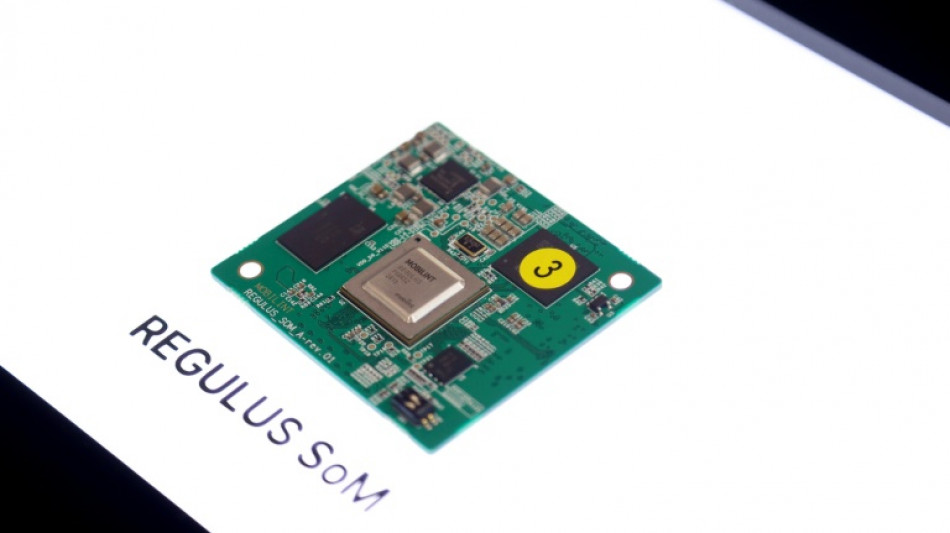
US announces new restrictions on AI chip exports / Photo: Ian Maule - AFP

 Millions may be forced to move as climate change hits South Asia: UN

 Four killed battling Indonesia fires as toxic haze cloaks region
 Thai farmers, fishermen challenge IMF, World Bank at Bangkok rally

 In Malaysia, frustration grows over Indonesia haze

 Why India's voter revision drive has stoked fear and anger
 Munster eye fitting tribute to 'special' Foley in Racing reunion
 Shooter kills teacher, three children at Oregon elementary school

 Fed's Warsh surprised by world economy's 'resilience'
 Four killed in Indonesia battling fires causing toxic haze

 New Zealand star Ponga breaks arm in Rugby League World Cup opener

 Indonesian stocks dive 11% as MSCI weighs market reclassification

 Seoul dismisses Pyongyang's scepticism over hypersonic weapon test

 Yamal on song as entertainers Barcelona face Betis challenge

 Wong weighs haze prosecutions as Singapore air quality worsens
 Brush fire prompts an evacuation order along Los Angeles coast
 'Mixed feelings': AI cracks centuries-old ciphers
 Le Pen looms large as Macron enters final months on EU stage

 Three children, one teacher killed in Oregon elementary school shooting

 Man Utd teetering towards crisis as Man City cloud hangs over Premier League

 Trump's new press secretary defends 'lawyer' title

 InterContinental Hotels Group PLC Announces Transaction in Own Shares - October 16

 'Multiple victims' in Oregon elementary school shooting, police say

 'Multiple victims' in Oregon elementary school shooting: police

 ChangeNOW Announces NOW AI After Resolving Website Integration Vulnerability

 Argentine demonstration over education cuts ends in clashes

The United States unveiled new export rules Monday on chips used for artificial intelligence, furthering efforts to make it tough for China and other rivals to access advanced technology in Joe Biden's final days as president.
The restrictions build on curbs announced in 2023 on exporting certain AI chips to China, which the United States sees as a strategic competitor in the field of advanced semiconductors.
"The US leads the world in AI now -- both AI development and AI chip design -- and it's critical that we keep it that way," Commerce Secretary Gina Raimondo told reporters.
But the effort drew industry criticism and sharp warnings that it would hurt US competitiveness.
Semiconductor Industry Association chief executive John Neuffer said: "We're deeply disappointed that a policy shift of this magnitude and impact is being rushed out the door days before a presidential transition and without any meaningful input from industry."
He added in a statement on Monday that the rule could cause "lasting damage to America's economy and global competitiveness" by ceding key markets to rivals.
Chip titan Nvidia said in a blog post that "while cloaked in the guise of an 'anti-China' measure, these rules would do nothing to enhance US security."
The new rules update controls on chips, requiring authorizations for exports, re-exports and in-country transfers -- while also including a series of exceptions for countries considered friendly to the United States.
AI data centers meanwhile will need to comply with enhanced security parameters in order to be able to import chips.
The rules make it "hard for our strategic competitors to use smuggling and remote access to evade our export control," White House National Security Advisor Jake Sullivan said.
They also create "incentives for our friends and partners around the world to use trusted vendors for advanced AI," he added.
The new rules will take effect in 120 days, Raimondo said, giving the incoming administration of President-elect Donald Trump time to potentially make changes.
In its blog post, Nvidia stressed that the first Trump administration showed how the United States "wins through innovation, competition and by sharing our technologies with the world -- not by retreating behind a wall of government overreach."
Trump put heavy tariffs on China during his first presidential term.
However, his backers in Silicon Valley could also see the rules as an undue burden on their ability to export products.
R.Chavez--AT