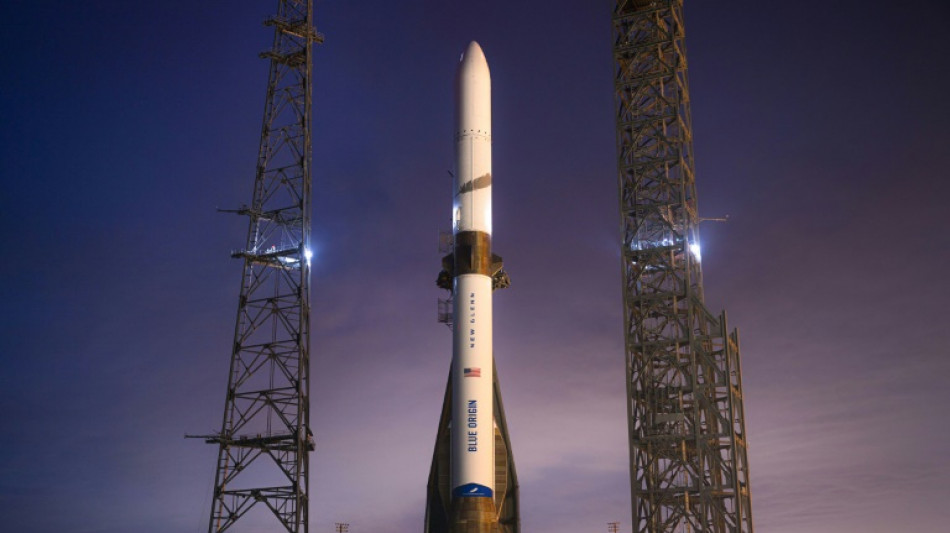
Five things to know about New Glenn, Blue Origin's new rocket / Photo: HANDOUT - BLUE ORIGIN/AFP/File

 Millions may be forced to move as climate change hits South Asia: UN

 Four killed battling Indonesia fires as toxic haze cloaks region

 Thai farmers, fishermen challenge IMF, World Bank at Bangkok rally

 In Malaysia, frustration grows over Indonesia haze

 Why India's voter revision drive has stoked fear and anger

 Munster eye fitting tribute to 'special' Foley in Racing reunion

 Shooter kills teacher, three children at Oregon elementary school

 Fed's Warsh surprised by world economy's 'resilience'

 Four killed in Indonesia battling fires causing toxic haze

 New Zealand star Ponga breaks arm in Rugby League World Cup opener

 Indonesian stocks dive 11% as MSCI weighs market reclassification

 Seoul dismisses Pyongyang's scepticism over hypersonic weapon test

 Yamal on song as entertainers Barcelona face Betis challenge

 Wong weighs haze prosecutions as Singapore air quality worsens

 Brush fire prompts an evacuation order along Los Angeles coast

 'Mixed feelings': AI cracks centuries-old ciphers

 Le Pen looms large as Macron enters final months on EU stage

 Three children, one teacher killed in Oregon elementary school shooting

 Man Utd teetering towards crisis as Man City cloud hangs over Premier League

 Trump's new press secretary defends 'lawyer' title

 InterContinental Hotels Group PLC Announces Transaction in Own Shares - October 16

 'Multiple victims' in Oregon elementary school shooting, police say

 'Multiple victims' in Oregon elementary school shooting: police

 ChangeNOW Announces NOW AI After Resolving Website Integration Vulnerability

 Argentine demonstration over education cuts ends in clashes

Blue Origin, the US space company founded by billionaire Jeff Bezos in 2000, is poised for a historic first: its maiden voyage into orbital space with a brand new rocket, New Glenn.
Here are five key things to know about the heavy-lift vehicle aiming to challenge SpaceX's dominance in the commercial space market.
- Homage -
New Glenn honors a legendary astronaut: John Glenn, the first American to orbit Earth in 1962.
It follows in the steps of New Shepard, Blue Origin's first rocket which was named for Alan Shepard, the first American in space.
Standing 320 feet (98 meters) tall -- roughly equivalent to a 32-story building -- New Glenn is both larger and more powerful than its smaller sibling, which is used for suborbital space tourism.
- Heavy-lift -
New Glenn is classified as a "heavy-lift launcher," capable of placing substantial payloads into low-Earth orbit. It is expected to carry up to 45 tons into orbit.
That is more than double that of SpaceX's Falcon 9, which can lift around 22 tons, though it falls short of the Falcon Heavy's 63.8-ton capacity.
However, New Glenn has a unique edge: its wider payload fairing, which can accommodate larger objects.
It "has the largest capacity to put objects in space, large objects" as a result of its wider payload fairing, Elliott Bryner, a professor at Embry-Riddle Aeronautical University, told AFP.
- Swiss knife -
Its versatility means New Glenn could become a "Swiss Army knife" of rockets, capable of deploying a diverse array of payloads to both low and higher orbits.
These are set to include commercial and military satellites -- as well as Project Kuiper, Bezos's planned space internet constellation, to compete with SpaceX's Starlink.
New Glenn also has the potential to carry crewed spacecraft, notes George Nield, president of Commercial Space Technologies. "One other potential use is for commercial space stations," he adds.
With the International Space Station slated for decommissioning in 2030, the race is on to develop replacements. Blue Origin is among the contenders vying to build the first privately run platform.
- Partially reusable -
Like SpaceX's Falcon 9, New Glenn features a reusable first-stage booster -- designed for up to 25 flights -- and an expendable second stage.
But to reuse the rocket, Blue Origin first has to land it. The company has mastered the technique with its much smaller New Shepard rocket, which touches down on solid ground. However, reusing New Glenn will require a successful landing on a drone ship stationed in the Atlantic Ocean.
This is no small feat: It took SpaceX six years to perfect the maneuver with Falcon 9 after its debut launch in 2010.
"Landing a rocket like this, the way they're doing it, is definitely not simple," said Bryner. "The level of technology required to do this is unbelievable."
Yet achieving reusability is crucial to reducing costs and broadening access to space, added Nield.
- Higher tech -
Under the hood, New Glenn's propulsion system represents a step up.
The first stage is powered by liquid methane, a cleaner and more efficient fuel than the kerosene used in both stages of Falcon 9.
Its second stage uses liquid hydrogen, an even cleaner and more powerful fuel, though more challenging to handle due to its cryogenic properties.
"It's the difference between driving a, you know, a Ferrari or a Volkswagen," William Anderson, a professor of aeronautics and astronautics at Purdue University told AFP, comparing the technology behind New Glenn and Falcon 9.
E.Hall--AT