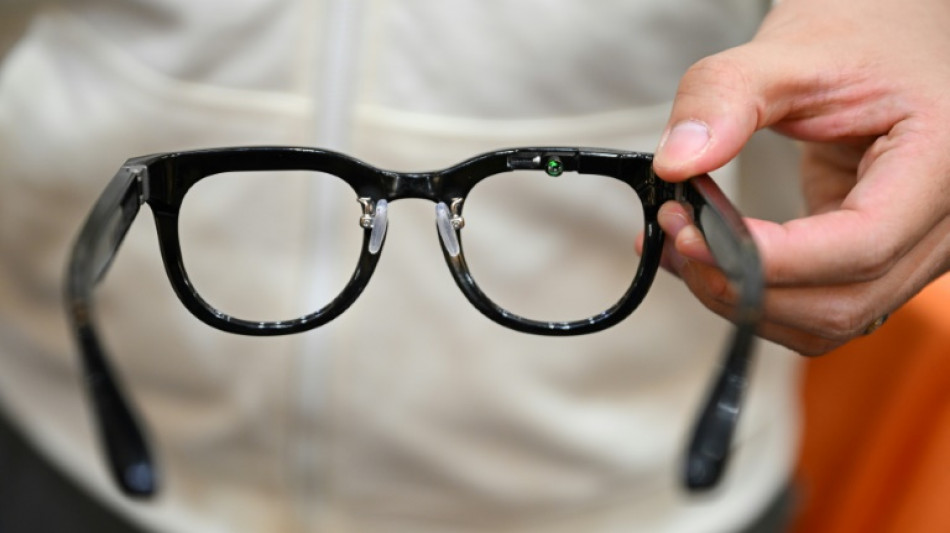
Smart glasses enter new era with sleeker designs, lower prices / Photo: Patrick T. Fallon - AFP

 Millions may be forced to move as climate change hits South Asia: UN

 Four killed battling Indonesia fires as toxic haze cloaks region

 Thai farmers, fishermen challenge IMF, World Bank at Bangkok rally

 In Malaysia, frustration grows over Indonesia haze

 Why India's voter revision drive has stoked fear and anger

 Munster eye fitting tribute to 'special' Foley in Racing reunion

 Shooter kills teacher, three children at Oregon elementary school

 Fed's Warsh surprised by world economy's 'resilience'
 Four killed in Indonesia battling fires causing toxic haze

 New Zealand star Ponga breaks arm in Rugby League World Cup opener

 Indonesian stocks dive 11% as MSCI weighs market reclassification

 Seoul dismisses Pyongyang's scepticism over hypersonic weapon test

 Yamal on song as entertainers Barcelona face Betis challenge

 Wong weighs haze prosecutions as Singapore air quality worsens

 Brush fire prompts an evacuation order along Los Angeles coast

 'Mixed feelings': AI cracks centuries-old ciphers

 Le Pen looms large as Macron enters final months on EU stage

 Three children, one teacher killed in Oregon elementary school shooting

 Man Utd teetering towards crisis as Man City cloud hangs over Premier League

 Trump's new press secretary defends 'lawyer' title

 InterContinental Hotels Group PLC Announces Transaction in Own Shares - October 16

 'Multiple victims' in Oregon elementary school shooting, police say

 'Multiple victims' in Oregon elementary school shooting: police

 ChangeNOW Announces NOW AI After Resolving Website Integration Vulnerability

 Argentine demonstration over education cuts ends in clashes

Producers of hi-tech connected eyewear are multiplying their innovations with increasingly discreet models in an attempt to make a difference in a highly competitive -- and fast-emerging -- market.
Live translation, GPS, cameras: glasses are quickly adopting new functionalities.
"There are so many of these smart wearables, and more of them are going on your face," said Techsponential analyst Avi Greengart at the Consumer Electronics Show (CES) in Las Vegas, where numerous smart glasses manufacturers showcased their latest innovations.
The industry has come a long way from its early days. Gone are the conspicuous protrusions of Google Glass and the bulky frames and cables of Epson's Moverio from the early 2010s.
Today's smart glasses, all paired with smartphone apps, increasingly resemble traditional eyewear. The Ray-Ban Meta, developed by Mark Zuckerberg's social media giant, currently leads the market with this new approach.
According to a recent MarketsandMarkets study, the sector's growth is "driven by advancements in augmented reality, artificial intelligence, and miniaturization technologies, which are pushing the boundaries of what these wearable devices can achieve."
However, integrating technology into fashionable frames requires careful compromise.
The Ray-Ban Meta, for instance, can capture photos and videos, play music, and provide information about objects in view, but doesn't offer augmented reality with superimposed images.
Meta representative Robin Dyer explained that while AR capabilities may come later, they would likely double the current price.
- 200 dollars -
Price is a major battleground in this market, particularly with the entry of Chinese manufacturers.
While Google Glass initially retailed for around $1,500 in 2013, today's smart glasses are approaching the price of premium conventional frames.
Meta's James Nickerson noted that their Ray-Ban collaboration starts at $300, just $50 more than standard Ray-Bans, offering "a cool camera" as a bonus.
Chinese startup Vue has pushed prices even lower, offering basic models with voice assistant and music capabilities for $200.
Some manufacturers, like XReal, focus on augmented reality, projecting smartphone, computer, or gaming console displays -- though this is a market for which Apple's VisonPro failed to create excitement last year.
For AR, recent advances help move away from the bulk of a virtual reality headset towards that of classic sunglasses, even if they require a cable to be connected to the device.
Meta's ambition is to launch its own pared down version, the Orion, currently in the test phase but not expected to be marketed until 2027 at the earliest.
- Chasing cool -
Companies like Even Realities and Halliday are pioneering ultra-thin frames that look identical to standard glasses while offering basic AR capabilities.
"If we want to make a good pair of smart glasses, we must first make a pair of cool glasses," emphasized Carter Hou, Halliday's second-in-command.
Halliday's $489 model, launching in March, displays text in the upper corner of the wearer's vision. Using AI, it can suggest responses during conversations, provide real-time translation, and function as a discrete teleprompter.
Even Realities has also taken a minimalist approach.
"We got rid of the speaker, we got rid of the camera," explained the company's Tom Ouyang. "Glasses are for the eyes, not the ears."
D.Johnson--AT