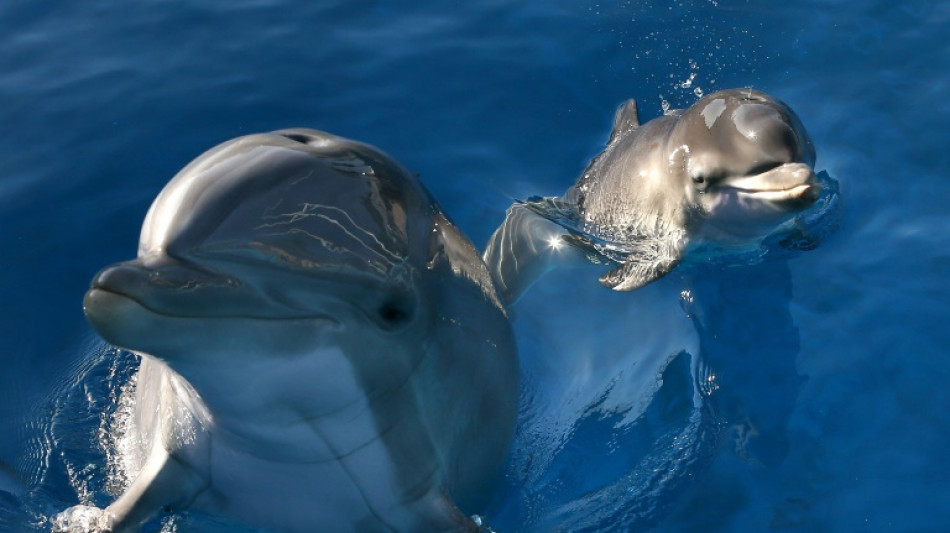
Pee pals: Dolphins taste friends' urine to know they're around / Photo: JUSTIN SULLIVAN - GETTY IMAGES NORTH AMERICA/AFP/File

 India's Padikkal makes 167 in first Sri Lanka Test

 Hurricane Lala pulls away from Hawaii's Big Island

 Petros, Vainio set new championship records to win Euro marathons

 Hurricane Lala brushes past Hawaii's Big Island, bringing heavy rain

 'Something we dreamed of': Bangladesh celebrates historic cricket win

 Rain holds up India on day two of Sri Lanka Test

 The Ukrainian social media channels tracking Russian missiles

 Disney offers fans an escapist bubble at D23 event

 Thousands await aid after deadly Indonesian quake

 Chinese ship sets off for Europe through Arctic, halving travel time

 Bangladesh on verge of historic win in Australia as Mehidy takes five

 Messi sees penalty saved as Nashville routs Inter Miami in MLS

 Heat is on as German winegrowers struggle to protect vines

 Hope fades for finding survivors of Colombia quake as rescued woman dies

 Japan aims for the moons of Mars

 'People could get hurt': Conservationists decry AI wildlife visuals

 'Another chance to live': Flores residents recall quake panic

 Rivers among nine inducted into Basketball Hall of Fame

 No.1 Scheffler leads by two at PGA St. Jude playoff event

 Rennie confident Jordan, Roigard will be fit to face Springboks

 PSG sign Belgian winger Godts from Ajax

 Nillessen claims shock European 1,500m gold

 Taylor scores two tries in winning debut as New Zealand captain

 England defender Spence leaves Spurs for Inter Milan

 Moore double leads Spurs to 3-0 friendly win over Hoffenheim

Think about people you know, and how you could tell they were around even if you couldn't see them: perhaps their voice, or a favored perfume.
For bottlenose dolphins, it's the taste of urine and signature whistles that allow them to recognize their friends at a distance, according to a study published Wednesday in Science Advances.
"Dolphins keep their mouths open and sample urine longer from familiar individuals than unfamiliar ones," first author Jason Bruck of the Stephen F. Austin State University in Texas wrote in an email to AFP.
"This is important because dolphins are the first vertebrate ever shown to have social recognition through taste alone."
The team, which included Sam Walmsley and Vincent Janik from the University of St Andrews, wrote that the use of taste could be highly beneficial in the open ocean because urine plumes persist for a while after an animal has left.
This alerts dolphins to the recent presence of that individual even if it had not signaled its presence vocally.
The question of whether animals can attach "labels" to their friends in their minds has been difficult to answer.
Bottlenose dolphins, which use signature whistles to selectively address specific individuals, and can remember these for over 20 years, were thus an interesting test case.
To investigate, the team presented eight dolphins with urine samples from familiar and unfamiliar individuals, finding they spent around three times as long sampling urine from those they knew.
Genital inspection, in which a dolphin uses its jaw to touch the genitals of another individual, is common in their social interactions, providing a good opportunity to learn the taste of others' urine.
For the purposes of this study, the dolphins were trained to provide urine samples on demand in exchange for food.
Dolphins do not have olfactory bulbs, leaving the team certain it was taste and not smell at play.
For the second part of the experiment, the team paired urine samples with recordings of signature whistles played via underwater speakers, corresponding to either the same dolphin that provided the urine sample, or a mismatched sample.
Dolphins remained close to the speaker longer when the vocalizations matched the urine samples -- potentially indicating that the two congruent lines of evidence together evoked more interest.
"It is not every day that scientists find evidence of 'noun'-like use of signals in a non-human vocal system. That's pretty exciting," Bruck told AFP.
Dolphins have rich social worlds, he added, and it may be "just as advantageous for a dolphin to recognize alliance members as it is for them to recognize potential antagonists."
- Obesity connection? -
The team suggested that lipids were likely responsible for individual chemical signatures.
"Given the recognition skills revealed in our study, we think that it is likely that dolphins can also extract other information from urine, such as reproductive state, or use pheromones to influence each other's behavior," they wrote.
In a surprising twist, the research could have implications for human obesity: the same gene that allows dolphins to identify lipids in urine is present in humans, where it helps people know when they have had enough to eat.
Studying the gene in dolphins could therefore improve understanding of how it works in people.
The work could also have other implications: human-caused pollution such as oil spills or other chemical runoff may impede the dolphins' ability to signal one another, thus doing even more harm than previously thought, said Bruck.
J.Gomez--AT