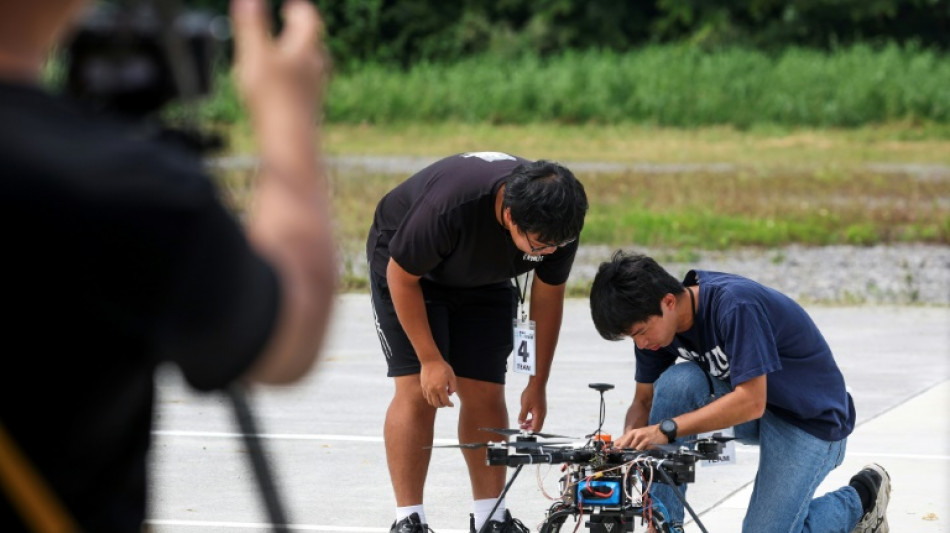
Taiwan students design drones for mock battle, as China threat looms / Photo: I-Hwa CHENG - AFP

 St. Louis City's unbeaten MLS run ends at 19, Union's reaches 15

 NFL Eagles bench Hurts at least a month with blood clot

 Across US, 'No Kings' events seek to boost early voting
 Tents spring up in Lisbon as Portugal housing protests spread
 'Best in world' Yamal powers Barca to Betis rout, Atletico strike late

 El Salvador's Bukele puts conditions on early release of gang prisoners

 Fire rages at town hall in France's Limoges after protests: authorities

 Unstoppable Barca thrash Betis to extend perfect start

 Maresca faces anxious wait over Haaland injury scare

 PSG fight back to beat Strasbourg after Dembele penalty miss

 Looting, blazes and clashes in France amid nationwide protests
 Walsh breaks her own 50 free world short course record

 Haaland brace extends Man City's winning start in Premier League

 'Special' Ombudsman storms to victory in Champion Stakes

 Brazil's right embraces election betting odds amid polls skepticism
 Four more Ebola cases detected in Kenya, bringing total to seven
 Clashes erupt in France as protesters vow to make government 'tremble'
 Chwalinska downs Swiatek to set up Wuhan final with world number 170 Kartal

 Chacarra takes lead as McIlroy falls away in Delhi

 Neto double gives Chelsea win marred by Martinez injury

 'Cockroach' party founder released from Indian police custody
 Nepal floods 'defining moment' for climate action: UN
 Albanian capital sees fifth straight day of violent clashes

 Leaders weigh 'huge benefit', risks of AI for global economy
 Zverev stunned by Davidovich Fokina in Shanghai semi-finals
At a drone testing field in southwestern Taiwan, university students watch anxiously as unmanned aerial vehicles they designed take off, land and, occasionally, crash in a simulated battlefield scenario.
They are taking part in a competition that is helping Taiwan's efforts to boost domestic drone production.
With Beijing sustaining military pressure on the island, Taipei is ramping up investment in unmanned aerial vehicles, or UAVs, as it seeks to bolster a more agile defence against a potential Chinese attack.
Both Ukraine and Russia have used UAVs extensively throughout their conflict, for surveillance and striking targets deep behind frontlines.
The UAVs flying in the National Defense Application UAV Challenge could potentially be adopted by drone companies and procured by the government.
"We can see drone applications in many current conflicts happening around the world said competition organiser Jan Shau-Shiun, a professor in the space systems engineering department at National Cheng Kung University.
"Taiwan is in a position where we may also face such an issue, so based on this theme, we aim to strengthen our drone capabilities."
China claims Taiwan as part of its territory and has refused to renounce the use of force to bring it under its control.
Now in its second year, the competition was held over two days last month at the Asia UAV AI Innovation Application R&D Center in Chiayi county.
Twenty teams from across Taiwan gathered to put their drones to the test. The field will be whittled down to a shortlist this month for another challenge before the winner is declared next year.
Multi-rotor and fixed-wing drones were required to fly autonomously to a height of at least 60 metres (around 200 feet), take images of a remote target, and return to base within 10 minutes.
To make the scenario more realistic -- and difficult -- organisers this year used a jammer to disrupt satellite signals to the UAVs, making it harder for them to stay airborne.
"From observing the war in Ukraine and other conflicts, we can see that there's often interference on the GNSS (Global Navigation Satellite System) before any fighting," said Jan.
- 'Hands-on skills' -
After spending countless hours designing and building their drones, with help from local drone or electronic component companies, teams watched nervously as their UAVs took flight.
Some drones failed to reach the required height or crashed due to the jamming.
Cheng Yong-jen, 24, breathed a sigh of relief after the drone he helped design ascended, soared into the distance and safely returned.
"It crashed, we repaired, it crashed again and we repaired again," said Cheng, a graduate student from National Formosa University.
"When the drone finally descended, I was in tears."
Lin Chun-Liang, lead judge and professor in electrical engineering at National Chung Hsing University, said the competition helped students develop "hands-on skills" not taught in schools.
Taiwan is spending hundreds of millions of dollars to buy and develop drones, and also nurture local talent to work in the sector, as it races to upgrade its military capabilities.
President Lai Ching-te has pledged to make Taiwan "the Asian hub of unmanned aerial vehicle supply chains".
Keeping workers in the industry, however, is a challenge in Taiwan where the huge semiconductor sector can offer higher salaries to top graduates.
Cheng said he planned to join a drone company after finishing his master's thesis on defence drones, insisting "this is the path we must take".
"We cannot stop moving forward just because we are behind others," said Cheng.
Ch.P.Lewis--AT