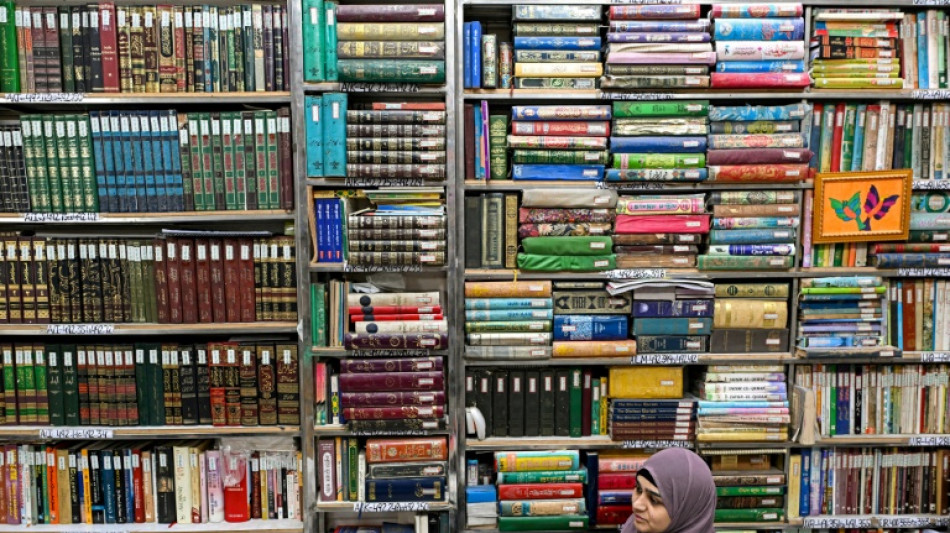
Fading literature: Delhi's famed Urdu Bazaar on last legs / Photo: Sajjad HUSSAIN - AFP

 St. Louis City's unbeaten MLS run ends at 19, Union's reaches 15
 NFL Eagles bench Hurts at least a month with blood clot

 Across US, 'No Kings' events seek to boost early voting

 Tents spring up in Lisbon as Portugal housing protests spread
 'Best in world' Yamal powers Barca to Betis rout, Atletico strike late
 El Salvador's Bukele puts conditions on early release of gang prisoners
 Fire rages at town hall in France's Limoges after protests: authorities

 Unstoppable Barca thrash Betis to extend perfect start

 Maresca faces anxious wait over Haaland injury scare

 PSG fight back to beat Strasbourg after Dembele penalty miss

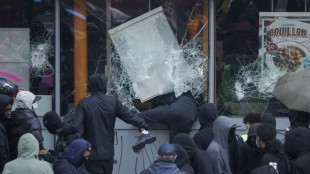
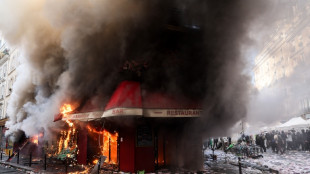 Looting, blazes and clashes in France amid nationwide protests
 Walsh breaks her own 50 free world short course record
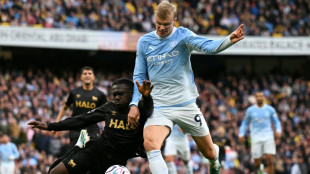 Haaland brace extends Man City's winning start in Premier League

 'Special' Ombudsman storms to victory in Champion Stakes

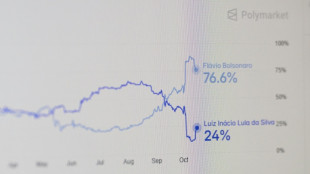 Brazil's right embraces election betting odds amid polls skepticism
 Four more Ebola cases detected in Kenya, bringing total to seven
 Clashes erupt in France as protesters vow to make government 'tremble'
 Chwalinska downs Swiatek to set up Wuhan final with world number 170 Kartal

 Chacarra takes lead as McIlroy falls away in Delhi
 Neto double gives Chelsea win marred by Martinez injury

 'Cockroach' party founder released from Indian police custody
 Nepal floods 'defining moment' for climate action: UN
 Albanian capital sees fifth straight day of violent clashes
 Leaders weigh 'huge benefit', risks of AI for global economy

 Zverev stunned by Davidovich Fokina in Shanghai semi-finals
In the bustling heart of Old Delhi, Indian bookseller Mohammed Mahfooz Alam sits forlorn in his quiet store, among the last few selling literature in a language beloved by poets for centuries.
Urdu, spoken by many millions today, has a rich past that reflects how cultures melded to forge India's complex history.
But its literature has been subsumed by the cultural domination of Hindi, struggling against false perceptions that its elegant Perso-Arabic script makes it a foreign import and a language of Muslims in the Hindu-majority nation.
"There was a time when, in a year, we would see 100 books being published," said 52-year-old Alam, lamenting the loss of the language and its readership.
The narrow streets of Urdu Bazaar, in the shadow of the 400-year-old Jama Masjid mosque, were once the core of the city's Urdu literary community, a centre of printing, publishing and writing.
Today, streets once crowded with Urdu bookstores abuzz with scholars debating literature are now thick with the aroma of sizzling kebabs from the restaurants that have replaced them.
Only half a dozen bookstores are left.
"Now, there are no takers," Alam said, waving at the streets outside. "It is now a food market."
- Dying 'day by day' -
Urdu, one of the 22 languages enshrined under India's constitution, is the mother tongue of at least 50 million people in the world's most populous country. Millions more speak it, as well as in neighbouring Pakistan.
But while Urdu is largely understood by speakers of India's most popular language Hindi, their scripts are entirely different.
Alam says he can see Urdu literature dying "day by day".
The Maktaba Jamia bookshop he manages opened a century ago. Alam took over its running this year driven by his love for the language.
"I have been sitting since morning, and barely four people have come," he said gloomily. "And even those were college or school-going children who want their study books."
Urdu, sharing Hindi's roots and mingled with words from Persian and Arabic, emerged as a hybrid speech between those who came to India through trade and conquest -- and the people they settled down amongst.
But Urdu has faced challenges in being viewed as connected to Islamic culture, a popular perception that has grown since the Hindu-nationalist Bharatiya Janata Party (BJP) of Prime Minister Narendra Modi took power in 2014.
Hard-right Hindu nationalists seeking to diminish Islam's place in India's history have opposed its use: in the past decade, protests have ranged from the use of Urdu in clothing advertisements to even graffiti.
"Urdu has been associated with Muslims, and that has hit the language too," said Alam.
"But it is not true. Everyone speaks Urdu. You go to villages, people speak Urdu. It is a very sweet language. There is peace in it."
- 'Feel the beauty' -
For centuries, Urdu was a key language of governance.
Sellers first set up stores in the Urdu Bazaar in the 1920s, selling stacks of books from literature to religion, politics and history -- as well as texts in Arabic and Persian.
By the 1980s, more lucrative fast-food restaurants slowly moved in, but the trade dropped dramatically in the past decade, with more than a dozen bookshops shutting down.
"With the advent of the internet, everything became easily available on the mobile phone," said Sikander Mirza Changezi, who co-founded a library to promote Urdu in Old Delhi in 1993.
"People started thinking buying books is useless, and this hit the income of booksellers and publishers, and they switched to other businesses."
The Hazrat Shah Waliullah Public Library, which Changezi helped create, houses thousands of books including rare manuscripts and dictionaries.
It is aimed at promoting the Urdu language.
Student Adeeba Tanveer, 27, who has a masters degree in Urdu, said the library provided a space for those wanting to learn.
"The love for Urdu is slowly coming back," Tanveer told AFP, adding that her non-Muslim friends were also keen to learn.
"It is such a beautiful language," she said. "You feel the beauty when you speak it."
H.Romero--AT