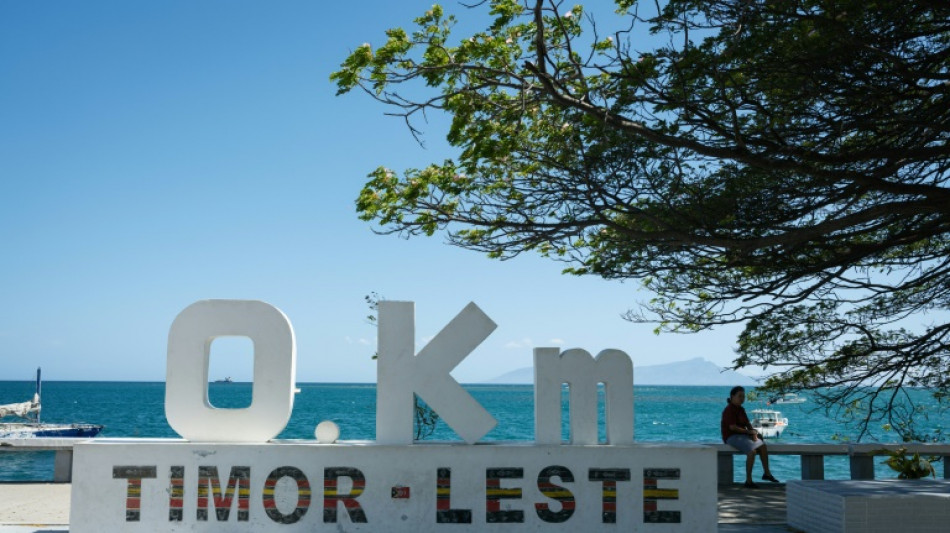
East Timor fights new battles 25 years after independence vote / Photo: Yasuyoshi CHIBA - AFP

 Japan to launch historic round-trip mission to Mars moon

 Musk back in the spotlight, but politics dims the awe

 England Rugby League World Cup hopes hang by a thread

 Williams lifts Valkyries past Dream in WNBA Finals opener

 Dubois destroys Wardley to retain WBO heavyweight crown
 Oregon families grapple with explaining school shooting to children
 Israeli settlers attack European diplomats, beat French mayor

 Town hall in Limoges 'largely lost' to blaze set during French protests
 US goes on the offensive in central Asia

 Emotional Lions come up short in Champions Cup as tributes paid to Andrews

 Diaz dazzles as Bayern batter Leipzig to go top

 Inter move clear at Serie A summit with Bologna win

 Liverpool still have 'lots to improve', says match-winner Isak
 Looters ransack shops during France cost-of-living protests

 Leinster thump Clermont as grieving Lions set for Champions Cup debut

 Haaland stars in Man City win, Liverpool beat Brentford

 Dortmund go top despite Union Berlin stalemate
 Venezia upset Napoli for first Serie A win of season
 Glasgow and Bulls win as grieving Lions set for Champions Cup debut
 Smiling pope returns to Vatican after cancer surgery

 In-form Atletico scrape late win at Espanyol
 Rabada returns as S.Africa seek to bounce back against Australia

 Zverev, Medvedev ousted with Spaniards to clash for Shanghai title
 French protesters clash with police during nationwide demonstrations
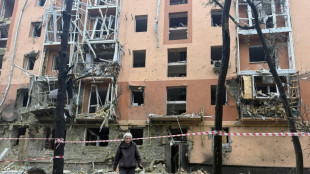 Zelensky says Trump could lift more Russia sanctions
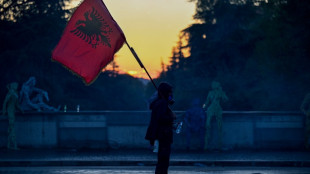
Along the waterfront of East Timor's capital, buzzing restaurants sell local dishes and Portuguese colonial fare facing turquoise waters where the Indonesian military launched an invasion nearly half a century before.
Since emerging from decades of brutal occupation in 2002 on the back of an independence vote 25 years ago, Asia's youngest nation has made remarkable political strides in its short history.
"The most successful? National healing, reconciliation, peace and stability," President Jose Ramos-Horta told AFP in a recent interview at his home in Dili.
"There has been tremendous progress."
Independent observers also say the micro-state of 1.3 million stands out as a regional beacon of democracy and press freedom.
"It's probably the most resilient and strongest democracy in Southeast Asia," said Joshua Kurlantzick, senior fellow at the Council on Foreign Relations.
But the country is fighting new battles on various fronts -- a poverty rate above 40 percent, crucial energy reserves that experts say will deplete within years, and a balancing act between Western allies and China.
- 'Doing reasonably well' -
In 1975 Indonesian forces stormed the capital of the former Portuguese colony, capturing it in hours.
Indonesian occupation followed, along with human rights abuses and the killing of an estimated quarter of the population, before a contentious 1999 referendum helped East Timor achieve independence.
It has since witnessed economic growth thanks to oil and gas profits.
"We are very happy. The progress has been extraordinary," said teacher Silverio Tilman, 58.
But not everyone has benefited.
"If you go outside of Dili, you'll see things have not changed economically much in the last 25 years," said Charles Scheiner, researcher at Dili-based NGO La'o Hamutuk.
"There's still very high levels of poverty. Child malnutrition is probably one of the worst in the world."
Ramos-Horta said a deal with Australia on a vast fossil fuel project, crucial to the tiny nation's economic future, will be struck by November.
"The country's economic trajectory largely hinges on the successful development of the Greater Sunrise gas field," said Parker Novak, nonresident fellow at the Atlantic Council.
Others warn the project's development would only delay looming economic problems.
East Timor is still a net food importer and has inadequate tourism infrastructure, making it hard to diversify.
Yet its president was more optimistic.
"Timor-Leste in 2002 had less than 60 years life expectancy. Today, almost 70," said Ramos-Horta. "We are doing reasonably well."
- Friends with all -
On his living room table were foreign affairs magazines with China's Xi Jinping and Russia's Vladimir Putin leading the front pages.
Adorning his walls were pictures of American icons like Marilyn Monroe, John F. Kennedy and Elvis Presley, next to a large image of Cuban revolution hero Che Guevara.
The juxtaposition is emblematic of East Timor's position as a small piece in the superpower competition between Washington and Beijing.
Ramos-Horta has pledged to be friends with all despite fears Dili could turn away from traditional Western allies as it seeks more investment.
"It's the Chinese helping us. We are not helping them," he said.
But Western partners are watching closely for fear of East Timor falling into a debt trap and becoming in thrall to Beijing.
Asked how he squared his own democracy fight with closer relations with China -- accused of indirectly supporting Russia's Ukraine invasion and conducting aggressive moves around self-ruled Taiwan -- Ramos-Horta says Western criticism was steeped in hypocrisy.
"Long before we were born as an independent state, the whole international community recognised Beijing... as the sole China," he said.
"Why does the West want little Timor-Leste to do the opposite?"
- Generation of '75 -
Ramos-Horta, 74, is feted at home and says he occasionally drives around safely in his American jeep to holiday in the mountains.
His tireless diplomacy in exile earned him a 1996 Nobel Peace Prize and the popularity to secure his first presidential term between 2007 and 2012, during which he survived an assassination attempt.
Prime Minister Xanana Gusmao, 78, is also revered as a liberation hero.
They come from an ageing class known as the "Generation of '75" who aided the independence battle and have rotated in positions of power.
Ramos-Horta came out of retirement in 2022 to win a second presidential term against former guerrilla fighter Francisco "Lu-Olo" Guterres.
But observers say it's time for a new class of leaders.
"The country has needed new leadership for the past 15 years," said Damien Kingsbury, a Deakin University politics professor.
"I expect that will only occur when the Generation of '75 die or are too sick to continue."
Ramos-Horta says he won't run again in 2027, and is scouting for new leaders.
And some young Timorese are ready for that change.
"This country needs a new generation," said Adao Guterres, a 25-year-old university student.
"A new generation ready to compete and improve this country."
R.Chavez--AT