
NASA launches probe to study if life possible on icy Jupiter moon / Photo: CHANDAN KHANNA - AFP

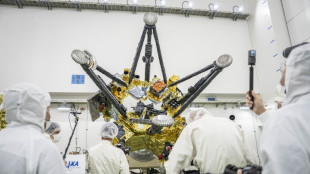 Japan to launch historic round-trip mission to Mars moon

 Musk back in the spotlight, but politics dims the awe

 England Rugby League World Cup hopes hang by a thread

 Williams lifts Valkyries past Dream in WNBA Finals opener

 Dubois destroys Wardley to retain WBO heavyweight crown

 Oregon families grapple with explaining school shooting to children

 Israeli settlers attack European diplomats, beat French mayor

 Town hall in Limoges 'largely lost' to blaze set during French protests

 US goes on the offensive in central Asia

 Emotional Lions come up short in Champions Cup as tributes paid to Andrews

 Diaz dazzles as Bayern batter Leipzig to go top

 Inter move clear at Serie A summit with Bologna win

 Liverpool still have 'lots to improve', says match-winner Isak

 Looters ransack shops during France cost-of-living protests

 Leinster thump Clermont as grieving Lions set for Champions Cup debut

 Haaland stars in Man City win, Liverpool beat Brentford

 Dortmund go top despite Union Berlin stalemate

 Venezia upset Napoli for first Serie A win of season

 Glasgow and Bulls win as grieving Lions set for Champions Cup debut

 Smiling pope returns to Vatican after cancer surgery

 In-form Atletico scrape late win at Espanyol

 Rabada returns as S.Africa seek to bounce back against Australia

 Zverev, Medvedev ousted with Spaniards to clash for Shanghai title

 French protesters clash with police during nationwide demonstrations

 Zelensky says Trump could lift more Russia sanctions

NASA's Europa Clipper probe blasted off from Florida on Monday, bound for an icy moon of Jupiter to discover whether it has the ingredients to support life.
Lift-off aboard a powerful SpaceX Falcon Heavy rocket took place shortly after noon (1600 GMT), with the probe set to reach Jupiter's moon Europa in five and a half years.
NASA later confirmed that it had successfully acquired a signal from the probe and that its massive solar arrays -- designed to capture the weak light that reaches Jupiter -- had fully unfolded.
The mission will allow the US space agency to uncover new details about Europa, which scientists believe could hold an ocean beneath its icy surface.
"With Europa Clipper, we're not searching for life on Europa, but we're trying to see if this ocean world is habitable, and that means we're looking for the water," NASA official Gina DiBraccio said ahead of the launch.
"We're looking for energy sources, and we're really looking for the chemistry there, so that we can understand what habitable environments might be throughout our whole universe," she added.
If life's ingredients are found, another mission would then have to make the journey to try to detect it.
"It's a chance for us to explore not a world that might have been habitable billions of years ago" like Mars, Europa Clipper program scientist Curt Niebur told reporters, "but a world that might be habitable today, right now."
At 30 meters (98 feet) wide with its solar panels fully extended, the probe is the largest ever designed by NASA for interplanetary exploration.
- Primitive life? -
While Europa's existence has been known since 1610, the first close-up images were taken by the Voyager probes in 1979, which revealed mysterious reddish lines crisscrossing its surface.
The next probe to reach Jupiter's icy moon was NASA's Galileo probe in the 1990s, which found it was highly likely that the moon was home to an ocean.
This time, the Europa Clipper carries a host of sophisticated instruments, including cameras, a spectrograph, radar and a magnetometer to measure its magnetic forces.
The mission will look to determine the structure and composition of Europa's surface, its depth, and even the salinity of its ocean, as well as the way the two interact -- to find out, for example, if water rises to the surface in places.
The aim is to understand whether the three ingredients necessary for life are present: water, energy and certain chemical compounds.
If these conditions exist on Europa, life could be found in the ocean in the form of primitive bacteria, explained Bonnie Buratti, the mission's deputy project scientist.
But the bacteria would likely be too deep for the Europa Clipper to see.
- 49 flybys -
The probe will cover 2.9 billion kilometers (1.8 billion miles) during its journey, with arrival expected in April 2030.
The main mission will last another four years.
The probe will make 49 close flybys over Europa, coming as close as 25 kilometers above the surface.
It will be subjected to intense radiation -- the equivalent of several million chest x-rays on each pass.
Some 4,000 people have been working on the $5.2 billion mission for around a decade.
NASA says the investment is justified by the importance of the data that will be collected.
If our solar system turns out to be home to two habitable worlds (Europa and Earth), "think of what that means when you extend that result to the billions and billions of other solar systems in this galaxy," said Niebur.
The Europa Clipper will operate at the same time as the European Space Agency's (ESA) Juice probe, which will study two other moons of Jupiter -- Ganymede and Callisto.
H.Romero--AT