Nobel winners hope protein work will spur 'incredible' breakthroughs / Photo: Jonathan NACKSTRAND - AFP

 Japan to launch historic round-trip mission to Mars moon
 Musk back in the spotlight, but politics dims the awe

 England Rugby League World Cup hopes hang by a thread

 Williams lifts Valkyries past Dream in WNBA Finals opener

 Dubois destroys Wardley to retain WBO heavyweight crown

 Oregon families grapple with explaining school shooting to children

 Israeli settlers attack European diplomats, beat French mayor

 Town hall in Limoges 'largely lost' to blaze set during French protests

 US goes on the offensive in central Asia

 Emotional Lions come up short in Champions Cup as tributes paid to Andrews

 Diaz dazzles as Bayern batter Leipzig to go top

 Inter move clear at Serie A summit with Bologna win

 Liverpool still have 'lots to improve', says match-winner Isak

 Looters ransack shops during France cost-of-living protests

 Leinster thump Clermont as grieving Lions set for Champions Cup debut

 Haaland stars in Man City win, Liverpool beat Brentford

 Dortmund go top despite Union Berlin stalemate
 Venezia upset Napoli for first Serie A win of season
 Glasgow and Bulls win as grieving Lions set for Champions Cup debut

 Smiling pope returns to Vatican after cancer surgery

 In-form Atletico scrape late win at Espanyol
 Rabada returns as S.Africa seek to bounce back against Australia

 Zverev, Medvedev ousted with Spaniards to clash for Shanghai title

 French protesters clash with police during nationwide demonstrations

 Zelensky says Trump could lift more Russia sanctions

The winners of the Nobel Prize in Chemistry for work revealing the secrets of proteins through artificial intelligence said Wednesday they hoped their research would "open the door to many incredible scientific breakthroughs".
But they also warned of the dangers of AI, saying that while it had "extraordinary potential for good", it could also have negative effects if allowed to develop unchecked.
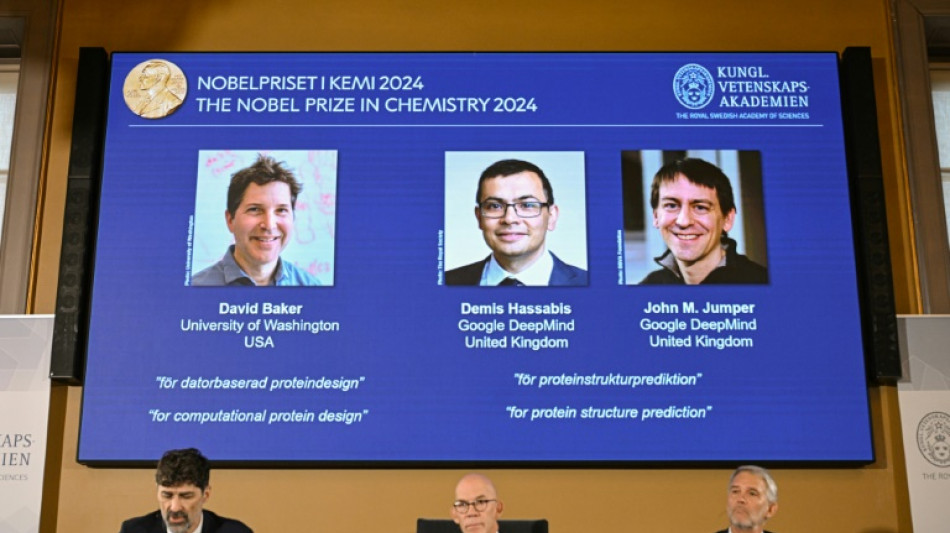
Americans David Baker and John Jumper, together with Briton Demis Hassabis, were honoured for cracking the code behind the structure of proteins, the building blocks of life.
The jury hailed their work as holding "enormous potential" in a range of fields.
At a press conference in London following the announcement, Jumper said the prize "represents the promise of computational biology".
"We want to make the world a better place, and we have these incredibly powerful tools to do it. We're ultimately going to make people healthy because of the work we do with AI," he added.
"I hope this is just a sign that we have opened the door to many incredible scientific breakthroughs."
Their work could have particular importance in the field of drug discovery, noted Hassabis.
"We think there's a huge potential there to revolutionise the way drug discovery is done, and try and shorten it down from almost a decade or more of work to... maybe months," he said.
AI particularly lends itself to molecular biology because it is able to identify "patterns that we never see," said Jumper.
"Medicine is hard because we don't understand how the body works in its extraordinary complexity," he added, calling their work "a step towards doing that".
- Late call -
Both Jumper and Hassabis said they had given up on getting the call, as the minutes ticked down to the announcement.
"I don't think they had either of our numbers, funnily enough," said Hassabis.
"So we got the call very late. We just thought 'it's not happening', or at least I did."
Jumper said that he was still waiting with only 30 minutes to go.
"I turned to my wife, and I said: 'Well, I guess it's not this year'.
"And then 30 seconds later, I got this phone call from Sweden, and I absolutely could not believe it."
Hassabis, 48, said his gaming background was the foundation of his computational expertise, and encouraged children to follow a similar path.
"I would actually encourage kids to play games, but not just to play them, but the most important thing is to try and make them.
"It's just a really fun way to get into the guts of how computers work," he added.
However, Hassabis sounded a note of caution about AI, which he called "one of the most transformative technologies in human history".
It has "the extraordinary potential for good... but also it can be used for harm," he said, warning "we have to really think very hard as these systems and techniques get more powerful".
"I'm a big believer in human ingenuity," Hassabis added, arguing "given enough time and enough resources and enough smart people", humanity can solve many of its most vexing problems.
M.White--AT