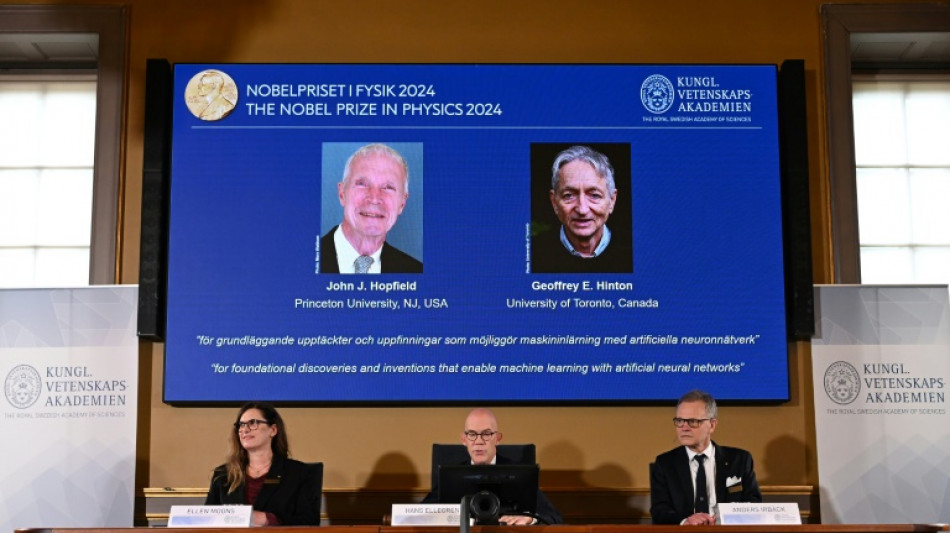
Nobel-winning physicist 'unnerved' by AI technology he helped create / Photo: Jonathan NACKSTRAND - AFP

 Japan to launch historic round-trip mission to Mars moon
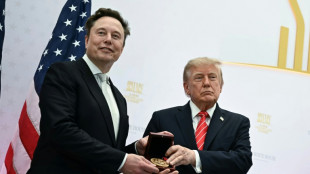 Musk back in the spotlight, but politics dims the awe
 England Rugby League World Cup hopes hang by a thread

 Williams lifts Valkyries past Dream in WNBA Finals opener

 Dubois destroys Wardley to retain WBO heavyweight crown

 Oregon families grapple with explaining school shooting to children
 Israeli settlers attack European diplomats, beat French mayor

 Town hall in Limoges 'largely lost' to blaze set during French protests

 US goes on the offensive in central Asia

 Emotional Lions come up short in Champions Cup as tributes paid to Andrews

 Diaz dazzles as Bayern batter Leipzig to go top

 Inter move clear at Serie A summit with Bologna win

 Liverpool still have 'lots to improve', says match-winner Isak

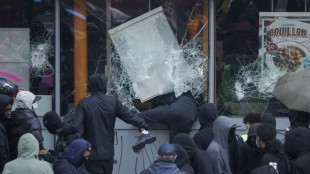 Looters ransack shops during France cost-of-living protests
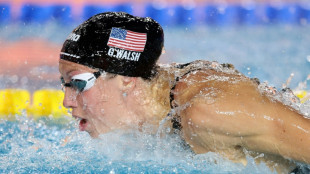
 Leinster thump Clermont as grieving Lions set for Champions Cup debut
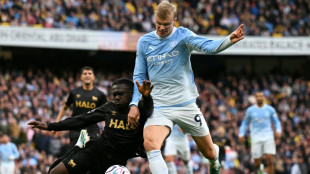
 Haaland stars in Man City win, Liverpool beat Brentford

 Dortmund go top despite Union Berlin stalemate
 Venezia upset Napoli for first Serie A win of season

 Glasgow and Bulls win as grieving Lions set for Champions Cup debut

 Smiling pope returns to Vatican after cancer surgery
 In-form Atletico scrape late win at Espanyol

 Rabada returns as S.Africa seek to bounce back against Australia

 Zverev, Medvedev ousted with Spaniards to clash for Shanghai title

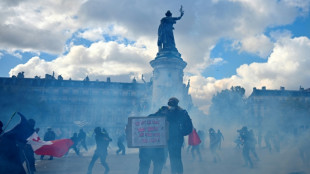 French protesters clash with police during nationwide demonstrations
 Zelensky says Trump could lift more Russia sanctions

A US scientist who won the 2024 Nobel physics prize for his pioneering work on artificial intelligence said Tuesday he found recent advances in the technology "very unnerving" and warned of possible catastrophe if it isn't kept in check.
John Hopfield, a professor emeritus at Princeton, joined co-winner Geoffrey Hinton in calling for a deeper understanding of the inner workings of deep-learning systems to prevent them from spiraling out of control.
Addressing a gathering at the New Jersey university via video link from Britain, the 91-year-old said that over the course of his life he had watched the rise of two powerful but potentially hazardous technologies -- biological engineering and nuclear physics.
"One is is accustomed to having technologies which are not singularly only good or only bad, but have capabilities in both directions," he said.
"And as a physicist, I'm very unnerved by something which has no control, something which I don't understand well enough so that I can understand what are the limits which one could drive that technology."
"That's the question AI is pushing," he continued, adding that despite modern AI systems appearing to be "absolute marvels," there is a lack of understanding about how they function, which he described as "very, very unnerving."
"That's why I myself, and I think Geoffrey Hinton also, would strongly advocate understanding as an essential need of the field, which is going to develop some abilities that beyond the abilities you can imagine at present."
Hopfield was honored for devising the "Hopfield network" — a theoretical model demonstrating how an artificial neural network can mimic the way biological brains store and retrieve memories.
His model was improved upon by British-Canadian Hinton, often dubbed the "Godfather of AI," whose "Boltzmann machine" introduced the element of randomness, paving the way for modern AI applications such as image generators.
With the meteoric rise of AI capabilities -- and the fierce race it has sparked among companies -- the technology has faced criticism for evolving faster than scientists can fully comprehend.
"You don't know that the collective properties you began with are actually the collective properties with all the interactions present, and you don't therefore know whether some spontaneous but unwanted thing is lying hidden in the works," stressed Hopefield.
He evoked the example of "ice-nine" -- a fictional, artificially engineered crystal in Kurt Vonnegut's 1963 novel "Cat's Cradle" developed to help soldiers deal with muddy conditions but which inadvertently freezes the world's oceans solid, causing the downfall of civilization.
"I'm worried about anything that says... 'I'm faster than you are, I'm bigger than you are...can you peacefully inhabit with me?' I don't know, I worry."
A.Moore--AT