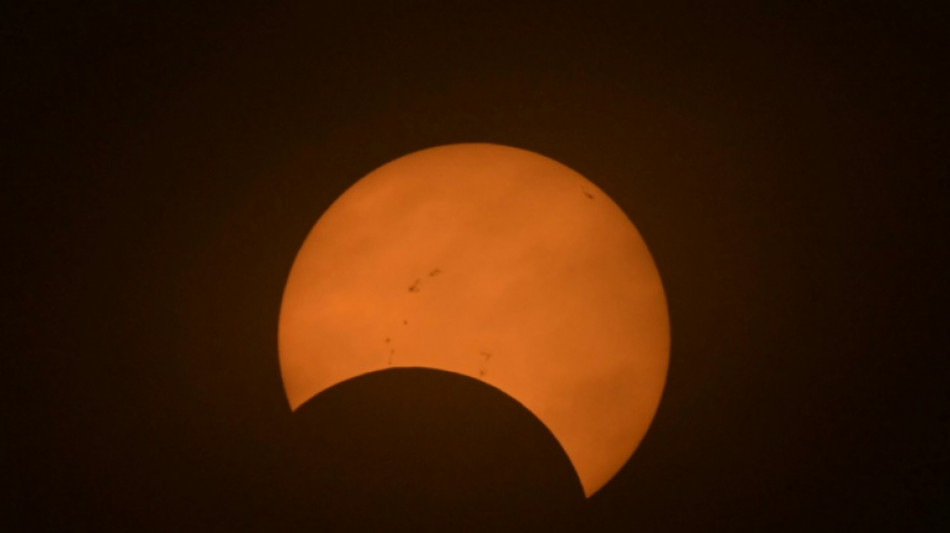
South America treated to rare 'ring of fire' eclipse / Photo: Juan MABROMATA - AFP

 Japan to launch historic round-trip mission to Mars moon

 Musk back in the spotlight, but politics dims the awe

 England Rugby League World Cup hopes hang by a thread

 Williams lifts Valkyries past Dream in WNBA Finals opener

 Dubois destroys Wardley to retain WBO heavyweight crown

 Oregon families grapple with explaining school shooting to children

 Israeli settlers attack European diplomats, beat French mayor

 Town hall in Limoges 'largely lost' to blaze set during French protests

 US goes on the offensive in central Asia

 Emotional Lions come up short in Champions Cup as tributes paid to Andrews

 Diaz dazzles as Bayern batter Leipzig to go top

 Inter move clear at Serie A summit with Bologna win

 Liverpool still have 'lots to improve', says match-winner Isak

 Looters ransack shops during France cost-of-living protests

 Leinster thump Clermont as grieving Lions set for Champions Cup debut

 Haaland stars in Man City win, Liverpool beat Brentford

 Dortmund go top despite Union Berlin stalemate

 Venezia upset Napoli for first Serie A win of season

 Glasgow and Bulls win as grieving Lions set for Champions Cup debut

 Smiling pope returns to Vatican after cancer surgery

 In-form Atletico scrape late win at Espanyol

 Rabada returns as S.Africa seek to bounce back against Australia

 Zverev, Medvedev ousted with Spaniards to clash for Shanghai title

 French protesters clash with police during nationwide demonstrations

 Zelensky says Trump could lift more Russia sanctions

Skygazers on the tip of South America were treated Wednesday to a spectacular "ring of fire" solar eclipse that was visible from Chile's Easter Island before heading to mainland Patagonia.
The rare spectacle -- which happens when the Sun momentarily all but disappears as the Moon crosses its path -- drew dozens of tourists, photographers and astronomy enthusiasts to the Pacific island of 7,000 inhabitants.
There, they pointed their lenses at a partly cloudy sky against the backdrop of the "moais" -- the giant statues iconic of Easter Island, long inhabited by Polynesian people.
"It was a mini sunset," 55-year-old Ninoska Huki told AFP of the "sublime" experience that hit the island shortly after noon local time.
A so-called annular solar eclipse occurs when the Earth, Moon and Sun line up.
Even when perfectly aligned, the Moon is too far from Earth to completely block out the Sun, creating instead the impression of a fiery ring.
At first, it appears as if a bite has been taken out of the Sun.
The bite grows bigger and bigger until the Moon moves directly in line with the Sun, at which point people nearby usually notice a distinct drop in temperature and brightness but for the ring.
As the day darkens, birds and animals sometimes enter a night-time routine, thinking sunset is near.
Full "annularity," the moment of the peak "ring," lasted about six minutes with Wednesday's eclipse, which began in the North Pacific before passing over the Andes and Patagonia regions of Latin America.
Lasting more than three hours from about 1700 to 2030 GMT, according to NASA, it was to finish over the Atlantic.
A partial eclipse would be visible from Bolivia, Peru, Paraguay, Uruguay, parts of Brazil, Mexico, New Zealand and several islands in the Pacific and Atlantic oceans, NASA said.
- Patagonian path -
On the southern tip of Argentina, people braved icy cold and windy weather to gather in the small Patagonian town of Puerto San Julian to observe the phenomenon from an esplanade facing the beach.
Retired teacher Julio Fernandez, 58, brought a telescope "so the children can see, because not many" ever get the chance.
Classes in the town were suspended for children to partake in the rare event.
The only safe methods to observe a "ring of fire" eclipse, according to experts, involve certified special glasses, or watching indirectly through a pinhole in a cardboard sheet projecting the image onto something else.
The next partial solar eclipse will take place on March 29, 2025, visible mainly from western North America, Europe and northwest Africa.
A.O.Scott--AT