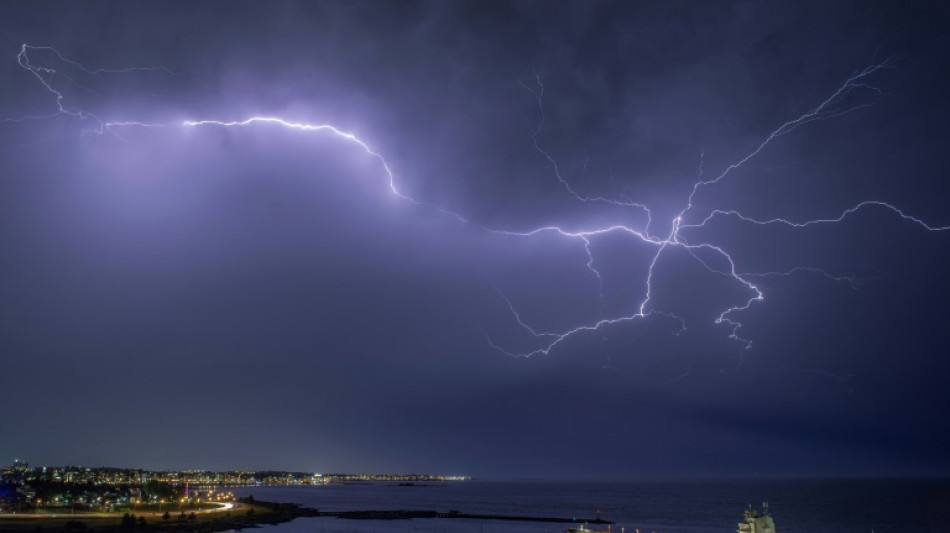
Thunderstorms are a 'boiling pot' of gamma rays, scientists find / Photo: Mariana SUAREZ - AFP/File

 Japan to launch historic round-trip mission to Mars moon

 Musk back in the spotlight, but politics dims the awe

 England Rugby League World Cup hopes hang by a thread

 Williams lifts Valkyries past Dream in WNBA Finals opener

 Dubois destroys Wardley to retain WBO heavyweight crown

 Oregon families grapple with explaining school shooting to children

 Israeli settlers attack European diplomats, beat French mayor

 Town hall in Limoges 'largely lost' to blaze set during French protests

 US goes on the offensive in central Asia

 Emotional Lions come up short in Champions Cup as tributes paid to Andrews

 Diaz dazzles as Bayern batter Leipzig to go top

 Inter move clear at Serie A summit with Bologna win

 Liverpool still have 'lots to improve', says match-winner Isak

 Looters ransack shops during France cost-of-living protests

 Leinster thump Clermont as grieving Lions set for Champions Cup debut

 Haaland stars in Man City win, Liverpool beat Brentford

 Dortmund go top despite Union Berlin stalemate

 Venezia upset Napoli for first Serie A win of season

 Glasgow and Bulls win as grieving Lions set for Champions Cup debut

 Smiling pope returns to Vatican after cancer surgery

 In-form Atletico scrape late win at Espanyol

 Rabada returns as S.Africa seek to bounce back against Australia

 Zverev, Medvedev ousted with Spaniards to clash for Shanghai title

 French protesters clash with police during nationwide demonstrations

 Zelensky says Trump could lift more Russia sanctions

Big thunderstorms continuously emit gamma rays that are undetectable from the ground, two studies said on Wednesday, upending what was previously thought -- and potentially pointing towards a clue in the mystery of how lightning is sparked.
Despite the fact that 40,000 thunderstorms generate more than eight million lightning strikes above our heads every day, they "remain poorly understood", physicist Joseph Dwyer said in an analysis of the new research in the journal Nature.
Normally when people think of gamma rays -- bursts of an incredibly high-energy form of light -- they are coming from out of this world, such as solar flares, exploding stars or black holes.
However in the 1990s, NASA satellites tasked with hunting down high-energy particles from such cosmic sources detected gamma rays coming from Earth.
Other than inside nuclear reactors, nothing on our planet had been thought capable of generating gamma rays.
Since then, two different types of gamma rays have been observed inside thunderstorms -- both invisible to the naked eye.
Gamma-ray glows can last for a few minutes over a region roughly 20 kilometres (12 miles) wide, while more powerful "flashes" last less than a millisecond.
"As it turns out, essentially all big thunderstorms generate gamma rays all day long in many different forms," Steven Cummer, a researcher at Duke University and a co-author of one of the studies, said in a statement.
- Bubbling cauldron of gamma rays -
To find out more about what is happening inside thunderstorms, the international team of researchers used an NASA ER-2 airplane.
The scientific aircraft, based the American U-2 spy plane, can fly more than twice as high as a commercial airliner, soaring far above storm clouds.
Over a month in 2023, the plane left a Florida air force based to fly at an altitude of 20 kilometres over active storms, capturing evidence that gamma radiation is much more common than had been thought.
The storms almost continuously generated gamma-ray glows for hours across thousands of square kilometres, all of which were closely linked to the most intense areas of the storm.
The storms resemble "a huge gamma-glowing 'boiling pot' in both pattern and behaviour," said the author of the first Nature study, which was authored by Martino Marisaldi of Norway's University of Bergen.
The second study revealed that glows could intensify into what it called "flickering" gamma-ray flashes. These could be the elusive "missing link" between glows and flashes, it added.
These observations "blur the line between these two types of emission, suggesting that gamma-ray glows often morph into intense pulses", Dwyer explained.
Lightning often follows these intense gamma ray emissions, which suggests they might play some role in sparking lightning strikes, according to the second study.
"How lightning is initiated inside thunderstorms is one of the greatest mysteries in the atmospheric sciences," Dwyer said.
"It is amazing that, more than two decades into the 21st century, Earth's atmosphere has enough surprises in store to motivate an entirely new line of research."
H.Thompson--AT