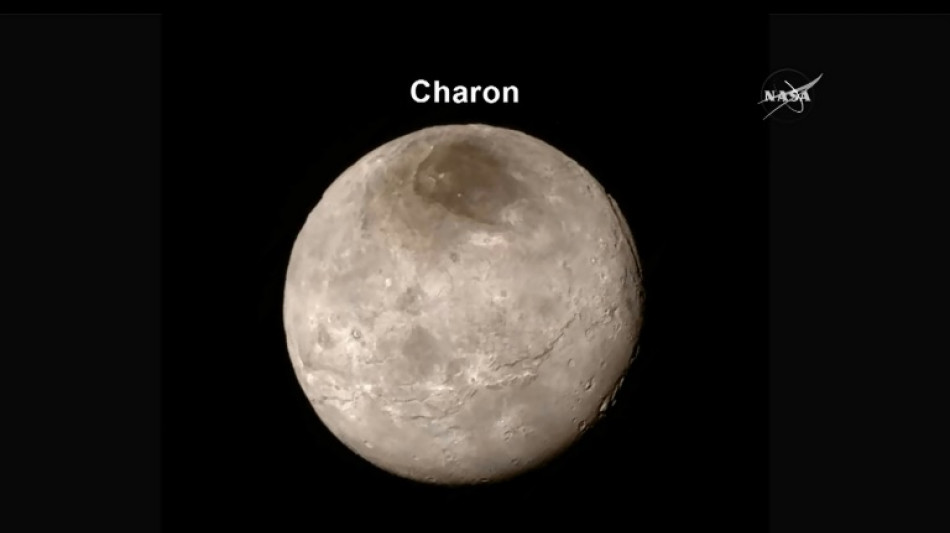
Webb telescope detects carbon dioxide on Pluto's largest moon / Photo: - - NASA TV/AFP/File

 Japan to launch historic round-trip mission to Mars moon

 Musk back in the spotlight, but politics dims the awe

 England Rugby League World Cup hopes hang by a thread

 Williams lifts Valkyries past Dream in WNBA Finals opener

 Dubois destroys Wardley to retain WBO heavyweight crown

 Oregon families grapple with explaining school shooting to children

 Israeli settlers attack European diplomats, beat French mayor

 Town hall in Limoges 'largely lost' to blaze set during French protests

 US goes on the offensive in central Asia

 Emotional Lions come up short in Champions Cup as tributes paid to Andrews

 Diaz dazzles as Bayern batter Leipzig to go top

 Inter move clear at Serie A summit with Bologna win

 Liverpool still have 'lots to improve', says match-winner Isak

 Looters ransack shops during France cost-of-living protests

 Leinster thump Clermont as grieving Lions set for Champions Cup debut

 Haaland stars in Man City win, Liverpool beat Brentford

 Dortmund go top despite Union Berlin stalemate
 Venezia upset Napoli for first Serie A win of season

 Glasgow and Bulls win as grieving Lions set for Champions Cup debut

 Smiling pope returns to Vatican after cancer surgery

 In-form Atletico scrape late win at Espanyol

 Rabada returns as S.Africa seek to bounce back against Australia

 Zverev, Medvedev ousted with Spaniards to clash for Shanghai title

 French protesters clash with police during nationwide demonstrations
 Zelensky says Trump could lift more Russia sanctions

Scientists using the James Webb Space Telescope have detected carbon dioxide on the frozen surface of Pluto's biggest moon, Charon, for the first time, research revealed on Tuesday.
The discovery of CO2, along with another chemical hydrogen peroxide (H2O2), could shed light on the icy worlds in the mysterious outer reaches of our Solar System.
Pluto was long known as the ninth planet from the Sun. But after other similar objects were spotted in a region beyond Neptune called the Kuiper Belt, it was downgraded to dwarf planet in 2006.
The doughnut-shaped Kuiper Belt is thought to be home to millions of icy worlds.
These objects are "time capsules that enable us to understand the formation of the Solar System", Silvia Protopapa of the Southwest Research Institute in the US state of Colorado told AFP.
Charon offers a rare glimpse into these worlds because -- unlike other Kuiper Belt objects including Pluto -- its surface is not obscured by highly volatile ices such as methane, she explained.
Protopapa is the lead author of a new study in the journal Nature Communications describing Webb's new discoveries on the biggest of Pluto's five moons.
- 'Piece of the puzzle' -
Charon, which is around the width of France and half the size of Pluto, was first discovered in 1978.
When NASA's New Horizon spacecraft flew past Charon in 2015, it discovered the surface was mainly covered in water ice and ammonia, which are thought to give the moon its red and grey appearance.
It also showed that material from beneath the planet's surface was sometimes being exposed via craters.
This suggested to scientists that CO2, an essential gas for life on Earth, could also be on Charon's surface.
Objects in the Kuiper Belt, including Pluto and Charon, are thought to have been formed from the protoplanetary disc -- a circle of gas and dust that surrounded the infant Sun around 4.5 billion years ago.
The protoplanetary disc -- which is also thought to have contributed to the formation of Earth -- is thought to have contained CO2.
But New Horizon did not spot the gas on Charon.
The Webb telescope has now answered this "open question", because it measures longer wavelengths of light, allowing it to probe deeper, Protopapa said.
If one were to hypothetically step onto the surface of Charon, the surface would be a mixture of water ice and dry ice -- the solid form of CO2, she said.
More surprisingly, the Webb telescope also detected hydrogen peroxide, Protopapa added.
The presence of the chemical, sometimes used as disinfectant on Earth, suggests Charon's icy surface is altered by ultra-violet light and solar wind from the distant Sun, according to the study.
Discovering and disentangling these chemicals on Charon are another "piece of the puzzle" in the quest to uncover more about these distant worlds -- and in turn the birth of our Solar System, Protopapa said.
A.Anderson--AT