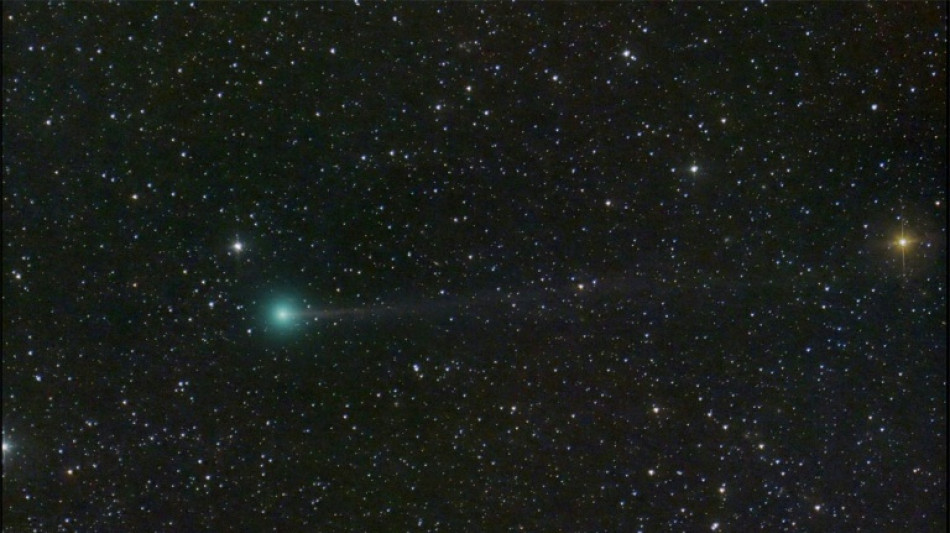
Fireworks forecast if comet survives risky Sun flypast / Photo: Dan Bartlett - NASA/AFP

 Japan to launch historic round-trip mission to Mars moon

 Musk back in the spotlight, but politics dims the awe

 England Rugby League World Cup hopes hang by a thread

 Williams lifts Valkyries past Dream in WNBA Finals opener

 Dubois destroys Wardley to retain WBO heavyweight crown

 Oregon families grapple with explaining school shooting to children

 Israeli settlers attack European diplomats, beat French mayor

 Town hall in Limoges 'largely lost' to blaze set during French protests

 US goes on the offensive in central Asia

 Emotional Lions come up short in Champions Cup as tributes paid to Andrews

 Diaz dazzles as Bayern batter Leipzig to go top

 Inter move clear at Serie A summit with Bologna win

 Liverpool still have 'lots to improve', says match-winner Isak

 Looters ransack shops during France cost-of-living protests

 Leinster thump Clermont as grieving Lions set for Champions Cup debut

 Haaland stars in Man City win, Liverpool beat Brentford

 Dortmund go top despite Union Berlin stalemate
 Venezia upset Napoli for first Serie A win of season

 Glasgow and Bulls win as grieving Lions set for Champions Cup debut

 Smiling pope returns to Vatican after cancer surgery

 In-form Atletico scrape late win at Espanyol

 Rabada returns as S.Africa seek to bounce back against Australia

 Zverev, Medvedev ousted with Spaniards to clash for Shanghai title

 French protesters clash with police during nationwide demonstrations

 Zelensky says Trump could lift more Russia sanctions

A comet is expected to risk having its tail clipped on Friday by flying perilously close to the Sun, promising fireworks next month should it survive the fraught flypast.
Astronomers believe the Tsuchinshan-ATLAS comet has been hurtling headfirst through the void of space towards the centre of the Solar System for millions of years.
Named for the Chinese observatory and South African programme which detected and confirmed its existence in 2023, the ball of rock and ice may have formed at a distance up to 400,000 times that between Earth and the Sun, models suggest.
Up till now, you had to be in the southern hemisphere to hope to see it with the naked eye.
But on Friday evening it is projected to cross as close to the Sun as it will get, before returning towards Earth.
From October 13 the comet will be visible in the northern hemisphere.
If the weather is right "it will jump to the eye" every night "in the direction of the setting sun", astronomer Lucie Maquet at the Paris Observatory told AFP.
- 'A brilliant comet' -
But that forecast assumes the comet does not fly too close to the Sun.
When comets approach our star, the melting ice contained at their core lets out a long trail of dust which reflects sunlight.
This characteristic tail is also the sign the comet is degassing. If the Sun affects the comet too much, it risks disintegrating.
As the cluster of frozen water and rock "may not resist the force of the Sun's gravity", a catastrophe "is always possible", Maquet said.
The good news is that the comet, officially named "C/2023 A3" by scientists, seems to have a rather massive core.
So "there's a good chance it will survive" its sunny pass-by, the astronomer said.
Initial forecasts predicting the comet would be especially bright as it visited our skies have since been revised down.
"But it will certainly be a brilliant comet," Maquet said.
- Unpredictable future -
The comet's future course is unpredictable.
Its solar sojourn will not be without consequences on its voyage, disturbed by the gravitational pull of the celestial objects it has crossed and by the weightloss inflicted by the Sun's harsh rays.
According to the models of The Paris Observatory's Institute of Celestial Mechanics, it could be "ejected from the solar system and lost among the stars".
All depends on the encounters the comet makes on its journey through the Oort cloud -- a frigid belt of tiny objects theorised to exist at the far end of the Solar System up to 3.2 light-years away -- in a few thousand years' time.
It would be enough, Maquet said, for the comet to pass by an object "that deflects it enough for a return trip to the Solar System".
W.Stewart--AT