Nuking a huge asteroid could save Earth, lab experiment suggests / Photo: N. Bartmann - EUROPEAN SPACE AGENCY/AFP/File

 Japan to launch historic round-trip mission to Mars moon

 Musk back in the spotlight, but politics dims the awe

 England Rugby League World Cup hopes hang by a thread

 Williams lifts Valkyries past Dream in WNBA Finals opener

 Dubois destroys Wardley to retain WBO heavyweight crown

 Oregon families grapple with explaining school shooting to children
 Israeli settlers attack European diplomats, beat French mayor

 Town hall in Limoges 'largely lost' to blaze set during French protests

 US goes on the offensive in central Asia

 Emotional Lions come up short in Champions Cup as tributes paid to Andrews

 Diaz dazzles as Bayern batter Leipzig to go top

 Inter move clear at Serie A summit with Bologna win

 Liverpool still have 'lots to improve', says match-winner Isak

 Looters ransack shops during France cost-of-living protests

 Leinster thump Clermont as grieving Lions set for Champions Cup debut

 Haaland stars in Man City win, Liverpool beat Brentford

 Dortmund go top despite Union Berlin stalemate
 Venezia upset Napoli for first Serie A win of season
 Glasgow and Bulls win as grieving Lions set for Champions Cup debut

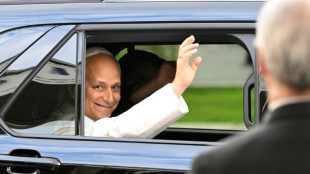 Smiling pope returns to Vatican after cancer surgery

 In-form Atletico scrape late win at Espanyol

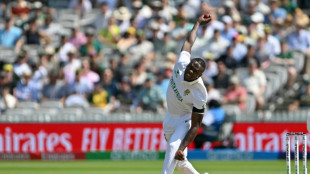 Rabada returns as S.Africa seek to bounce back against Australia

 Zverev, Medvedev ousted with Spaniards to clash for Shanghai title

 French protesters clash with police during nationwide demonstrations
 Zelensky says Trump could lift more Russia sanctions

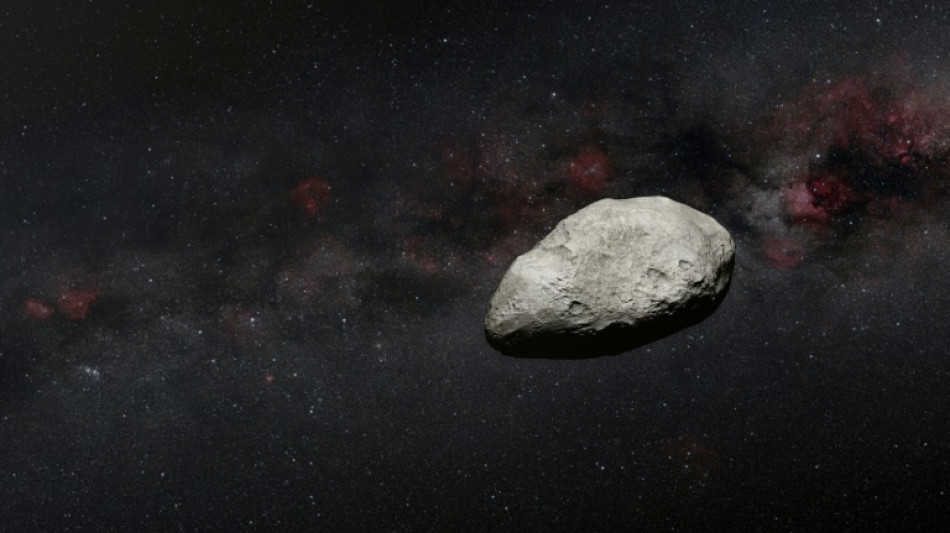
Humanity could use a nuclear bomb to deflect a massive, life-threatening asteroid hurtling towards Earth in the future, according to scientists who tested the theory in the labaratory by blasting X-rays at a marble-sized "mock asteroid".
The biggest real-life test of our planetary defences was carried out in 2022, when NASA's fridge-sized DART spacecraft smashed into a 160-metre (525-feet) wide asteroid, successfully knocking it well off course.
But for bigger asteroids, merely crashing spaceships into them will probably not do the trick.
When the roughly 10-kilometre wide Chicxulub asteroid struck the Yucatan peninsula around 66 million years ago, it is believed to have plunged Earth into darkness, sent kilometres-high tsunamis rippling around the globe and killed three quarters of all life -- including wiping out the dinosaurs.
We humans are hoping to avoid a similar fate.
There is no current threat looming, but scientists have been working on how to stave off any big asteroids that could come our way in the future.
A leading theory has been to be blow them up with a nuclear bomb -- a last-ditch plan famously depicted in the 1998 sci-fi action movie "Armageddon".
In the movie, Bruce Willis and a plucky team of drillers save Earth from an asteroid 1,000 kilometres wide -- roughly the size of Texas.
For a proof-of-concept study published in the journal Nature Physics this week, a team of US scientists worked on a much smaller scale, taking aim at a mock asteroid just 12 millimetres (half an inch) wide.
To test whether the theory would work, they used what was billed as the world's largest X-ray machine at Sandia National Laboratories in Albuquerque, New Mexico.
The machine is capable of generating "the brightest flash of X-rays in the world using 80 trillion watts of electricity", Sandia's Nathan Moore, the lead study author, told AFP.
Much of the energy created by a nuclear explosion is in the form of X-rays. Since there is no air in space, there would be no shockwave or fireball.
But the X-rays still pack a powerful punch.
- Turned into a 'rocket engine' -
For the lab experiment, the X-rays easily vaporised the surface of the mock asteroid.
The vaporising material then propelled the mock asteroid in the opposite direction, so that it effectively "turned into a rocket engine," Moore said.
It reached speeds of 250 kilometres an hour, "about as fast as a high-speed train," he added.
The test marked the first time that predictions about how X-rays would affect an asteroid had been confirmed, Moore said.
"It really proves this concept could work."
The scientists used modelling to scale up their experiment, estimating that X-rays from a nuclear blast could deflect an asteroid up to four kilometres wide -- if given enough advanced notice.
The biggest asteroids are the easiest to detect ahead of time, so "this approach could be quite viable" even for asteroids the size of the dinosaur-killing Chicxulub, Moore said.
The experiment was based on using a one-megaton nuclear weapon. The largest ever detonated was the 50-megaton Soviet Tsar Bomba.
If there was to be a planet-saving mission in the future, the nuclear bomb would need to be placed within a few kilometres of the asteroid -- and millions of kilometres away from Earth, Moore said.
- Asteroids come in many flavours -
Testing out the theory using a real nuke would be dangerous, hugely expensive -- and banned by international treaties.
But there is still plenty to be discovered before such a high-risk test.
The largest uncertainty right now is that asteroids can "come in many flavours", Moore said.
"We have to be prepared for every scenario."
For example, the asteroid hit by DART, Dimorphos, turned out to be a loosely held-together pile of rubble.
The European Space Agency's Hera mission is scheduled to launch next month on a mission to find out more about its composition -- and the finer details about how DART sent it packing.
Mary Burkey, a staff scientist at California's Lawrence Livermore National Laboratory that was not involved in the new study, has run computer simulations about using nukes on asteroids.
She praised the study, saying that "being able to match my calculations to real-life data increases the credibility of my results."
Her simulations have also demonstrated that such a mission "would be a very effective means to defend planet Earth", Burkey told AFP.
"However, in order for it to work, there must be enough time after a mission for the extra push of velocity to move the asteroid's trajectory off Earth."
Y.Baker--AT