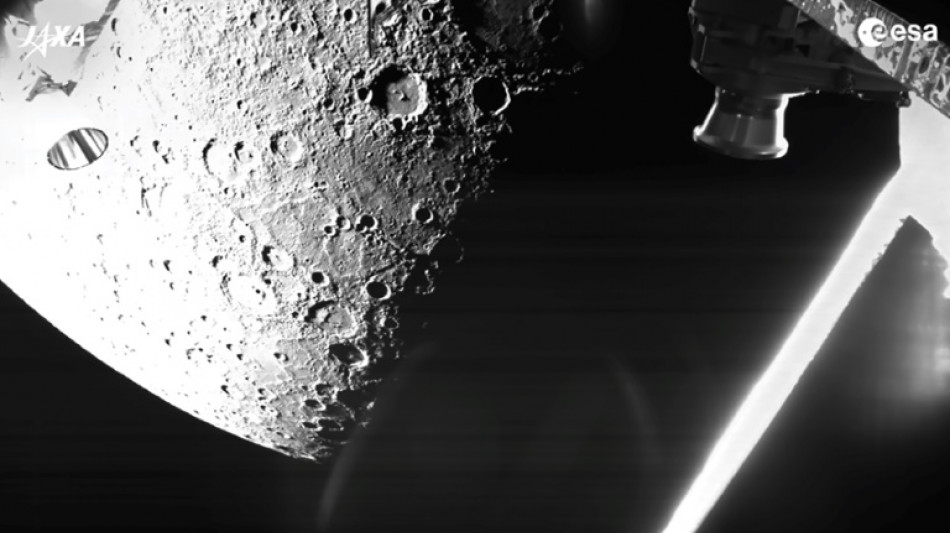
Spacecraft flies closer to Mercury than planned after thruster glitch / Photo: - - EUROPEAN SPACE AGENCY/AFP/File

 Rays defeat Guardians to level MLB playoff series

 Western brands under pressure as 'pre-owned' luxury booms in China

 'Never seen anything like it': mass looting grips Paris

 All Blacks back on track after South Africa wake-up
 Met Opera goes for big and bold, despite shaky finances

 Hollywood's fresh take on tech titans: from heroes to villains

 St. Louis City's unbeaten MLS run ends at 19, Union's reaches 15

 NFL Eagles bench Hurts at least a month with blood clot

 Across US, 'No Kings' events seek to boost early voting

 Tents spring up in Lisbon as Portugal housing protests spread

 'Best in world' Yamal powers Barca to Betis rout, Atletico strike late

 El Salvador's Bukele puts conditions on early release of gang prisoners

 Fire rages at town hall in France's Limoges after protests: authorities

 Unstoppable Barca thrash Betis to extend perfect start

 Maresca faces anxious wait over Haaland injury scare

 PSG fight back to beat Strasbourg after Dembele penalty miss

 Looting, blazes and clashes in France amid nationwide protests

 Walsh breaks her own 50 free world short course record

 Haaland brace extends Man City's winning start in Premier League

 'Special' Ombudsman storms to victory in Champion Stakes

 Brazil's right embraces election betting odds amid polls skepticism

 Four more Ebola cases detected in Kenya, bringing total to seven

 Clashes erupt in France as protesters vow to make government 'tremble'

 Chwalinska downs Swiatek to set up Wuhan final with world number 170 Kartal

 Chacarra takes lead as McIlroy falls away in Delhi

A spacecraft carrying European and Japanese probes passed closer to Mercury than originally planned overnight after thruster problems delayed the mission to study the little-known, Sun-scorched planet.
The BepiColombo mission launched in 2018 on a winding path that had been intended to enter the orbit of the planet closest to the Sun in December 2025.
But in April, a glitch with the spacecraft's thrusters sapped some of its power supply, forcing teams on the ground to change its trajectory and delaying its arrival until November 2026.
The new path meant the spacecraft needed to fly 35 kilometres (22 miles) closer to the planet than initially planned -- passing just 165 kilometres above the surface -- during its latest flyby.
The European Space Agency's operations team confirmed that "all went well" with the flyby overnight, the mission's account on X said on Thursday.
It also posted a new image taken by the probe of the planet, whose pockmarked surface resembles the Moon.
It was the fourth of six planned flybys of Mercury on the mission's nine-billion-kilometre journey before it can finally settle into the planet's orbit.
Most of the time Mercury is closer to Earth than Mars -- but the red planet can be reached by missions from Earth in just seven months.
Mercury is "the most difficult" planet for probes to reach, explained Paris Observatory astronomer Alain Doressoundiram.
The planet's relatively tiny mass -- it is only slightly bigger than the Moon -- means its gravitational pull is extremely weak compared to the Sun, making it tricky for satellites to stay in its orbit.
"It takes much more energy to brake and stop at Mercury than to go to Mars," Doressoundiram told AFP.
This is where delicate manoeuvres called gravitational assists come in. These slingshots around celestial bodies allow spacecraft to speed up, slow down, or change trajectory.
The glitch with the electric thrusters means the spacecraft is now operating with only 90 percent of its planned power supply.
After months spent investigating the problem, the thrusters will "remain operating below the minimum thrust required for an insertion into orbit around Mercury in December 2025," mission manager Santa Martinez said in a statement earlier this week.
The new slower path means BepiColombo is now planned to enter orbit in November 2026.
- Space 'oddities' -
Mercury is by far the least studied of the four rocky, innermost planets in our solar system, which also include Venus, Earth and Mars.
NASA's Mariner 10 was the first probe to capture a close picture of its lunar-looking surface in 1974.
No spacecraft had orbited the planet until the MESSENGER probe arrived in 2011.
The NASA mission confirmed "some rather bizarre things," said Doressoundiram, a specialist on the surfaces of planets.
One of these "oddities" is that Mercury is the only rocky planet other than Earth to have a magnetic field, Doressoundiram said. Exactly how it has such a magnetic field so close to the Sun is not fully understood.
Another "oddity" is that Mercury's iron core composes 60 percent of its mass -- compared to only a third for Earth.
Mercury's surface is also marked by "hollows," which could suggest relatively recent geologic activity.
Also unclear is the composition of minerals on covering the planet's surface, which is blasted with intense radiation from the Sun.
These are just some of the mysteries that the BepiColombo mission hopes to shed light on when it finally orbits Mercury for at least a year and a half.
The spacecraft carries two separate satellites, one from the ESA and another from Japan's JAXA space agency, which have a total of 16 scientific instruments.
A.Clark--AT