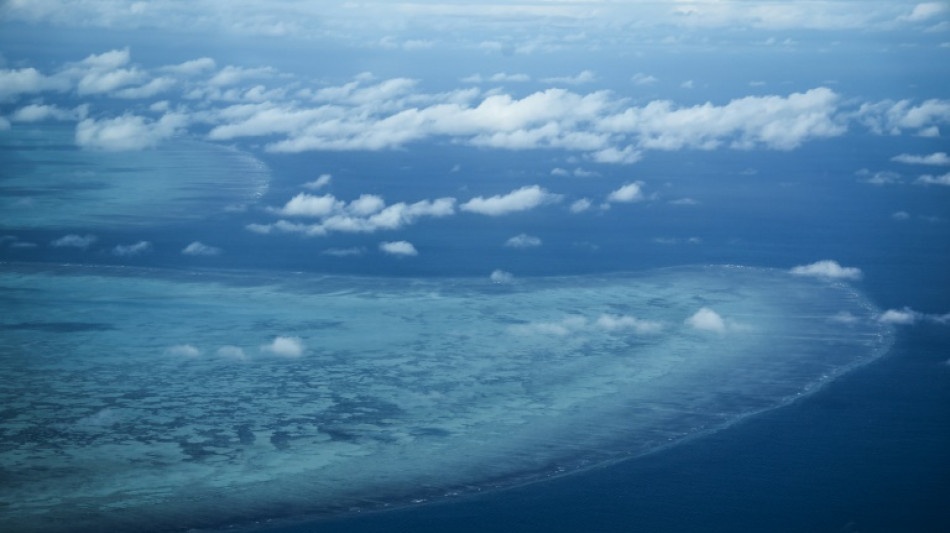
Great Barrier Reef ocean temperatures hit 400-year record: study / Photo: DAVID GRAY - AFP

 Rays defeat Guardians to level MLB playoff series

 Western brands under pressure as 'pre-owned' luxury booms in China
 'Never seen anything like it': mass looting grips Paris

 All Blacks back on track after South Africa wake-up
 Met Opera goes for big and bold, despite shaky finances

 Hollywood's fresh take on tech titans: from heroes to villains

 St. Louis City's unbeaten MLS run ends at 19, Union's reaches 15

 NFL Eagles bench Hurts at least a month with blood clot

 Across US, 'No Kings' events seek to boost early voting

 Tents spring up in Lisbon as Portugal housing protests spread

 'Best in world' Yamal powers Barca to Betis rout, Atletico strike late

 El Salvador's Bukele puts conditions on early release of gang prisoners

 Fire rages at town hall in France's Limoges after protests: authorities

 Unstoppable Barca thrash Betis to extend perfect start

 Maresca faces anxious wait over Haaland injury scare

 PSG fight back to beat Strasbourg after Dembele penalty miss

 Looting, blazes and clashes in France amid nationwide protests

 Walsh breaks her own 50 free world short course record

 Haaland brace extends Man City's winning start in Premier League

 'Special' Ombudsman storms to victory in Champion Stakes

 Brazil's right embraces election betting odds amid polls skepticism

 Four more Ebola cases detected in Kenya, bringing total to seven

 Clashes erupt in France as protesters vow to make government 'tremble'

 Chwalinska downs Swiatek to set up Wuhan final with world number 170 Kartal

 Chacarra takes lead as McIlroy falls away in Delhi

For the past decade, water temperatures along Australia's famed Great Barrier Reef have been the warmest in 400 years, a major study said on Thursday.
Ocean temperatures around the spectacular coral system have increased yearly since 1960 but were particularly hotter during recent mass coral bleaching events, according to a study in the science journal Nature.
The warmer waters are most likely down to human-induced climate change, the report said.
Co-author Helen McGregor said she was "extremely concerned" about the reef, describing the temperature increases as "unprecedented".
"These are corals that have lived for 400 years and this is the warmest temperatures they're experiencing. These are the Redwood trees of the reef," she told AFP.
Often dubbed the world's largest living structure, the Great Barrier Reef is a 2,300-kilometre (1,400-mile) long expanse, home to a stunning array of biodiversity that includes more than 600 types of coral and 1,625 fish species.
But repeated mass bleaching events -- when extreme heat saps the coral of nutrients and colour -- threaten the reef's fragile ecosystem.
Coral bleaching occurs when water temperatures rise more than one degree Celsius (1.8 degrees Fahrenheit).
- 'Changes happening too quickly' -
The Australian researchers examined sea surface temperatures in the Coral Sea –- a 2,000-kilometre (1,200-mile) stretch of ocean that extends down the northeast coast and includes the Great Barrier Reef.
Scientists used coral skeleton samples to reconstruct sea surface temperatures from 1618 to 1995, as well as more recent data.
They found temperatures before 1900 had been relatively stable but the sea had warmed 0.12C (0.2F) on average since 1960 until the present.
Those temperatures were even higher during the past five mass bleaching events in 2016, 2017, 2020, 2022 and 2024, the report found.
McGregor said that although corals could recover, increasing high temperatures and repeated bleaching events were straining that ability.
"These changes -- from what we're seeing so far -- appear to be happening too rapidly for the corals to adapt to so it really threatens the reef as we know it," said McGregor, a climate researcher at the University of Wollongong.
This year's bleaching event has left 81 percent of the reef with extreme or high levels of damage -- one of the most severe and widespread on record, the latest government data shows.
It will take scientists a few more months to determine how much of the reef is beyond recovery.
- 'Existentially threatened' -
Richard Leck, World Wide Fund Australia's head of oceans, said the future of the reef was "increasingly vulnerable".
"At the moment, we can see the reef is resilient. It's bounced back from previous coral bleaching events but at some point that elastic band will snap," he told AFP.
"Coral reefs, as an ecosystem, are the first ecosystem on the planet to be existentially threatened by climate change."
"I think we have to be hopeful that the world is not going to stand by and let that happen. But it is a fraction of a second to midnight," he said.
Governments around the globe are ramping up efforts to help curb greenhouse gases or invest in reef adaptation and mitigation efforts.
Australia has invested about Aus$5 billion ($3.2 billion) in improving water quality, reducing the effects of climate change, and protecting threatened species.
But Australia, one of the world's largest gas and coal exporters, has only recently set targets to become carbon neutral.
P.A.Mendoza--AT