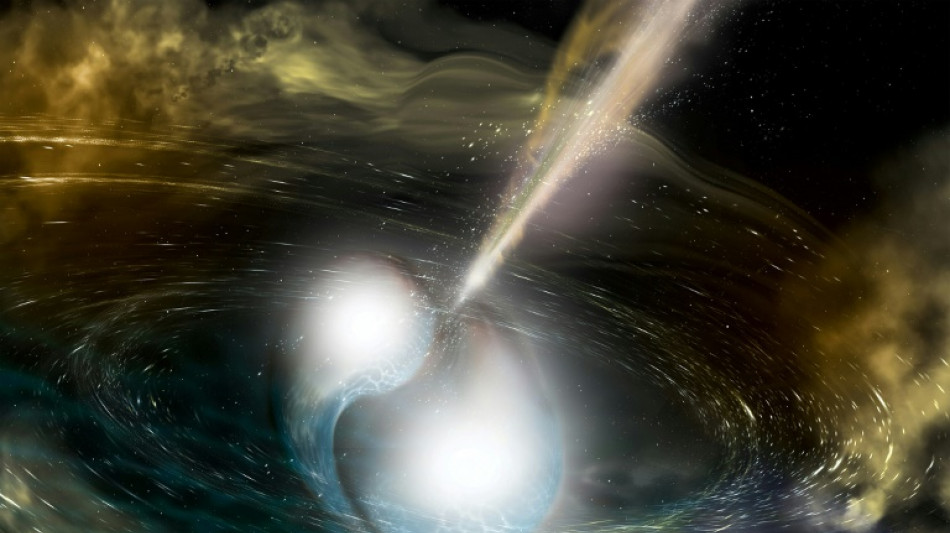
China, France to launch satellite to better understand the universe / Photo: A. Simonnet - National Science Foundation/AFP/File

 Vietnam signs free trade deal with four European nations
 One million migrating raptors dodge illegal hunters above Georgia's Black Sea coast

 Rays defeat Guardians to level MLB playoff series
 Western brands under pressure as 'pre-owned' luxury booms in China
 'Never seen anything like it': mass looting grips Paris

 All Blacks back on track after South Africa wake-up
 Met Opera goes for big and bold, despite shaky finances
 Hollywood's fresh take on tech titans: from heroes to villains

 St. Louis City's unbeaten MLS run ends at 19, Union's reaches 15

 NFL Eagles bench Hurts at least a month with blood clot

 Across US, 'No Kings' events seek to boost early voting

 Tents spring up in Lisbon as Portugal housing protests spread
 'Best in world' Yamal powers Barca to Betis rout, Atletico strike late

 El Salvador's Bukele puts conditions on early release of gang prisoners

 Fire rages at town hall in France's Limoges after protests: authorities

 Unstoppable Barca thrash Betis to extend perfect start

 Maresca faces anxious wait over Haaland injury scare

 PSG fight back to beat Strasbourg after Dembele penalty miss

 Looting, blazes and clashes in France amid nationwide protests

 Walsh breaks her own 50 free world short course record

 Haaland brace extends Man City's winning start in Premier League

 'Special' Ombudsman storms to victory in Champion Stakes

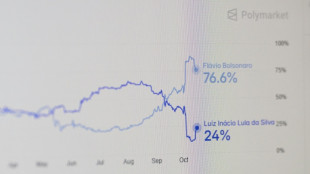 Brazil's right embraces election betting odds amid polls skepticism

 Four more Ebola cases detected in Kenya, bringing total to seven

 Clashes erupt in France as protesters vow to make government 'tremble'
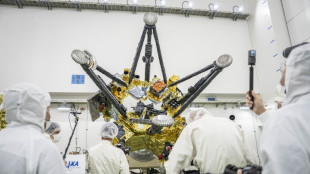
A French-Chinese satellite will blast off Saturday on a hunt for the mightiest explosions in the universe, in a notable example of cooperation between a Western power and the Asian giant.
Developed by engineers from both countries, the Space Variable Objects Monitor (SVOM) will seek out gamma-ray bursts, the light from which has travelled billions of light years to reach Earth.
The 930-kilogram satellite carrying four instruments -- two French, two Chinese -- will lift off aboard a Chinese Long March 2-C rocket from a space base in Xichang, in the southwestern province of Sichuan.
Gamma-ray bursts generally occur after the explosion of huge stars -- those more than 20 times as big as the sun -- or the fusion of compact stars.
The extremely bright cosmic beams can give off a blast of energy equivalent to over a billion billion suns.
Observing them is like "looking back in time, as the light from these objects takes a long time to reach us", Ore Gottlieb, an astrophysicist at the Flatiron Institute's Center for Astrophysics in New York, told AFP.
- 'Several mysteries' -
The rays carry traces of the gas clouds and galaxies they pass through on their journey through space -- valuable data for better understanding the history and evolution of the universe.
"SVOM has the potential to unravel several mysteries in the field of (gamma-ray bursts), including detecting the most distant GRBs in the universe, which correspond to the earliest GRBs," Gottlieb said.
The most distant bursts identified to date were produced just 630 million years after the Big Bang -- five percent of the current age of the universe.
"We are... interested in gamma-ray bursts for their own sake, because they are very extreme cosmic explosions which allow us to better understand the death of certain stars," said Frederic Daigne, an astrophysicist at the Institut d'Astrophysique de Paris.
"All of this data makes it possible to test the laws of physics with phenomena that are impossible to reproduce in the laboratory on Earth."
Once analysed, the data could help to better understand the composition of space, the dynamics of gas clouds or other galaxies.
The project stems from a partnership between the French and Chinese space agencies as well as other scientific and technical groups from both nations.
Space cooperation at this level between the West and China is fairly uncommon, especially since the United States banned all collaboration between NASA and Beijing in 2011.
- Race against time -
"US concerns on technology transfer have inhibited US allies from collaborating with the Chinese very much, but it does happen occasionally," said Jonathan McDowell, an astronomer at the Harvard-Smithsonian Center for Astrophysics in the United States.
In 2018, China and France jointly launched CFOSAT, an oceanographic satellite mainly used in marine meteorology.
And several European countries have taken part in China's Chang'e lunar exploration programme.
So while SVOM is "by no means unique", it remains "significant" in the context of space collaboration between China and the West, said McDowell.
Once in orbit 625 kilometres (388 miles) above the Earth, the satellite will send its data back to observatories.
The main challenge is that gamma-ray bursts are extremely brief, leaving scientists in a race against time to gather information.
Once it detects a burst, SVOM will send an alert to a team on duty around the clock.
Within five minutes, they will have to rev up a network of telescopes on the ground that will align precisely with the axis of the burst's source to make more detailed observations.
A.Ruiz--AT