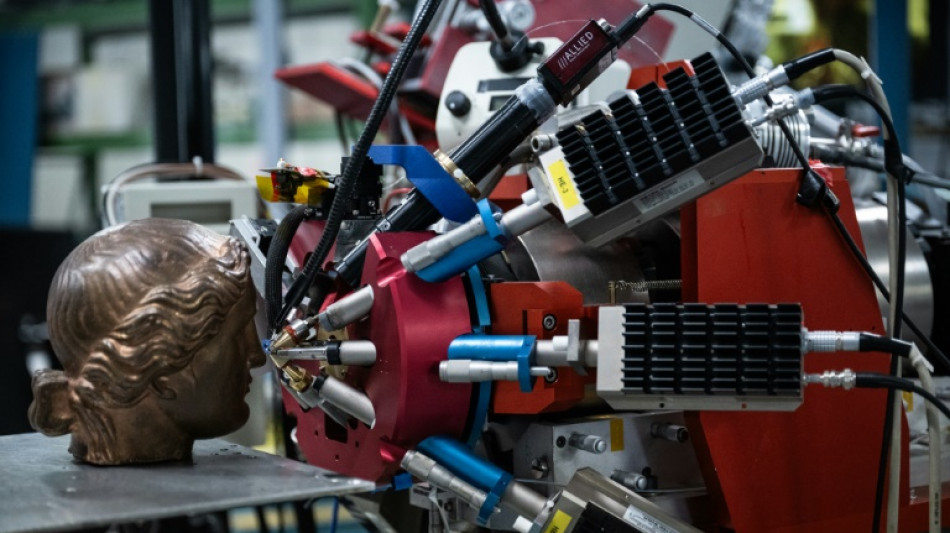
The high-tech art lab hidden underneath Paris / Photo: JULIEN DE ROSA - AFP

 Vietnam signs free trade deal with four European nations

 One million migrating raptors dodge illegal hunters above Georgia's Black Sea coast

 Rays defeat Guardians to level MLB playoff series

 Western brands under pressure as 'pre-owned' luxury booms in China
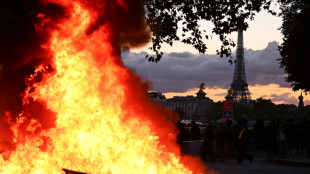 'Never seen anything like it': mass looting grips Paris

 All Blacks back on track after South Africa wake-up
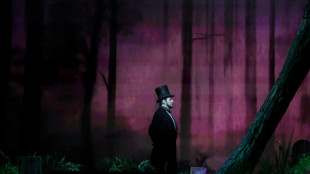 Met Opera goes for big and bold, despite shaky finances

 Hollywood's fresh take on tech titans: from heroes to villains
 St. Louis City's unbeaten MLS run ends at 19, Union's reaches 15

 NFL Eagles bench Hurts at least a month with blood clot

 Across US, 'No Kings' events seek to boost early voting

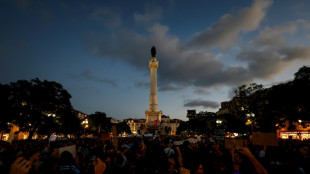 Tents spring up in Lisbon as Portugal housing protests spread

 'Best in world' Yamal powers Barca to Betis rout, Atletico strike late

 El Salvador's Bukele puts conditions on early release of gang prisoners

 Fire rages at town hall in France's Limoges after protests: authorities

 Unstoppable Barca thrash Betis to extend perfect start

 Maresca faces anxious wait over Haaland injury scare

 PSG fight back to beat Strasbourg after Dembele penalty miss

 Looting, blazes and clashes in France amid nationwide protests
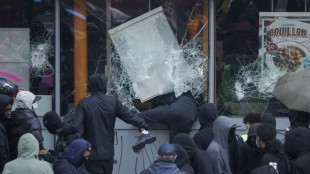
 Walsh breaks her own 50 free world short course record

 Haaland brace extends Man City's winning start in Premier League

 'Special' Ombudsman storms to victory in Champion Stakes

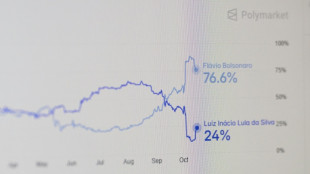 Brazil's right embraces election betting odds amid polls skepticism
 Four more Ebola cases detected in Kenya, bringing total to seven
 Clashes erupt in France as protesters vow to make government 'tremble'

It looks like the lair of a Bond villain: behind armoured doors, buried underground below the Louvre in Paris, lies one of the most high-tech art labs in the world.
Across three floors and nearly 6,000 square metres, the Centre for Research and Restoration of Museums of France (C2RMF) includes its own particle accelerator called AGLAE, and is bustling with radiologists, chemists, geologists, metallurgists, archaeologists and engineers.
The 150-strong team examines around 1,000 artworks per year, discovering precisely which materials and methods went into making them, their origin and age, and how the years have altered them.
Their analyses inform restoration teams within the centre, at the Louvre, Versailles and beyond.
Many great artworks have passed through the lab since its creation in 1999, including the Mona Lisa, the stained-glass windows of Notre-Dame Cathedral or Napoleon's sabre.
- Like 'CSI' -
When AFP was granted a rare visit recently, an 11th century bronze sculpture of the Hindu god Vishnu had recently arrived from Cambodia ahead of exhibitions in France and the United States next year.
A masterpiece of Khmer art, the "Vishnu of Western Mebon" was found at Angkor Wat in 1936, a rare reclining depiction of the Hindu god that would have measured some six metres when it was complete.
Behind thick, lead doors, a team of 10 specialists was carrying out X-rays and 3D scanning on the statue.
Certain parts would then be tested with techniques such as X-ray fluorescence and spectrometry that bombard it with gamma rays and electrons to discover its detailed chemical and molecular composition.
"We're a bit like NASA, each with our own skills, or 'CSI: Miami', the scientific police," said team leader David Bourgarit, an archaeo-metallurgical research engineer.
"Our crime scenes are archaeological discoveries. We try to understand who made them, how and why, like a police investigation," he added.
He pointed to little white dots around the eyebrows of the statue that he said were said were another metal, "denser than copper", which will require further analysis to identify.
The team also wants to identity the clay used to make the initial mould for the statue, traces of which are still inside.
That should allow them to pinpoint exactly where it was made by comparing to earth samples.
Some fragments may also pass through AGLAE (the French acronym for the Grand Louvre Accelerator of Elemental Analysis), installed in the 1990s and the only one in the world to work exclusively on artworks.
In a room packed with machinery, the straight-line accelerator gives off a powerful roar as it creates and blasts particles at artworks and artefacts.
It allows the scientists to ascertain the amounts and combinations of elements in the objects, adding another layer of analysis for dating and verifying their authenticity.
M.O.Allen--AT