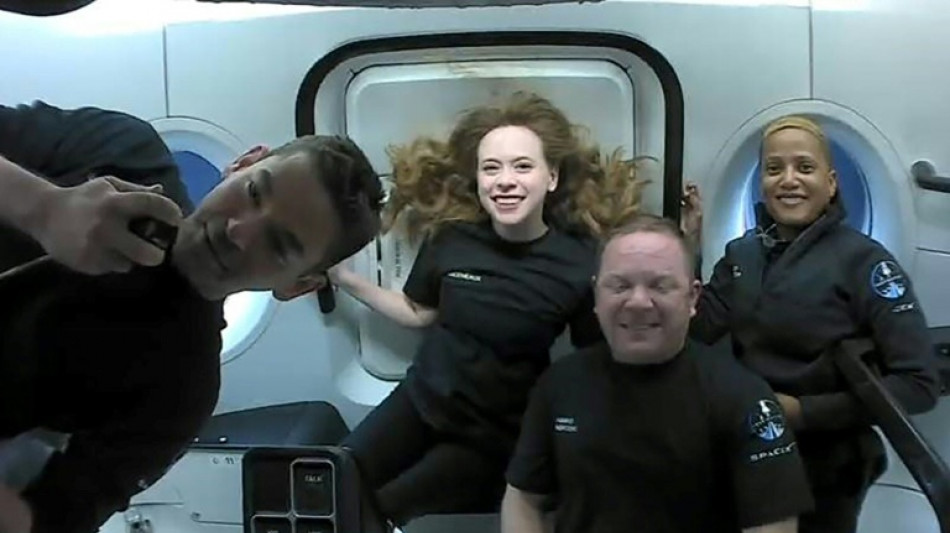
Human bodies mostly recover from space, tourist mission shows / Photo: Handout - Inspiration4/AFP/File

 Vietnam signs free trade deal with four European nations

 One million migrating raptors dodge illegal hunters above Georgia's Black Sea coast

 Rays defeat Guardians to level MLB playoff series

 Western brands under pressure as 'pre-owned' luxury booms in China
 'Never seen anything like it': mass looting grips Paris

 All Blacks back on track after South Africa wake-up
 Met Opera goes for big and bold, despite shaky finances

 Hollywood's fresh take on tech titans: from heroes to villains

 St. Louis City's unbeaten MLS run ends at 19, Union's reaches 15

 NFL Eagles bench Hurts at least a month with blood clot

 Across US, 'No Kings' events seek to boost early voting

 Tents spring up in Lisbon as Portugal housing protests spread

 'Best in world' Yamal powers Barca to Betis rout, Atletico strike late

 El Salvador's Bukele puts conditions on early release of gang prisoners

 Fire rages at town hall in France's Limoges after protests: authorities

 Unstoppable Barca thrash Betis to extend perfect start

 Maresca faces anxious wait over Haaland injury scare

 PSG fight back to beat Strasbourg after Dembele penalty miss

 Looting, blazes and clashes in France amid nationwide protests

 Walsh breaks her own 50 free world short course record

 Haaland brace extends Man City's winning start in Premier League

 'Special' Ombudsman storms to victory in Champion Stakes

 Brazil's right embraces election betting odds amid polls skepticism

 Four more Ebola cases detected in Kenya, bringing total to seven

 Clashes erupt in France as protesters vow to make government 'tremble'

How bad for your health is space travel? Answering this question will be crucial not just for astronauts aiming to go to Mars, but for a booming space tourism industry planning to blast anyone who can afford it into orbit.
In what was been billed as the most comprehensive look yet at the health effects of space, dozens of papers were published on Tuesday using new data from four SpaceX tourists onboard the first all-civilian orbital flight in 2021.
Researchers from more than 100 institutions across the world sifted through the data to demonstrate that human bodies change in a variety of ways once they reach space -- but most go back to normal within months of returning to Earth.
Our bodies are put under a huge amount of stress while in space, from being blasted with radiation to the disorientating effect of weightlessness.
By studying astronauts, researchers have known for decades that space flight can cause health issues such as loss of bone mass, as well as heart, eyesight and kidney problems.
Fewer than 700 people have ever travelled into space, meaning that the sample size is small -- and governments can be reticent when it comes to sharing all their findings.
However the four American tourists who spent three days in space during the Inspiration4 mission were happy to see their data made public.
The early results, which were compared to 64 other astronauts, were published in Nature journals on Tuesday.
When people are in space, they undergo changes to their blood, heart, skin, proteins, kidneys, genes, mitochondria, telomeres, cytokines and other health indicators, the researchers found.
But around 95 percent of their health markers returned to their previous level within three months.
- 'I love my space scar' -
The "big take-home" message is that people mostly make a rapid recovery after space flight, said one of the main study authors, Christopher Mason from Weill Cornell Medicine.
Mason told journalists he hoped the "most in-depth examination we've ever had of a crew" would help scientists understand what drugs or measures will be needed in the future to help protect people blasting off to space.
The Inspiration4 mission, financed by its billionaire captain Jared Isaacman, had the stated goal of demonstrating that space is accessible to people who have not spent years training for the feat.
To do so, the four civilian astronauts received a huge number of medical tests.
"I love my space scar," nurse Hayley Arceneaux said of the lingering mark from a skin biopsy. She was just 29 when she went into space.
One study found that the telomeres -- caps similar to those on shoelaces which protect the ends of chromosomes from fraying -- of all four subjects dramatically lengthened when they arrived in space.
But their telomeres all shrunk back to near their original length within months of them returning to Earth.
Because telomeres also lengthen as people age, finding a way to address this problem could help "us mere Earthlings" in the never-ending fight against ageing, said Colorado State University's Susan Bailey.
It even could lead to anti-ageing products such as "telomerase-infused face cream", the study author speculated.
- Safe mission to Mars? -
Looking at the data so far, "there's no reason we shouldn't be able to safely get to Mars and back," Mason said.
"You probably wouldn't take multiple trips because it's a lot of radiation," he added.
One of the studies found that mice exposed to radiation equivalent to 2.5 years in space suffered permanent kidney damage.
"If we don't develop new ways to protect the kidneys, I'd say that while an astronaut could make it to Mars they might need dialysis on the way back," lead study author Keith Siew of the London Tubular Centre said in a statement.
But Mason emphasised that the research was "really mostly good news".
"I think it bodes well for people who think: maybe I'll go to space in six months," he said.
While there was not enough data to say anything definitive, female astronauts seemed to be more tolerant of the stress of spaceflight, he added.
"It may be driven just by the fact that women have to give child birth," meaning their bodies are more used to major changes, Mason said.
E.Flores--AT