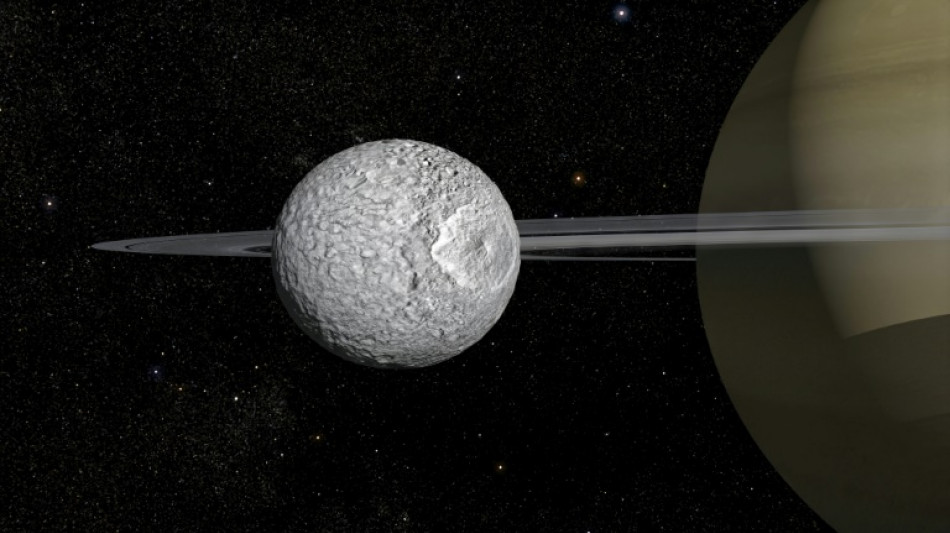
Life on 'Death Star'? Saturn moon Mimas has hidden ocean / Photo: Frederic Durillon - Animea Studio | Observatoire de Paris - PSL, IMCCE/AFP

 Dozens of orangutans saved from Indonesia blazes as region grapples with haze

 Pope addresses crowd in Vatican after cancer surgery

 Russia-US diesel deal delivery to take 15-20 days: Russia

 China's Yin wins in Shanghai for back-to-back LPGA titles
 After a year in turmoil, the Louvre faces uncertain future

 Dozens of orangutans saved from Indonesia blazes

 Ordinary day, extraordinary times: Kyiv under Russian attack

 What is holding up the US-India trade deal?

 Oxygen tanks, purifier sales spike as haze crisis hits Southeast Asia

 Messi brace lifts Inter Miami to 3-1 win in Atlanta

 Japan to launch historic round-trip mission to Mars moon

 Musk back in the spotlight, but politics dims the awe

 England Rugby League World Cup hopes hang by a thread

 Williams lifts Valkyries past Dream in WNBA Finals opener

 Dubois destroys Wardley to retain WBO heavyweight crown

 Oregon families grapple with explaining school shooting to children

 Israeli settlers attack European diplomats, beat French mayor

 Town hall in Limoges 'largely lost' to blaze set during French protests

 US goes on the offensive in central Asia

 Emotional Lions come up short in Champions Cup as tributes paid to Andrews

 Diaz dazzles as Bayern batter Leipzig to go top

 Inter move clear at Serie A summit with Bologna win

 Liverpool still have 'lots to improve', says match-winner Isak

 Looters ransack shops during France cost-of-living protests

 Leinster thump Clermont as grieving Lions set for Champions Cup debut

Saturn's small moon Mimas seems an unlikely suspect in the hunt for life in Earth's backyard -- it is probably best known for looking like the "Death Star" in the Star Wars films.
But scientists said on Wednesday that underneath the unassuming moon's icy shell is a vast hidden ocean that has many of the ingredients necessary to host primitive alien life.
Mimas is the latest to join a growing family of icy moons thought to harbour inner oceans in our Solar System which also includes fellow Saturn satellites Enceladus and Titan as well as Jupiter's Europa and Ganymede.
But the inclusion of Mimas in this list has come as a surprise.
"If there is one place in the universe where we did not expect to find conditions favourable to life, it is Mimas," said Paris Observatory astronomer Valery Lainey, the lead author of a new study in the journal Nature.
Mimas, which is only 400 kilometres (250 miles) in diameter, was "not at all suitable for the job", Lainey told a press conference.
Discovered by English astronomer William Herschel in 1789, the moon has the nickname "Death Star" because one particularly huge crater makes it look eerily similar to the space station used by Darth Vader and the villainous Empire in Star Wars.
Its craggy, crater-riddled surface is inert, showing no sign of underlying geologic activity that would suggest a hidden ocean.
- 'Something happening inside' -
Other water worlds such as Mimas' big sibling Enceladus have smooth surfaces due to their rumbling internal oceans and many geysers.
These geysers, which shoot out material from the surface, also demonstrate that there is enough heat below to keep the water in a liquid state.
Despite its seemingly desolate exterior, Lainey said the researchers suspected that "something was happening inside" Mimas.
They studied how the moon's rotation is affected by its interior structure, first publishing research in 2014 which was not strong enough to prove the presence of a hidden ocean.
Most scientists remained convinced by the other main hypothesis: that Mimas has a solid core of rock.
"We could have left it there," Lainey said, adding that they were "frustrated".
For the new study, the team carefully analysed the moon's rotation and orbit in dozens of images taken by NASA's Cassini spacecraft, which orbited Saturn from 2004 to 2017.
They detected tiny oscillations -- rotations of just a few hundred metres -- which could not have occurred if the moon had a solid rock interior.
"The only viable conclusion is that Mimas has a subsurface ocean," said two US-based scientists not involved in the study.
"The finding calls for a fresh take on what constitutes an ocean moon," Matija Cuk of the Search for Extraterrestrial Intelligence (SETI) and planetary scientist Alyssa Rose Rhoden wrote in a comment article in Nature.
- The right stuff for life -
Mimas' ice-covered shell is between 20 and 30 kilometres thick, similar to Enceladus, the study estimated.
The researchers believe the ocean formed relatively recently -- between five to 15 million years ago -- which could explain why signs of its existence have yet to rise and smooth the moon's surface.
The ocean likely exists due to the influence of Saturn's many other moons, whose tidal effects shook Mimas and created the necessary heat, they said.
Mimas "brings together all the conditions necessary for habitability: water maintained by a heat source that is in contact with rocks so that chemical exchanges develop," said study co-author Nicolas Rambaux, also of the Paris Observatory.
So could this nearby water world harbour primitive forms of life such as bacteria?
"That question will be addressed by future space missions over the coming decades," Lainey said.
"One thing is certain: if you are looking for the most recent conditions of habitability to have formed in the Solar System, Mimas is the place to look."
A.Clark--AT