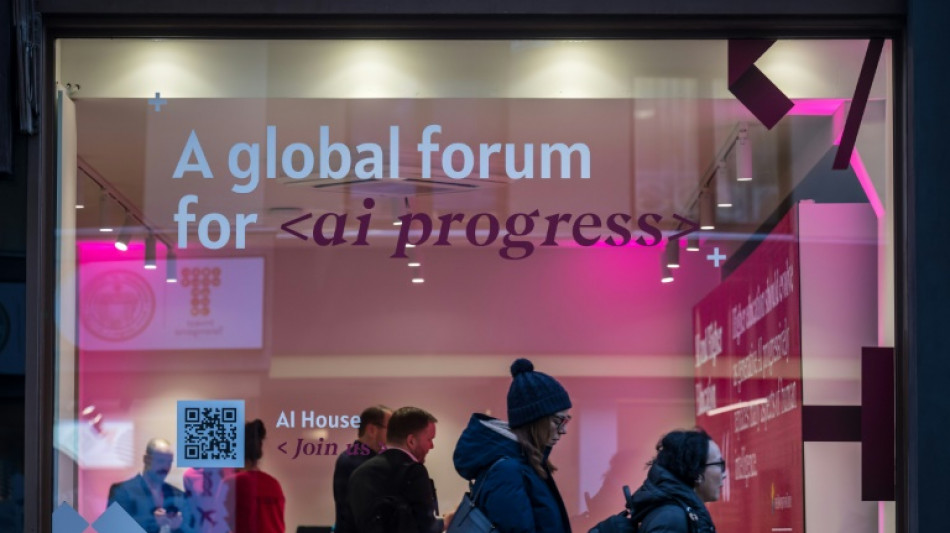
In Davos, AI excitement persists but fears over managing risks / Photo: Fabrice COFFRINI - AFP

 Kremlin says Ukrainian attacks won't change war aims as Kyiv hits Saint Petersburg

 Martinez starts for Man Utd after outburst
 Alberta separatists rally ahead of independence vote
 Diesel shortage raises petroleum share of India’s exports to three-year high

 France assesses protest damage after 1,800 arrests

 Gord launches four AI tools for sustainability and emissions management

 Doha 2036 bid sets out sport-led social legacy

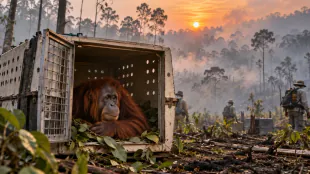 Conservation teams rescue orangutans from Indonesian wildfires

 Truck ploughs into Hindu festival crowd in India, killing 13

 Kuwait announces maintenance closures in Nuzha, Surra and Rai

 Moody’s lifts OYO parent Prism outlook to positive before planned IPO

 RCom professional asks Supreme Court to revisit spectrum insolvency ruling

 Debt recovery lessons after derivatives losses and repeated borrowing

 Katie Alexander reportedly leaves flat shared with Eamonn Holmes

 Body found in search for missing Glasgow teenager

 Andi King recounts late-life transition after decades behind an “alpha male” identity

 Bromsgrove Repair Cafe reports nearly 80% repair success rate

 B.C. Lions focus on playoff momentum after Calgary defeat

 Tata Trusts plans network of 40 to 50 not-for-profit hospitals

 Bajaj Finance set to report second-quarter results on October 19

 Messi reaches 936 career goals after Inter Miami brace

 Indian petrol and diesel prices remain unchanged on October 18

 Australia elect to bowl against South Africa in second Test

 Dozens of orangutans saved from Indonesia blazes as region grapples with haze

 Pope addresses crowd in Vatican after cancer surgery

Walking around in Davos where the global elites gathered for the World Economic Forum this week, there were two inescapable words on the windows: artificial intelligence.
If 2023 was the year everyone including investors and politicians were feverishly excited about AI, 2024 looks set to be a more sober year where people try to tackle how the world benefits from AI while mitigating its risks.
AI was the buzzword on everyone's lips at the World Economic Forum, when they weren't talking about a possible return of former US president Donald Trump.
The world's biggest tech companies including Google, Meta and Microsoft were out in force, with their most senior executives in town for panels but also unofficial chats with businesses and politicians from around the world.
The hype over AI reached fever pitch last year after ChatGPT burst onto the scene in late 2022, demonstrating the rapid developments of the technology.
The chatbot could pour out expressive poems and essays in seconds, and even pass medical and legal exams.
ChatGPT also focused minds on AI regulation to protect individuals from its dangers and harness innovation, with politicians in China, the European Union and the United States passing or working on legislation last year.
UN Secretary General Antonio Guterres said on Wednesday climate and AI had been "exhaustively discussed" by governments, media and leaders at Davos.
"And yet, we have not yet an effective global strategy to deal with either," he said.
China's Premier Li Qiang called for global cooperation on the issue while Guterres told reporters that President Xi Jinping told him he wanted the UN to be at the centre of efforts on AI governance.
Guterres last year set up a panel on AI that delivered a draft report in December, with recommendations on five guiding principles for AI including inclusivity.
- Microsoft president 'optimist' -
The cautious tone had already been set before Davos began on Monday after the International Monetary Fund (IMF) published a report with sobering statistics.
The IMF said AI would affect nearly 40 percent of jobs around the world, and some 60 percent in the advanced world -- replacing some jobs while complementing others.
With people attending from all over the world including China, India, Saudi Arabia, South Africa, there was also focus on what AI will mean for the Global South.
The UN's panel of experts includes Marietje Schaake, international policy director at Stanford University Cyber Policy Center.
The UN has a "unique role with its global legitimacy", she said, "to correct the wrong, if you want to think about it that way, of not having included people, their contexts, their lived experiences, their needs from the global south".
Microsoft President Brad Smith told AFP he was already an "optimist" before Davos about the world working together better on AI. "Nothing has changed," he said.
"What Davos enables is lots of conversations with people who are not always in the same room, and you take stock of where things are, you find out where people have values in common, and you find where you have challenges that you need to address," he said Wednesday.
Sapthagiri Chapalapalli, head of Tata Consultancy Services Europe, said the "overwhelming majority" of people he spoke to at Davos "feel that (AI) has immense potential".
He described how he fielded different questions from participants including how to use AI to improve productivity.
Another question that came up, Chapalapalli said, was: "'How do we do AI in a more responsible manner?'"
The EU believes its comprehensive law to regulate AI is one of the answers to managing the technology's risks.
- Disinformation fears -
There is already a big test for regulators and companies as billions worldwide prepare to vote in polls in Europe, India, Mexico and the United States.
At Davos, the dangers posed by AI for those elections were on the agenda.
Senior EU official Vera Jourova said she pressed big tech executives on what they were doing to prepare for the elections.
Jourova also said Brussels' efforts on its "AI Act" were welcomed.
"What I hear very often from American companies is that the European way of regulating things ahead mitigates risks ex ante, that it creates a bigger legal certainty than in the United States," she told journalists.
ChatGPT creator OpenAI's CEO, Sam Altman, acknowledged the concerns over AI's impact on elections this year but insisted his company was "focused" on the issue.
S.Jackson--AT