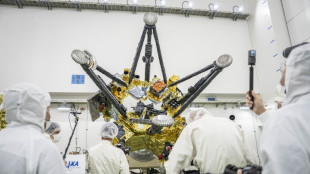
Doomed US lunar lander's space odyssey continues...for now / Photo: - - Astrobotic/AFP/File

 Kremlin says Ukrainian attacks won't change war aims as Kyiv hits Saint Petersburg

 Martinez starts for Man Utd after outburst

 Alberta separatists rally ahead of independence vote

 Diesel shortage raises petroleum share of India’s exports to three-year high

 France assesses protest damage after 1,800 arrests

 Gord launches four AI tools for sustainability and emissions management

 Doha 2036 bid sets out sport-led social legacy

 Conservation teams rescue orangutans from Indonesian wildfires

 Truck ploughs into Hindu festival crowd in India, killing 13

 Kuwait announces maintenance closures in Nuzha, Surra and Rai

 Moody’s lifts OYO parent Prism outlook to positive before planned IPO

 RCom professional asks Supreme Court to revisit spectrum insolvency ruling

 Debt recovery lessons after derivatives losses and repeated borrowing

 Katie Alexander reportedly leaves flat shared with Eamonn Holmes

 Body found in search for missing Glasgow teenager

 Andi King recounts late-life transition after decades behind an “alpha male” identity

 Bromsgrove Repair Cafe reports nearly 80% repair success rate

 B.C. Lions focus on playoff momentum after Calgary defeat

 Tata Trusts plans network of 40 to 50 not-for-profit hospitals

 Bajaj Finance set to report second-quarter results on October 19

 Messi reaches 936 career goals after Inter Miami brace

 Indian petrol and diesel prices remain unchanged on October 18

 Australia elect to bowl against South Africa in second Test

 Dozens of orangutans saved from Indonesia blazes as region grapples with haze

 Pope addresses crowd in Vatican after cancer surgery

Is it the little spaceship that could?
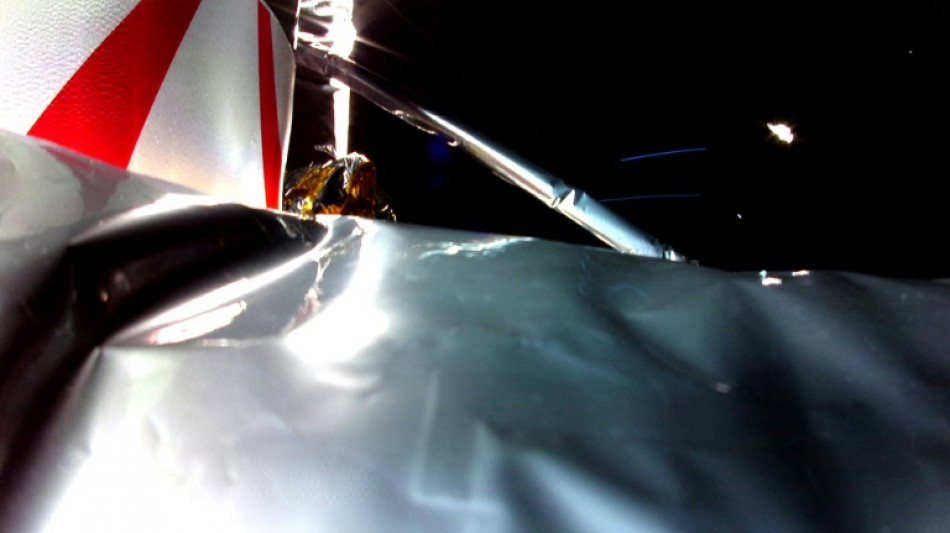
A private US lunar lander that's been hemorrhaging fuel since an onboard explosion at the start of its journey is somehow still chugging along, snapping selfies and running science instruments as it continues its journey through space.
Though Astrobotic, the company that built the Peregrine robot, has said a controlled touchdown on the Moon is no longer possible, it hasn't ruled out a so-called "hard landing" or crash -- a prospect that has space watchers gripped.
"Peregrine has now been operating in space for more than 4 days," Astrobotic said in its latest update posted on X on Friday, adding it remained "stable and operational."
The rate of fuel loss has steadily diminished as the pressure inside its tank drops, meaning the company has been able to extend the spacecraft's life far longer than it initially thought possible.
Meanwhile, the US, German and Mexican space agencies have been able to power on the scientific instruments they wanted to run on the Moon.
"Measurements and operations of the NASA-provided science instruments on board will provide valuable experience, technical knowledge, and scientific data to future CLPS lunar deliveries," said Joel Kearns, deputy associate administrator for exploration for NASA.
Commercial Lunar Payload Services is the experimental NASA program under which the space agency paid Astrobotic more than $100 million to ship its hardware of Peregrine, as part of a strategy to seed a commercial lunar economy and reduce its own overheads.
Astrobotic is the third private entity to have failed in a soft landing, following an Israeli nonprofit and a Japanese company.
- 'Shots on goal' -
Though it hasn't worked out this time, NASA officials have made clear their strategy of "more shots on goal" means more chances to score, and the next attempt, by Houston-based Intuitive Machines, launches in February.
Astrobotic itself will get another chance in November with its Griffin lander transporting NASA's VIPER rover to the lunar south pole.
For now, the Pittsburgh-based company is staying tight-lipped on Peregrine's intended destination, leaving enthusiasts to make their own calculations.
Amateur astronomer Tony Dunn used publicly available data provided by NASA's Jet Propulsion Laboratory (JPL) to plot out the spaceship's current course, posting a graphic on social media platform X showing it would collide with the Moon on January 23.
But "it's really anybody's guess as to what is actually going to happen because of the leaking fuel," which could easily push it off course, he told AFP.
Or, Astrobotic could intentionally point Peregrine another way, such as flying by the Moon and shooting for interplanetary space.
While a hard lunar landing might satisfy some of Astrobotic's clients, such as those flying human ashes and DNA to the Moon, it could anger others like the Navajo Nation, which had called that cargo a "desecration" of the celestial body.
"I think it would be a shame if they completed their failed mission by littering the surface of the Moon with debris," Justin Walsh, a professor of art history, archaeology, and space studies at USC told AFP, adding that humanity had left some 180 tons of material on the surface since the first Soviet impactor crashed in 1959.
T.Perez--AT