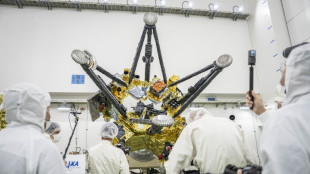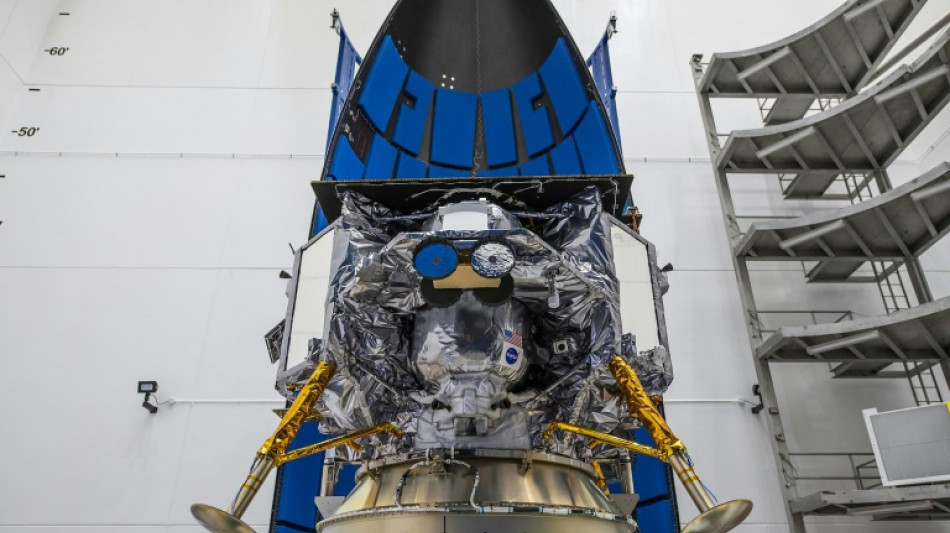
New US lunar lander runs into technical problem: company / Photo: - - NASA/AFP/File

 Boland strikes twice for Australia in rain-hit South Africa Test

 Marseille put Angers to the sword in Ligue 1

 Albanian PM refuses to quit as violent protests enter sixth day

 Chwalinska fights back to win Wuhan Open in title breakthrough

 Kulusevski on brink of return for Spurs after 17-month absence

 Ukraine sets Saint Petersburg refinery ablaze in large-scale drone attack

 Spain's in-form Chacarra wins DP World India Championship

 Two pilots die in Saudi coalition helicopter crash near Yemen border

 Riyadh skyscraper shifts tenants online as Houthi attacks intensify

 Messi scores twice as Inter Miami defeat Atlanta United 3-1

 Qatar and Norway review bilateral ties at Oslo consultations

 Vietnam and EFTA states sign free-trade agreement in Hanoi

 Gold closes week near $4,165 as US inflation outlook pressures market

 PSG rally past Strasbourg to take Ligue 1 lead

 India’s services surplus narrows as import growth overtakes exports

 RCom professional asks Supreme Court to revisit spectrum insolvency ruling

 Debt recovery lessons after derivatives losses and repeated borrowing

 Katie Alexander reportedly leaves flat shared with Eamonn Holmes

 Body found in search for missing Glasgow teenager

 Andi King recounts late-life transition after decades behind an “alpha male” identity

 Bromsgrove Repair Cafe reports nearly 80% repair success rate

 B.C. Lions focus on playoff momentum after Calgary defeat

 PNB expects festive demand to add up to two points to quarterly credit growth

 Cyient DLM drops 12% as margin concerns overshadow quarterly growth

 Arizona quarterback says audible led to dismissal and teammates’ suspensions

The first US lunar lander launched in more than five decades has experienced an anomaly preventing it from pointing its solar panels towards the Sun, the company that built the robot said Monday.
Astrobotic's Peregrine lunar lander separated successfully from United Launch Alliance's new Vulcan rocket overnight from the Cape Canaveral Space Force Base, and quickly established communications with NASA's Deep Space Network of ground-based radio antennas.
All its systems powered on as expected, and it "entered a fully operational state," Astrobotic said in a tweet.
But "unfortunately, an anomaly occurred which prevented Astrobotic from achieving a stable sun-pointing orientation.
"The team is responding in real time as the situation unfolds and will be providing updates as data is obtained and analyzed."
The lander's documentation, available online, says that while in orbit, Peregrine's top mounted solar panel stays pointed at the Sun to enable maximum power generation.
"The solar panel is utilized to provide battery charge and maintain lander and payload operations. After descent to the lunar surface the power system continues to provide reliable power services to payloads through the end of mission," it says.
Peregrine is on its way to the Moon and is supposed to hold its orbit before finally landing on a mid-latitude region called Sinus Viscositatis, or Bay of Stickiness, on February 23.
Until now, a soft landing on Earth's nearest celestial neighbor has only been accomplished by a handful of nations. But the United States and others are increasingly turning to the commercial sector to carry out routine missions and ship hardware at a fraction of the cost.
O.Brown--AT