First US lunar lander in five decades blasts off on private mission / Photo: CHANDAN KHANNA - AFP

 Boland strikes twice for Australia in rain-hit South Africa Test

 Marseille put Angers to the sword in Ligue 1

 Albanian PM refuses to quit as violent protests enter sixth day

 Chwalinska fights back to win Wuhan Open in title breakthrough

 Kulusevski on brink of return for Spurs after 17-month absence

 Ukraine sets Saint Petersburg refinery ablaze in large-scale drone attack

 Spain's in-form Chacarra wins DP World India Championship

 Two pilots die in Saudi coalition helicopter crash near Yemen border

 Riyadh skyscraper shifts tenants online as Houthi attacks intensify

 Messi scores twice as Inter Miami defeat Atlanta United 3-1

 Qatar and Norway review bilateral ties at Oslo consultations

 Vietnam and EFTA states sign free-trade agreement in Hanoi

 Gold closes week near $4,165 as US inflation outlook pressures market

 PSG rally past Strasbourg to take Ligue 1 lead

 India’s services surplus narrows as import growth overtakes exports

 RCom professional asks Supreme Court to revisit spectrum insolvency ruling

 Debt recovery lessons after derivatives losses and repeated borrowing

 Katie Alexander reportedly leaves flat shared with Eamonn Holmes

 Body found in search for missing Glasgow teenager

 Andi King recounts late-life transition after decades behind an “alpha male” identity

 Bromsgrove Repair Cafe reports nearly 80% repair success rate

 B.C. Lions focus on playoff momentum after Calgary defeat

 PNB expects festive demand to add up to two points to quarterly credit growth

 Cyient DLM drops 12% as margin concerns overshadow quarterly growth

 Arizona quarterback says audible led to dismissal and teammates’ suspensions

The first American spacecraft to attempt to land on the Moon in more than half a century blasted off early Monday -- but this time, private industry is leading the charge.
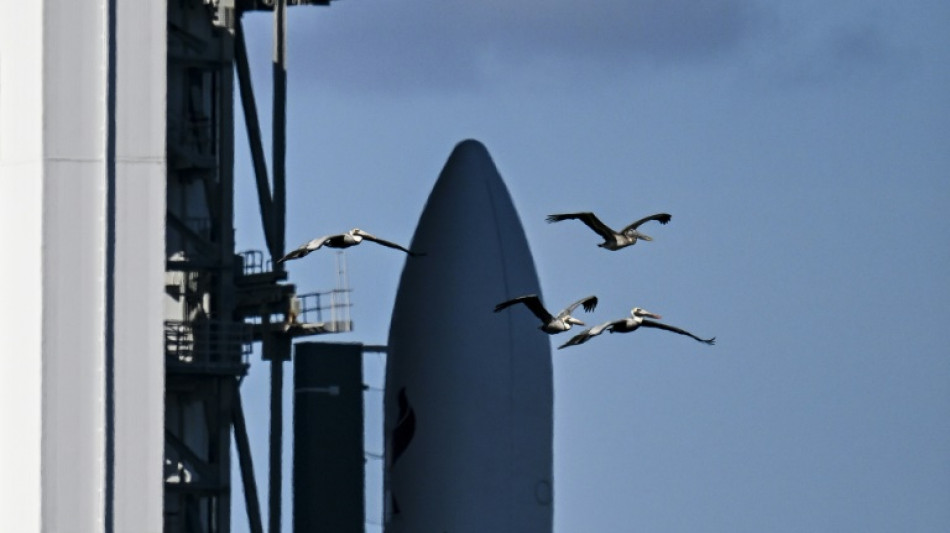
A brand new rocket, United Launch Alliance's Vulcan Centaur, lifted off from Cape Canaveral Space Force Station in Florida at 2:18 am (0718 GMT) for its maiden voyage, carrying Astrobotic's Peregrine Lunar Lander.
"Successful #VulcanRocket staging, ignition," ULA said on X, formerly Twitter, following the launch.
Eric Monda, ULA's strategic planning director, described the launch as "spot on."
"It was so cool. I ran outside to watch the launch," he said on NASA's live stream.
If all goes to plan, Peregrine will touch down on a mid-latitude region of the Moon called Sinus Viscositatis, or Bay of Stickiness, on February 23.
"Leading America back to the surface of the Moon for the first time since Apollo is a momentous honor," Astrobotic's CEO John Thornton said ahead of the launch.
Until now, a soft landing on Earth's nearest celestial neighbor has only been accomplished by a handful of national space agencies: the Soviet Union was first, in 1966, followed by the United States, which is still the only country to put people on the Moon.
China has successfully landed three times over the past decade, while India was the most recent to achieve the feat on its second attempt, last year.
Now, the United States is turning to the commercial sector to stimulate a broader lunar economy and ship its own hardware at a fraction of the cost, under the Commercial Lunar Payload Services (CLPS) program.
- A challenging task -
NASA paid Astrobotic more than $100 million for the task, while another contracted company, Houston-based Intuitive Machines, is looking to launch in February and land near the south pole.
"We think that it's going to allow... more cost effective and more rapidly accomplished trips to the lunar surface to prepare for Artemis," said Joel Kearns, the US space agency's deputy associate administrator for exploration.
Artemis is the NASA-led program to return astronauts to the Moon later this decade, in preparation for future missions to Mars.
Controlled touchdown on the Moon is a challenging undertaking, with roughly half of all attempts ending in failure. Absent an atmosphere that would allow the use of parachutes, a spacecraft must navigate through treacherous terrain using only its thrusters to slow descent.
Private missions by Israel and Japan, as well as a recent attempt by the Russian space agency, have all ended in failure -- though the Japanese Space Agency is targeting mid-January for the touchdown of its SLIM lander launched last September.
Making matters more fraught is the fact that it is the first launch for ULA's Vulcan, although the company claims a 100 percent success rate in more than 150 prior launches.
ULA's new rocket is planned to have reusable first stage booster engines, which the company, a joint venture between Lockheed Martin and Boeing, expects will help save costs.
- Science instruments, human remains -
On board Peregrine is a suite of scientific instruments that will probe radiation and surface composition, helping to pave the way for the return of astronauts.
But it also contains more colorful cargo, including a shoebox-sized rover built by Carnegie Mellon University, a physical Bitcoin, and, somewhat controversially, cremated remains and DNA, including those of Star Trek creator Gene Roddenberry, legendary sci-fi author and scientist Arthur C. Clarke and a dog.
The Navajo Nation, America's largest Indigenous tribe, has said sending this cargo to the Moon desecrates something that is sacred to their culture. Though they were granted a last-ditch meeting with White House, NASA and other officials, their objections failed to remove the cargo.
The Vulcan rocket's upper stage, which will circle the Sun after it deploys the lander, is meanwhile carrying more late cast members of Star Trek, as well as hair samples of presidents George Washington, Dwight D. Eisenhower and John F. Kennedy.
E.Hall--AT