Blue Origin returns to space after year-long hiatus / Photo: Handout - BLUE ORIGIN/AFP

 Boland strikes twice for Australia in rain-hit South Africa Test

 Marseille put Angers to the sword in Ligue 1

 Albanian PM refuses to quit as violent protests enter sixth day

 Chwalinska fights back to win Wuhan Open in title breakthrough

 Kulusevski on brink of return for Spurs after 17-month absence

 Ukraine sets Saint Petersburg refinery ablaze in large-scale drone attack

 Spain's in-form Chacarra wins DP World India Championship

 Two pilots die in Saudi coalition helicopter crash near Yemen border

 Riyadh skyscraper shifts tenants online as Houthi attacks intensify

 Messi scores twice as Inter Miami defeat Atlanta United 3-1

 Qatar and Norway review bilateral ties at Oslo consultations

 Vietnam and EFTA states sign free-trade agreement in Hanoi

 Gold closes week near $4,165 as US inflation outlook pressures market

 PSG rally past Strasbourg to take Ligue 1 lead

 India’s services surplus narrows as import growth overtakes exports
 RCom professional asks Supreme Court to revisit spectrum insolvency ruling

 Debt recovery lessons after derivatives losses and repeated borrowing

 Katie Alexander reportedly leaves flat shared with Eamonn Holmes

 Body found in search for missing Glasgow teenager

 Andi King recounts late-life transition after decades behind an “alpha male” identity

 Bromsgrove Repair Cafe reports nearly 80% repair success rate

 B.C. Lions focus on playoff momentum after Calgary defeat

 PNB expects festive demand to add up to two points to quarterly credit growth

 Cyient DLM drops 12% as margin concerns overshadow quarterly growth

 Arizona quarterback says audible led to dismissal and teammates’ suspensions

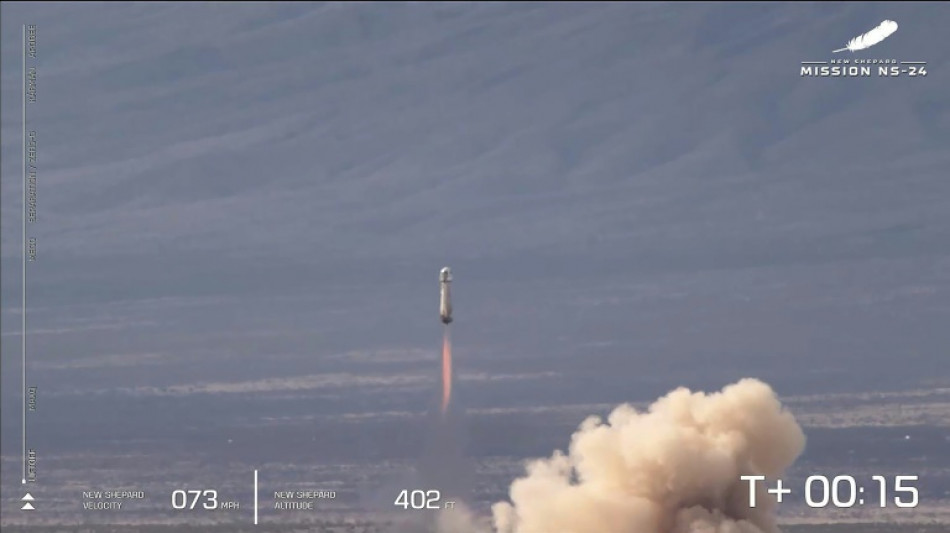
Blue Origin launched its first rocket in more than a year on Tuesday, reviving the US company's fortunes with a successful return to space following an uncrewed crash in 2022.
Though mission NS-24 carried a payload of science experiments, not people, it paves the way for Jeff Bezos' aerospace enterprise to resume taking wealthy thrill-seekers to the final frontier.
The New Shepard suborbital rocket blasted off from the pad at Launch Site One, near Van Horn, Texas, at 10:42 am (1642 GMT).
After separating from the booster, the gumdrop-shaped capsule attained a peak altitude of 66.5 miles (107 kilometers) above sea level, well above the internationally recognized boundary of space known as the Karman line, which is 62 miles high.
The booster then successfully landed vertically on the launchpad, against the majestic backdrop of the Sierra Diablo mountains, followed a few minutes later by the capsule floating to the desert floor on three giant parachutes.
All in all, the mission lasted 10 minutes and 13 seconds.
"Demand for New Shepard flights continues to grow and we're looking forward to increasing our flight cadence in 2024," said Phil Joyce, the company's senior vice president.
The science experiments onboard included one to demonstrate the operation of hydrogen fuel cell technology in microgravity, and another showing how water and gas move in a weightless environment.
Future applications could include monitoring water quality for astronauts in space.
- Long break -
On September 12, 2022, a Blue Origin rocket became engulfed in flames shortly after launch. The capsule, fixed to the top of the rocket, successfully initiated an emergency separation sequence and floated safely to the ground on parachutes.
The accident prompted a year-long probe by the Federal Aviation Administration (FAA), which found it was caused by the failure of an engine nozzle that experienced higher-than-expected operating temperatures.
The regulator issued a set of corrective actions for Blue Origin to undertake before it could resume flying, including the redesign of certain engine parts. It confirmed Sunday that it had approved Blue Origin's application to fly again.
In all, Blue Origin has carried out six crewed flights -- some passengers were paying customers and others were guests -- since July 2021, when Bezos himself took part in the first.
While Blue Origin has been grounded, rival Virgin Galactic -- the company founded by British billionaire Richard Branson -- has pressed on, with five commercial flights this year.
The two companies compete in the emerging space tourism sector, operating in suborbital space.
- Reusable rocket, no carbon emissions -
While Blue Origin launches a small rocket vertically, Virgin Galactic uses a large carrier plane to gain altitude and then drop off a smaller, rocket-powered spaceplane that completes the journey to space.
In both cases, passengers enjoy a few minutes of weightlessness and can view the curvature of the Earth through large windows.
Virgin Galactic tickets were sold for between $200,000-$450,000; Blue Origin does not publicly disclose its ticket prices.
Blue Origin can boast of the fact that nearly all of its rocket platform is re-used, including the booster, capsule, engine, landing gear and parachutes.
Its engine meanwhile is fueled by liquid oxygen and hydrogen, meaning the only byproduct during flight is water vapor, with no carbon emissions.
Blue Origin is also developing a heavy rocket for commercial purposes called New Glenn, with the maiden flight planned for next year.
This rocket, which measures 98 meters (320 feet) high, is designed to carry payloads of as much as 45 metric tons into low Earth orbit.
D.Johnson--AT