The feline frontier: NASA sends cat video from deep space / Photo: Handout - NASA/JPL-Caltech/AFP

 Boland strikes twice for Australia in rain-hit South Africa Test

 Marseille put Angers to the sword in Ligue 1

 Albanian PM refuses to quit as violent protests enter sixth day

 Chwalinska fights back to win Wuhan Open in title breakthrough

 Kulusevski on brink of return for Spurs after 17-month absence

 Ukraine sets Saint Petersburg refinery ablaze in large-scale drone attack

 Spain's in-form Chacarra wins DP World India Championship

 Two pilots die in Saudi coalition helicopter crash near Yemen border

 Riyadh skyscraper shifts tenants online as Houthi attacks intensify

 Messi scores twice as Inter Miami defeat Atlanta United 3-1

 Qatar and Norway review bilateral ties at Oslo consultations

 Vietnam and EFTA states sign free-trade agreement in Hanoi

 Gold closes week near $4,165 as US inflation outlook pressures market

 PSG rally past Strasbourg to take Ligue 1 lead

 India’s services surplus narrows as import growth overtakes exports

 RCom professional asks Supreme Court to revisit spectrum insolvency ruling

 Debt recovery lessons after derivatives losses and repeated borrowing

 Katie Alexander reportedly leaves flat shared with Eamonn Holmes

 Body found in search for missing Glasgow teenager

 Andi King recounts late-life transition after decades behind an “alpha male” identity

 Bromsgrove Repair Cafe reports nearly 80% repair success rate

 B.C. Lions focus on playoff momentum after Calgary defeat

 PNB expects festive demand to add up to two points to quarterly credit growth

 Cyient DLM drops 12% as margin concerns overshadow quarterly growth

 Arizona quarterback says audible led to dismissal and teammates’ suspensions

NASA on Monday announced it had used a state-of-the-art laser communication system on a spaceship 19 million miles (31 million kilometers) away from Earth -- to send a high-definition cat video.
The 15-second meow-vie featuring an orange tabby named Taters is the first to be streamed from deep space, and demonstrates it's possible to transmit the higher-data-rate communications needed to support complex missions such as sending humans to Mars.
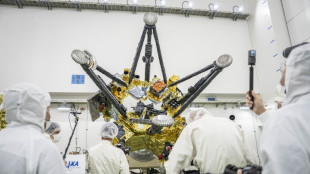
The video was beamed to Earth using a laser transceiver on the Psyche probe, which is journeying to the main asteroid belt between Mars and Jupiter to explore a mysterious metal-rich object. When it sent the video, the spaceship was 80 times the distance between the Earth and Moon.
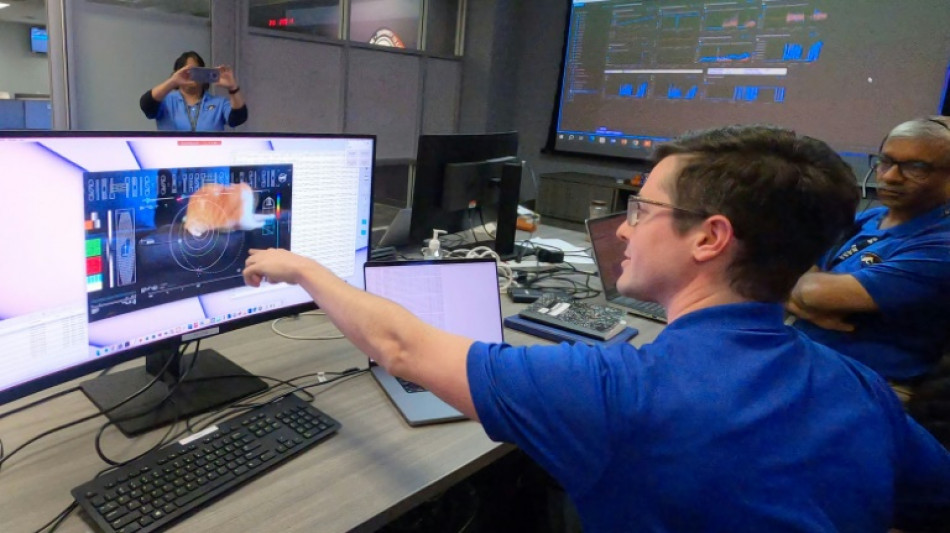
The encoded near-infrared signal was received by the Hale Telescope at Caltech's Palomar Observatory in San Diego County, and from there sent to NASA's Jet Propulsion Laboratory (JPL) in Southern California.
"One of the goals is to demonstrate the ability to transmit broadband video across millions of miles. Nothing on Psyche generates video data, so we usually send packets of randomly generated test data," said Bill Klipstein, the tech demo's project manager at JPL.
"But to make this significant event more memorable, we decided to work with designers at JPL to create a fun video, which captures the essence of the demo as part of the Psyche mission."
Space missions have traditionally relied on radio waves to send and receive data, but working with lasers can increase the data rate by 10 to 100 times.
- Giant pounce for catkind -
The ultra-HD video took 101 seconds to send to Earth at the system's maximum bit rate of 267 megabits per second -- faster than most home broadband connections.
"In fact, after receiving the video at Palomar, it was sent to JPL over the internet, and that connection was slower than the signal coming from deep space," said Ryan Rogalin, the project's receiver electronics lead at JPL.
So why a cat video? First, there's the historic connection, said JPL. When American interest in television began growing in the 1920s, a statue of Felix the Cat was broadcast to serve as a test image.
And while cats may claim the title as man's best friend, few can dispute their number-one position when it comes to internet videos and meme culture.
Uploaded before launch, the clip shows Tabby, the pet of a JPL employee, chasing a laser light on a couch, with test graphics overlayed. These include Psyche's orbital path and technical information about the laser and its data bit rate.
While laser transmission has been demonstrated in low Earth orbit and as far away as the Moon, the Psyche mission is the first time it's been deployed in deep space. Aiming a laser beam from millions of miles away requires extremely precise "pointing," a major technical hurdle engineering teams had to solve.
The technology demonstration even needs to compensate for the fact that in the time it takes for light to travel from the spacecraft to Earth, both the probe and the planet will have moved -- so the uplink and downlink lasers need to adjust for the change accordingly.
P.Hernandez--AT