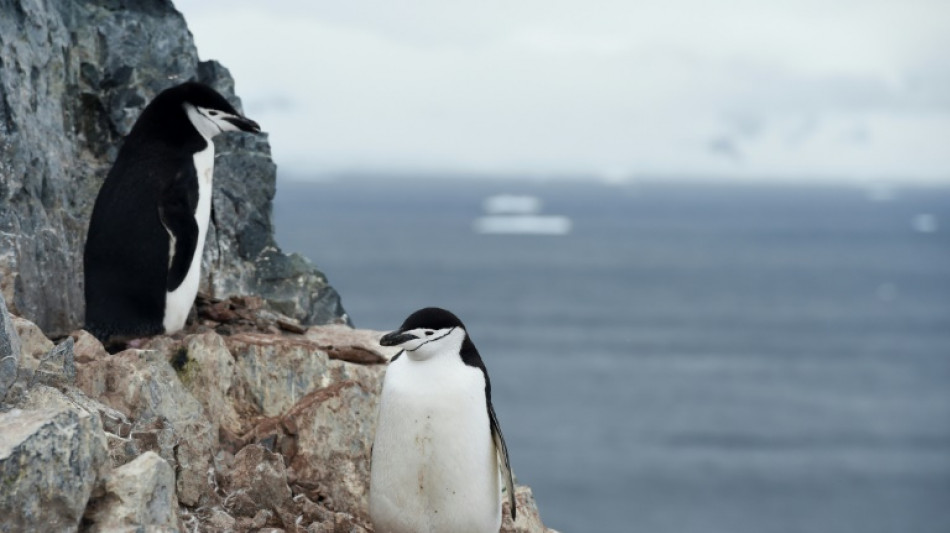
Penguins snatch 11 hours of sleep through seconds-long micronaps / Photo: EITAN ABRAMOVICH - AFP/File

 Boland strikes twice for Australia in rain-hit South Africa Test

 Marseille put Angers to the sword in Ligue 1

 Albanian PM refuses to quit as violent protests enter sixth day

 Chwalinska fights back to win Wuhan Open in title breakthrough

 Kulusevski on brink of return for Spurs after 17-month absence

 Ukraine sets Saint Petersburg refinery ablaze in large-scale drone attack

 Spain's in-form Chacarra wins DP World India Championship

 Two pilots die in Saudi coalition helicopter crash near Yemen border

 Riyadh skyscraper shifts tenants online as Houthi attacks intensify

 Messi scores twice as Inter Miami defeat Atlanta United 3-1

 Qatar and Norway review bilateral ties at Oslo consultations

 Vietnam and EFTA states sign free-trade agreement in Hanoi

 Gold closes week near $4,165 as US inflation outlook pressures market

 PSG rally past Strasbourg to take Ligue 1 lead

 India’s services surplus narrows as import growth overtakes exports

 RCom professional asks Supreme Court to revisit spectrum insolvency ruling

 Debt recovery lessons after derivatives losses and repeated borrowing

 Katie Alexander reportedly leaves flat shared with Eamonn Holmes

 Body found in search for missing Glasgow teenager

 Andi King recounts late-life transition after decades behind an “alpha male” identity

 Bromsgrove Repair Cafe reports nearly 80% repair success rate

 B.C. Lions focus on playoff momentum after Calgary defeat

 PNB expects festive demand to add up to two points to quarterly credit growth

 Cyient DLM drops 12% as margin concerns overshadow quarterly growth

 Arizona quarterback says audible led to dismissal and teammates’ suspensions

In humans, nodding off for a few seconds is a clear sign of insufficient sleep -- and can be dangerous in some situations, such as when driving a car.
But a new study published on Thursday finds chinstrap penguins snooze thousands of times per day, accumulating their daily sleep requirement of more than 11 hours in short bursts averaging just four seconds.
The flightless birds might have evolved this trait because of their need to remain constantly vigilant, according to the authors of the paper in Science.
The researchers argued that the findings show, contrary to prior assumptions, the benefits of sleep can accrue incrementally, at least in some species.
Chinstrap penguins (Pygoscelis antarcticus), named for the thin black band of plumage that extends from ear to ear, may be the most abundant species of penguin. Their current population is estimated at nearly eight million breeding pairs that are found mainly on the Antarctic Peninsula and South Atlantic Ocean islands.
When nesting, single parent penguins have to keep watch over their egg, guarding them from predatory birds called skuas while their partners are away on foraging trips that last several days.
They also have to defend their nests from other penguins that might try to steal nest material. Once a penguin partner finally returns, the couple switch roles.
A team led by Paul-Antoine Libourel of Lyon Neuroscience Research Centre implanted electrodes on 14 birds at a colony on King George Island in December 2019. They recorded electrical activity in the brain and neck muscles, and they used accelerometers and GPS to study body movement and location.
Combined with video recordings and direct observation over multiple days, they were able to identify numerous peculiarities.
The penguins' sleep occurred while standing or while lying to incubate their eggs, with the average bout lasting 3.91 seconds. In total they slept more than 10,000 times a day.
Penguins on the periphery got longer and deeper bouts of sleep than those in the center -- which can be explained by the excess noise and physical bumping that occurs in the middle of a colony, or the heightened risk of nest material theft.
Although the scientists did not directly measure whether the birds were gaining the restorative benefits of sleep, the fact the penguins were successful at breeding led them to believe this was indeed the case, with the moments of neuronal silence providing windows for rest and recovery.
In humans, however, conditions that fragment sleep such as sleep apnea have impacts on cognitive function and might even precipitate neurodegenerative disease, such as Alzheimer's.
"Thus, what is abnormal in humans could be perfectly normal in birds or other animals, at least under certain conditions," wrote scientists Christian Harding and Vladyslav Vyazovskiy in a related commentary piece.
W.Morales--AT