Six exoplanets discovered in synchronised dance around star / Photo: Julia Han JANICKI, Paz PIZARRO - AFP

 Boland strikes twice for Australia in rain-hit South Africa Test

 Marseille put Angers to the sword in Ligue 1

 Albanian PM refuses to quit as violent protests enter sixth day

 Chwalinska fights back to win Wuhan Open in title breakthrough

 Kulusevski on brink of return for Spurs after 17-month absence

 Ukraine sets Saint Petersburg refinery ablaze in large-scale drone attack

 Spain's in-form Chacarra wins DP World India Championship

 Two pilots die in Saudi coalition helicopter crash near Yemen border

 Riyadh skyscraper shifts tenants online as Houthi attacks intensify

 Messi scores twice as Inter Miami defeat Atlanta United 3-1

 Qatar and Norway review bilateral ties at Oslo consultations

 Vietnam and EFTA states sign free-trade agreement in Hanoi

 Gold closes week near $4,165 as US inflation outlook pressures market

 PSG rally past Strasbourg to take Ligue 1 lead

 India’s services surplus narrows as import growth overtakes exports

 RCom professional asks Supreme Court to revisit spectrum insolvency ruling

 Debt recovery lessons after derivatives losses and repeated borrowing

 Katie Alexander reportedly leaves flat shared with Eamonn Holmes

 Body found in search for missing Glasgow teenager

 Andi King recounts late-life transition after decades behind an “alpha male” identity

 Bromsgrove Repair Cafe reports nearly 80% repair success rate

 B.C. Lions focus on playoff momentum after Calgary defeat

 PNB expects festive demand to add up to two points to quarterly credit growth

 Cyient DLM drops 12% as margin concerns overshadow quarterly growth

 Arizona quarterback says audible led to dismissal and teammates’ suspensions

Six exoplanets have been spotted in a perfectly synchronised dance around a nearby star, offering clues about the formation of our own Solar System, astronomers said on Wednesday.
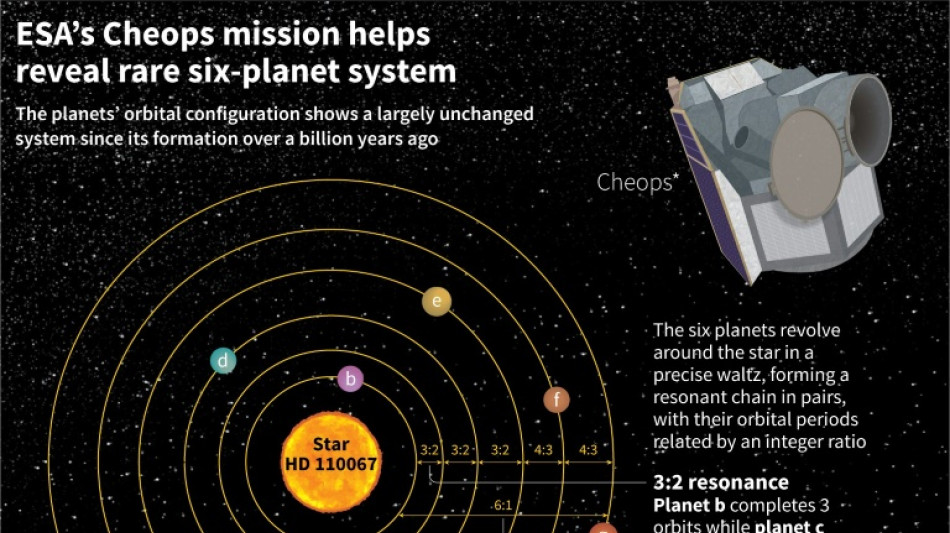
The six planets orbit the bright star HD 110067 around 100 light years away from Earth. The star is visible from the Northern Hemisphere as part of the Coma Berenices constellation.
The planets are so close to their star that all six would all fit into the orbit of Mercury and our Sun, Adrien Leleu, a researcher at the University of Geneva, told AFP.
All of the very hot planets are somewhere between the size of Earth and Neptune, said Leleu, the co-author of a new study published in the journal Nature.
All six have a similar make-up to Neptune -- "a rocky body covered with a thick envelope of gas," he added.
None of these "sub-Neptunes" are thought to be far away enough from their star to host liquid water, a key ingredient for supporting life.
While not habitable, they are remarkable in another way: all six planets are precisely synchronised with each other in their orbit.
NASA's Transiting Exoplanet Survey Satellite (TESS) first discovered two exoplanets orbiting the star in 2020.
The satellite, known as the exoplanet hunter, spotted the pair by measuring the change in brightness when they passed over their host star.
The planet closest to the star orbits around it in just nine days.
However there were some indications that other planets could be passing over the star, which astronomers suspected were orbiting over a longer period.
HESS is designed to scan the sky for a few weeks, so was not the best hunter for planets with longer orbits.
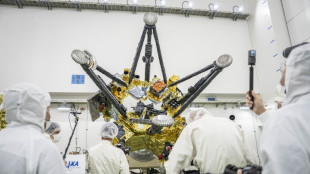
So the European Space Agency's Cheops satellite, which can target a star for much longer, was brought into the chase.
Over time, Cheops managed to spot four more planets.
- In lockstep -
The planets carry out a delicate dance called "orbital resonance" in which the gravity of each keeps the others in rhythm.
In the time that the first planet carries out three trips around its star, the second planet does two revolutions. When the second planet goes around three times, the third planet has done two orbits, and so on.
The last planet completes one orbit in the time it takes the first to do six -- proof that they are all connected by a "resonance chain," Leleu said.
More than 5,000 exoplanets, planets outside our Solar System, have been discovered since the first was spotted in 1995 -- but this system is the first to have so many planets acting in such harmony.
But in theory this is how all planets start off, said the study's lead author Rafael Luque of the University of Chicago.
The HD 110067 system is believed to have remained virtually unchanged since its birth at least four billion years ago.
However the planets of our home Solar System, which is not much older, do not orbit in sync, Leleu said.
This could be because of "frequent chaotic events" after the birth of the Solar System, such as the formation of giant plants like Jupiter and Saturn, which could have destabilised the orbits of the smaller planets, Luque said.
It also could have been because of some giant meteorite, he added.
The astronomers hope that the new system will help understand the history of our Solar System -- and how it lost its rhythm.
G.P.Martin--AT