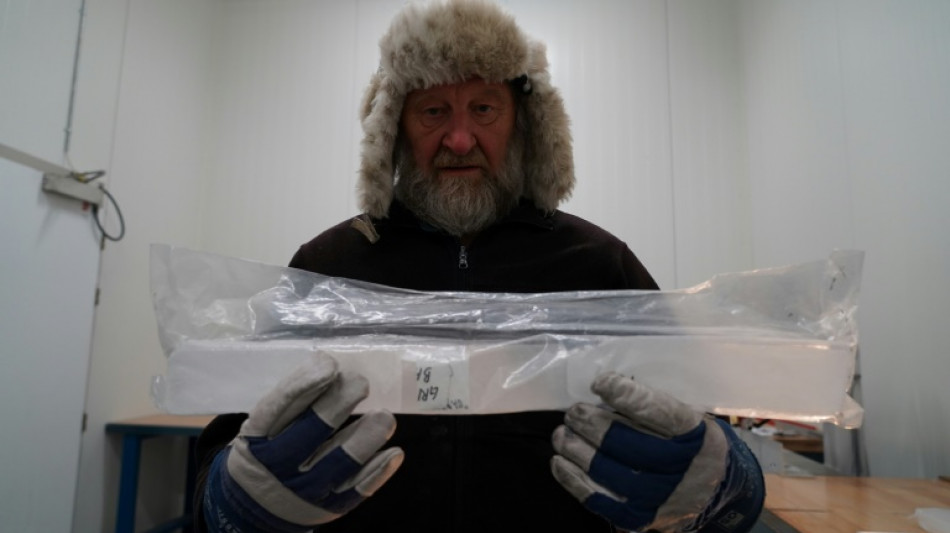
Frozen library of ancient ice tells tales of climate's past / Photo: James BROOKS - AFP

 Four soldiers dead, dozens injured in fire at Canada military base
 Ton-up Agha helps Pakistan down Sri Lanka in tri-series opener

 Man Utd draw at Leeds keeps pressure on Carrick

 Barca defenders Garcia, Kounde injured before key games
 Lula, Bolsonaro to face off in first debate of bruising election
 Maza and Schick help Leverkusen clip Freiburg's wings

 Leeds hit back to deny Man Utd morale-boosting win

 Zelensky tells NBC 'thankful' US has unblocked intelligence sharing
 Pau see off Leicester in Champions Cup

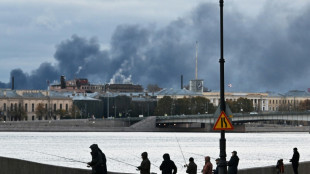
 Kremlin says Ukrainian attacks won't change war aims as Kyiv hits Saint Petersburg

 Martinez starts for Man Utd after outburst
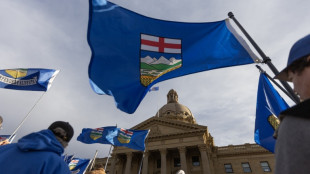 Alberta separatists rally ahead of independence vote

 Vietnam and EFTA states sign free-trade agreement in Hanoi
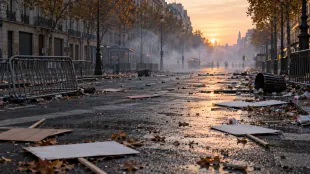 France assesses protest damage after 1,800 arrests

 Gord launches four AI tools for sustainability and emissions management

 Doha 2036 bid sets out sport-led social legacy

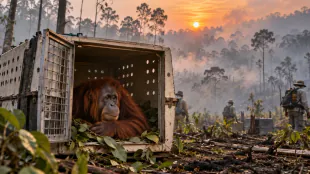 Conservation teams rescue orangutans from Indonesian wildfires

 Gold closes week near $4,165 as US inflation outlook pressures market

 PSG rally past Strasbourg to take Ligue 1 lead

 India’s services surplus narrows as import growth overtakes exports

 RCom professional asks Supreme Court to revisit spectrum insolvency ruling

 Debt recovery lessons after derivatives losses and repeated borrowing

 B.C. Lions focus on playoff momentum after Calgary defeat

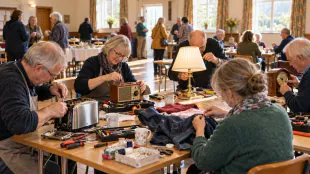 Bromsgrove Repair Cafe reports nearly 80% repair success rate

 Robertson and Selby chase rare Home Nations sweep in Belfast

How was the air breathed by Caesar, the Prophet Mohammed or Christopher Columbus? A giant freezer in Copenhagen holds the answers, storing blocks of ice with atmospheric tales thousands of years old.
The Ice Core Archive, housing 25 kilometres (15 miles) of ice collected primarily from Greenland, is helping scientists understand changes in the climate.
"What we have in this archive is prehistoric climate change, a record of man's activities in the last 10,000 years," glaciology professor Jorgen Peder Steffensen of the University of Copenhagen told AFP.
Blocks of ice have been his passion for 43 years -- and it was while drilling into Greenland's ice sheet that he met his wife Dorthe Dahl-Jensen, also a top expert in the field of paleoclimatology.
Steffensen has since 1991 managed the repository, one of the biggest in the world, with 40,000 blocks of ice stacked on long rows of shelves in large boxes.
The frozen samples are unique, made up of compressed snow and not frozen water.
"All the airspace between the snowflakes is trapped as bubbles inside (and) the air inside these bubbles is the same age as the ice," Steffensen explained.
The repository's antechamber is similar to a library's reading room: this is where scientists can examine the ice they have withdrawn from the main "library", or storage room.
But they must be quick: the temperature in the antechamber is kept at -18 degrees Celsius (-0.4F) -- decidedly balmy compared to the -30C (-22F) in the storage room.
Here, Steffensen removes a block of ice from a box. Its air bubbles are visible to the naked eye: it's snow that fell during the winter of year zero.
"So we have the Christmas stuff, the real Christmas snow," says Steffensen with a big grin, his head covered in a warm winter bonnet with furry ear flaps.
- Bedrock -
A team of researchers brought the first ice cores to Denmark in the 1960s from Camp Century, a secret US military base on Greenland.
The most recent ones date from this summer, when scientists hit the bedrock on eastern Greenland at a depth of 2.6 kilometres, gathering the oldest ice possible.
Those samples contain extracts from 120,000 years ago, during the most recent interglacial period when air temperatures in Greenland were 5C higher than today.
"The globe has easily been much warmer than it is today. But that's before humans were there," Steffensen said.
This recently acquired ice should help scientists' understanding of rising sea levels, which can only be partly explained by the shrinking ice cap.
Another part of the explanation comes from ice streams, fast-moving ice on the ice sheet that is melting at an alarming rate.
"If we understand the ice streams better, we can get a better idea of how much the contribution will be (to rising sea levels) from Greenland and Antarctica in the future," Steffensen said.
He hopes they'll be able to predict the sea level rise in 100 years with a margin of error of 15 centimetres -- a big improvement over today's 70 centimetres.
- 'Treasure' -
Ice cores are the only way of determining the state of the atmosphere prior to man-made pollution.
"With ice cores we have mapped out how greenhouse gases, carbon dioxide and methane vary over time," Steffensen said.
"And we can also see the impact of the burning of fossil fuels in modern times."
This project is separate from the Ice Memory foundation, which has collected ice cores from 20 sites worldwide to preserve them for future researchers at the French-Italian Concordia research station in Antarctica, before they disappear forever due to climate change.
"Storing Greenland's ice memory is very good," said the head of the foundation, Jerome Chappellaz.
But, he noted, the storage of samples in an industrial freezer is susceptible to technical glitches, funding woes, attacks, or even wars.
In 2017, a freezer that broke down at the University of Alberta in Canada exposed 13 percent of its precious samples thousands of years old to undesirably warm temperatures.
At Concordia Station, the average annual temperature is -55C, providing optimal storage conditions for centuries to come.
"They have a treasure," said Chappellaz, appealing to the Danes to join Concordia's project.
"We must protect this treasure and, as far as possible, ensure that it joins mankind's world heritage."
M.Robinson--AT