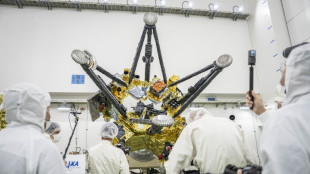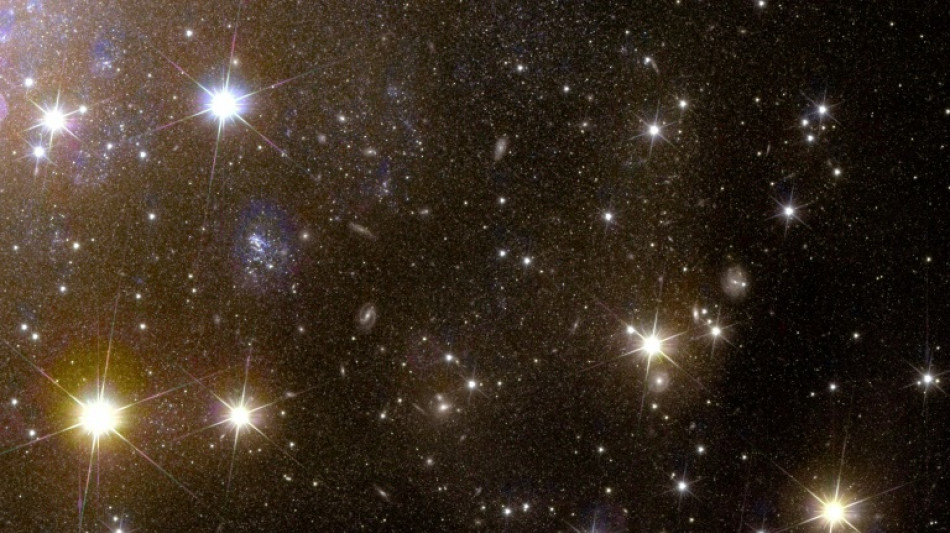
Glimpses of the 'galactic zoo': The five new Euclid images / Photo: Handout - ESA/Euclid/Euclid Consortium/NASA/AFP

 Four soldiers dead, dozens injured in fire at Canada military base

 Ton-up Agha helps Pakistan down Sri Lanka in tri-series opener

 Man Utd draw at Leeds keeps pressure on Carrick

 Barca defenders Garcia, Kounde injured before key games

 Lula, Bolsonaro to face off in first debate of bruising election

 Maza and Schick help Leverkusen clip Freiburg's wings

 Leeds hit back to deny Man Utd morale-boosting win

 Zelensky tells NBC 'thankful' US has unblocked intelligence sharing

 Pau see off Leicester in Champions Cup

 Kremlin says Ukrainian attacks won't change war aims as Kyiv hits Saint Petersburg

 Martinez starts for Man Utd after outburst

 Alberta separatists rally ahead of independence vote

 Vietnam and EFTA states sign free-trade agreement in Hanoi

 France assesses protest damage after 1,800 arrests

 Gord launches four AI tools for sustainability and emissions management

 Doha 2036 bid sets out sport-led social legacy

 Conservation teams rescue orangutans from Indonesian wildfires

 Gold closes week near $4,165 as US inflation outlook pressures market

 PSG rally past Strasbourg to take Ligue 1 lead

 India’s services surplus narrows as import growth overtakes exports

 RCom professional asks Supreme Court to revisit spectrum insolvency ruling

 Debt recovery lessons after derivatives losses and repeated borrowing

 B.C. Lions focus on playoff momentum after Calgary defeat

 Bromsgrove Repair Cafe reports nearly 80% repair success rate

 Robertson and Selby chase rare Home Nations sweep in Belfast

The first images from Europe's Euclid space telescope released Tuesday range from a well-known nebula to never-before-seen galaxies 10 billion light years away, illustrating its wide-lens view of the universe.
Here are the five images -- described by Euclid scientist Jean-Charles Cuillandre as "a range of objects from the galactic zoo in terms of diversity, colours and shapes" -- starting with the closest to Earth and moving out into the cosmos.
- Horsehead Nebula -
A giant red horse seems to rear its head against a background of swirling stars, some still being formed in a stellar nursery.
The Horsehead Nebula -- also known as Barnard 33 -- is 1,375 light years away.
The horse's head is in fact dark clouds in front of ultraviolet radiation coming from Sigma Orionis, which is the eastern star on the belt of the Orion constellation.
The Horsehead Nebula has been observed before, but the European Space Agency's Euclid telescope is the first to deliver such a complete view in just an hour, thanks to its wide lens.
Scientists hope that by scouring through Euclid's observations of the nebula, they will find previously unseen Jupiter-sized planets, as well as stars still in their infancy.
- Globular cluster NGC 6397 -
At 7,800 light years away -- but still in our Milky Way galaxy -- this cluster is a collection of hundreds of thousands of stars bound together by gravity.
"Currently no other telescope than Euclid can observe the entire globular cluster and at the same time distinguish its faint stellar members in the outer regions from other cosmic sources," Euclid Consortium scientist Davide Massari said in a statement.
Scientists hope to use Euclid's observations to spot stars trailing such globular clusters as they travel through our galaxy.
"The surprising thing is that we don't see these stars trailing," Euclid project scientist Rene Laureijs told AFP.
"One of the theories is that there might be dark matter around the globular cluster, which keeps all the stars together," he said.
The ESA hopes Euclid will shed more light on dark matter and dark energy, which are thought to make up 95 percent of the universe but remain shrouded in mystery.
- An irregular galaxy -
Not all galaxies are pretty spirals like our own. Images of the irregular dwarf galaxy NGC 6822, some 1.6 million light years from Earth, have been captured before, including by the James Webb Space Telescope.
However Euclid is the first to be able to capture the whole galaxy in barely an hour.
As is often the case in the early universe, this galaxy's stars are low on metal, and the scientists hope that analysing them will shed light on how galaxies evolve.
- The 'hidden galaxy' -
The spiral galaxy IC 342 earned the nickname the "hidden galaxy" because it can be difficult to spot behind the disc of our own Milky Way.
It is relatively nearby -- in galactic terms at least -- some 11 million light years from Earth.
However Euclid's infrared vision was able to peer through the dust to spot never-before-seen globular clusters, ESA said.
- Perseus Cluster -
ESA described this image as "a revolution for astronomy".
It depicts the Perseus Cluster, which contains a thousand galaxies some 240 million light years away.
But in the background there are more than 100,000 additional galaxies, some 10 billion light years away, ESA said. Many of those distant galaxies have never been spotted before.
Laureijs said it was "very exciting" when the team saw the image for the first time and found low-level light coming not from the cluster, but from stars left over from collisions between galaxies.
That these stars were not being pulled back into the galaxies could suggest the presence of dark matter, he said.
Laureijs emphasised that this remains "circumstantial evidence," and that future research could reveal more about dark matter's distribution throughout the universe.
A.Taylor--AT