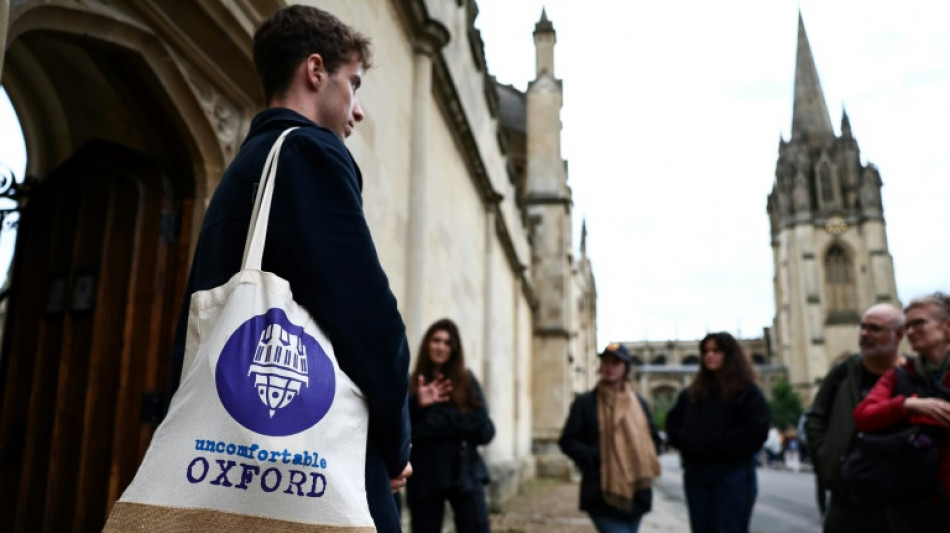
In UK, tourists discover darker side of Oxford and Cambridge / Photo: HENRY NICHOLLS - AFP

 Four soldiers dead, dozens injured in fire at Canada military base
 Ton-up Agha helps Pakistan down Sri Lanka in tri-series opener

 Man Utd draw at Leeds keeps pressure on Carrick

 Barca defenders Garcia, Kounde injured before key games
 Lula, Bolsonaro to face off in first debate of bruising election
 Maza and Schick help Leverkusen clip Freiburg's wings

 Leeds hit back to deny Man Utd morale-boosting win

 Zelensky tells NBC 'thankful' US has unblocked intelligence sharing
 Pau see off Leicester in Champions Cup

 Kremlin says Ukrainian attacks won't change war aims as Kyiv hits Saint Petersburg

 Martinez starts for Man Utd after outburst
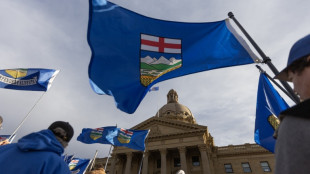 Alberta separatists rally ahead of independence vote

 Vietnam and EFTA states sign free-trade agreement in Hanoi

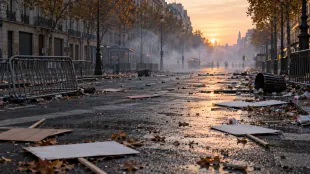 France assesses protest damage after 1,800 arrests

 Gord launches four AI tools for sustainability and emissions management

 Doha 2036 bid sets out sport-led social legacy

 Conservation teams rescue orangutans from Indonesian wildfires
 Gold closes week near $4,165 as US inflation outlook pressures market

 PSG rally past Strasbourg to take Ligue 1 lead

 India’s services surplus narrows as import growth overtakes exports
 RCom professional asks Supreme Court to revisit spectrum insolvency ruling

 Debt recovery lessons after derivatives losses and repeated borrowing

 B.C. Lions focus on playoff momentum after Calgary defeat

 Bromsgrove Repair Cafe reports nearly 80% repair success rate

 Robertson and Selby chase rare Home Nations sweep in Belfast

British universities Oxford and Cambridge are constantly ranked among the best in the world and celebrated for their academic excellence.
But their murkier history is being brought to life for tourists, as the country increasingly grapples with its colonial past.
"This is not the standard walking tour," warned guide and student Claire McCann, before leading her group onto the cobbled streets of Oxford, which attract some seven million visitors every year.
Majestic buildings, many dating back to the Middle Ages, bear witness to the rich history of the university city, some 50 miles (80 kilometres) northwest of London.
Most British prime ministers, including current UK leader Rishi Sunak, and the Labour main opposition leader Keir Starmer, have studied behind the high walls of Oxford's various colleges.
But their university years are not the subject of the tour, which instead focuses on "difficult legacies" -- a burning issue brought to the fore in the UK since Black Lives Matter anti-racism protests.
First stop on the tour is Oriel College, outside of which sits a statue of alumnus Cecil Rhodes (1853-1902), a coloniser who dreamed of a British Africa from Cape Town to Cairo.
McCann, originally from South Africa, read a quote of Rhodes in which he described Africans as the "most despicable specimens of human beings".
She highlighted his role in the Second Boer War (1899-1902) and that he founded De Beers, which is still the world's number one diamond company.
As part of the tour, she talked about the "exploitation" in the mines, which made Rhodes a fortune and also allowed him to set up one of the most prestigious academic awards in the world.
Notable Rhodes scholars include former US president Bill Clinton.
"What should happen with the statue?" asked McCann.
- Slavery -
The "Rhodes Must Fall" campaign launched by students called for the statue's removal. But Oxford decided in 2021 that the statue would remain in place.
A short walk away across the High Street is All Souls College, which McCann described as "the most exclusive college in Oxford".
Dating back to the 1430s, it is one of the richest and only accepts two or three new research students per year.
"All Souls demonstrates for us how networks of prestige have historically been supported by economic exploitation and slavery," said McCann.
Following the Black Lives Matter protests of 2020, All Souls announced that it would no longer call its library after Christopher Codrington, a former student.
When Codrington died in 1710, he left part of his fortune to the university, which according to All Souls' website came "largely" from his family's plantations in the West Indies that were "worked by enslaved people of African descent".
More than 20,000 people have participated in the walks, called Uncomfortable tours, since they started in 2018.
They also exist in Cambridge and the founders hope to extend them to London and even Paris.
"Did you know that Oxford and Cambridge combined own more land than the Church of England?" asked guide Ashley Lance as she walked along the tranquil River Cam, opposite Cambridge University's sumptuous King's College Chapel.
"According to a study published in 2018, Cambridge is the most unequal city in Britain," she added.
- 'Shocking' -
Lance, 27, explained that two worlds exist in the city: one comprised of the university, with its students, professors and laboratories and the other made up of the rest of the population.
Despite their rivalries -- Oxford is referred to as "the other place" in Cambridge -- the two universities have had much in common.
Women were able to study at Oxford from 1870, but had to wait until 1920 to qualify for a degree.
They were banned from libraries for a long time, for fear they would be "far too distracting" to men, explained McCann.
Oriel, founded in 1326, was the last Oxford college to open its doors to women, in 1985.
In Cambridge, St John's College, founded in 1511, accepted women from 1980. But on the day the first female students arrived, a faculty official lowered a flag to half-mast and wore a black armband.
"It's so shocking," said one exasperated Londoner on the tour, visiting with her daughter.
Michelle Miller, an American who has just moved to Oxford with her husband, said she was interested in the lesser-known aspects of popular tourist destinations.
"We didn't know there were so many controversies," the 52-year-old told AFP.
W.Morales--AT