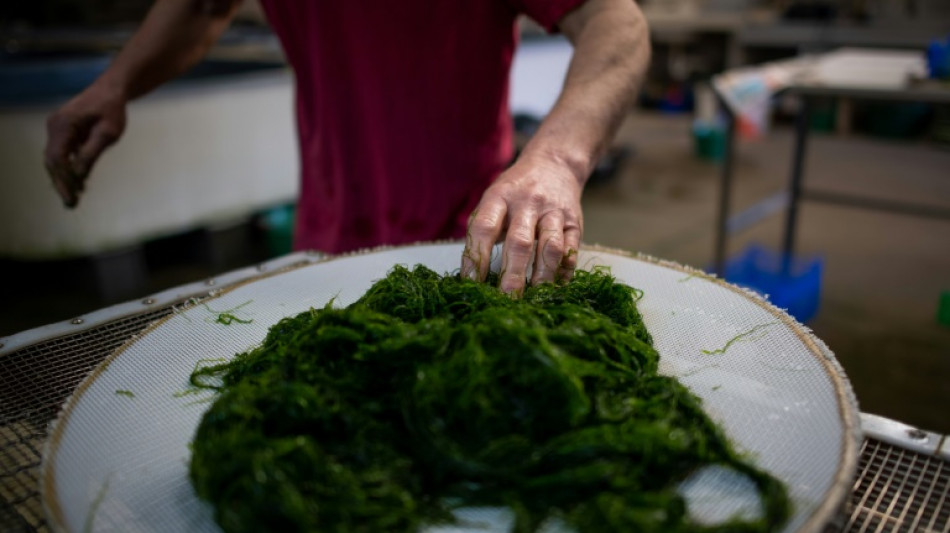
Back on the menu? Europeans once ate seaweed, research shows / Photo: LOIC VENANCE - AFP/File

 Four soldiers dead, dozens injured in fire at Canada military base

 Ton-up Agha helps Pakistan down Sri Lanka in tri-series opener

 Man Utd draw at Leeds keeps pressure on Carrick

 Barca defenders Garcia, Kounde injured before key games

 Lula, Bolsonaro to face off in first debate of bruising election

 Maza and Schick help Leverkusen clip Freiburg's wings

 Leeds hit back to deny Man Utd morale-boosting win

 Zelensky tells NBC 'thankful' US has unblocked intelligence sharing

 Pau see off Leicester in Champions Cup

 Kremlin says Ukrainian attacks won't change war aims as Kyiv hits Saint Petersburg

 Martinez starts for Man Utd after outburst

 Alberta separatists rally ahead of independence vote

 Vietnam and EFTA states sign free-trade agreement in Hanoi

 France assesses protest damage after 1,800 arrests

 Gord launches four AI tools for sustainability and emissions management

 Doha 2036 bid sets out sport-led social legacy

 Conservation teams rescue orangutans from Indonesian wildfires

 Gold closes week near $4,165 as US inflation outlook pressures market

 PSG rally past Strasbourg to take Ligue 1 lead

 India’s services surplus narrows as import growth overtakes exports

 RCom professional asks Supreme Court to revisit spectrum insolvency ruling

 Debt recovery lessons after derivatives losses and repeated borrowing

 B.C. Lions focus on playoff momentum after Calgary defeat

 Bromsgrove Repair Cafe reports nearly 80% repair success rate

 Robertson and Selby chase rare Home Nations sweep in Belfast

Europeans now rarely eat seaweed, but it was an important part of their diet until the late Middle Ages, archaeologists said Tuesday, calling for the eco-friendly aquatic plant to be put back on the menu.
Seaweed, a healthy and sustainable source of protein, is a staple food in some Asian countries such as Japan. But it has long been shunned by traditional Western diets -- with a few exceptions, such as the Welsh dish laverbread.
It was previously thought that since the rise of farming, Europeans had mostly used seaweed as fuel, fertiliser or to feed livestock. It was only eaten to stave off hunger during famine, so the thinking went.
But a new study published in the journal Nature Communications found that Europeans were gobbling up seaweed millennia after that point, and suggested the continent re-embrace the nutritious food.
To find out about ancient seaweed consumption, a UK-led team of researchers analysed dental plaque extracted from the teeth of 74 different people who lived thousands of years ago at 28 sites ranging from Scotland to Spain.
Using a mass spectrometry technique to identify organic compounds, they found evidence that the teeth had chowed down on several different aquatic plants.
Red seaweed was eaten both in Scotland's northern Orkney islands around 5,000 years ago and at Casa Corona in southern Spain 8,000 years ago, the study found.
Freshwater aquatic plants, such as the pondweed Potamogeton, were commonly eaten in Portugal, Scotland and Lithuania, it added.
Karen Hardy, an archaeologist at Scotland's University of Glasgow and the study's lead author, told AFP that aquatic plants were "very likely eaten over a much more wide timescale than we found".
Europeans were previously believed to have turned their noses up at seaweed following the introduction of agriculture more than 10,000 years ago.
However, research in this field has focused on agricultural production, so may have missed out on seaweed, which is easy to find and eat.
The authors of the study said seaweed has the potential to be a locally sourced, low-emission option that does not require the mass farming of the meals normally seen on Europe's plates.
"It's very healthy, it's nutritious, it's available, it's renewable," Hardy said.
"People ate it in the past in Europe," she said, adding hopefully that maybe they will again.
Y.Baker--AT