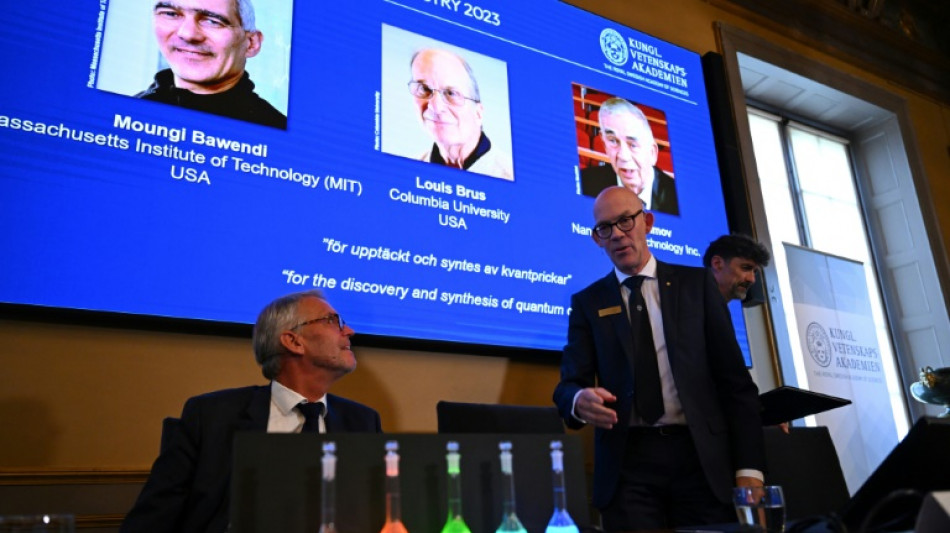
Trio win chemistry Nobel for 'quantum dots' after leak / Photo: Jonathan NACKSTRAND - AFP

 Macron denounces 'unbridled' violence as France hit by new clashes

 Hurzeler lauds 'hard worker' Gomez after Brighton goal from halfway line

 Toulouse hold off Exeter, Northampton save English Champions Cup blushes

 Arsenal snatch late win to keep pressure on Man City as Man Utd held
 Arsenal strike late to keep pressure on Man City as Man Utd held

 Four soldiers dead, dozens injured in fire at Canada military base

 Ton-up Agha helps Pakistan down Sri Lanka in tri-series opener

 Man Utd draw at Leeds keeps pressure on Carrick

 Barca defenders Garcia, Kounde injured before key games

 Lula, Bolsonaro to face off in first debate of bruising election

 Maza and Schick help Leverkusen clip Freiburg's wings

 Leeds hit back to deny Man Utd morale-boosting win

 Zelensky tells NBC 'thankful' US has unblocked intelligence sharing

 Pau see off Leicester in Champions Cup
 Kremlin says Ukrainian attacks won't change war aims as Kyiv hits Saint Petersburg

 Martinez starts for Man Utd after outburst
 Alberta separatists rally ahead of independence vote

 Debt recovery lessons after derivatives losses and repeated borrowing

 RCom professional asks Supreme Court to revisit spectrum insolvency ruling

 India’s services surplus narrows as import growth overtakes exports

 PSG rally past Strasbourg to take Ligue 1 lead

 Gold closes week near $4,165 as US inflation outlook pressures market

 Two pilots die in Saudi coalition helicopter crash near Yemen border

 Riyadh skyscraper shifts tenants online as Houthi attacks intensify

 Qatar and Norway review bilateral ties at Oslo consultations

A trio of US-based researchers on Wednesday won the Nobel Chemistry Prize for developing tiny "quantum dots" used to illuminate TVs and lamps, hours after a prematurely sent statement revealed their names.
French-born Moungi Bawendi, Louis Brus of the United States and Russian-born Alexei Ekimov brought advances on tiny particles that "now spread their light from televisions and LED lamps, and can also guide surgeons when they remove tumour tissue," the jury said.
But a rare leak led to the winners' names being mistakenly sent to media outlets hours before they were officially announced, prompting an apology from the awards' overseers.
Hans Ellegren, Secretary General of the Royal Swedish Academy of Sciences, said a press release went out for "still unknown reasons."
"We deeply regret that this happened. The important thing is that it did not affect the awarding of the prize recipients in any way," Ellegren said during a press conference.
- 'Sound asleep ' -
However, Bawendi told reporters he had not heard the news before receiving the call from the Nobel Committee.
"I didn't know, I was I was awakened by the Swedish Academy. I was sound asleep," he said via telephone during a press conference, noting it he had not expected the call.
Bawendi listed his feelings as "very surprised. Sleepy, shocked. Unexpected and very honoured."
Nobel leaks are rare, with the various prize-awarding academies going to great lengths to keep the winners' names under wraps until the announcements.
Bawendi, 62, born in Paris to French and Tunisian parents, is a professor at Massachusetts Institute of Technology (MIT) in the United States.
Brus, 80, is a professor at Columbia in New York, and Russian-born Alexei Ekimov, 78, was formerly the chief scientist at the US-based Nanocrystals Technology.
- 'Almost perfect' -
According to the jury, physicists had "long known" about the quantum effects that could arise in nanoparticles, but previously it was "impossible to sculpt in nanodimensions."
In the early 1980s, Ekimov "succeeded in creating size-dependent quantum effects in coloured glass," and a few years later, Brus was the first "to prove size-dependent quantum effects in particles floating freely in a fluid."
"In 1993, Moungi Bawendi revolutionised the chemical production of quantum dots, resulting in almost perfect particles. This high quality was necessary for them to be utilised in applications," the jury explained.
In addition to their current use, they are believed to to be able to contribute to flexible electronics, tiny sensors, thinner solar cells and encrypted communication in the future, with the Academy noting that "we have just started exploring the potential of these tiny particles."
The trio will share the award of 11 million Swedish kronor (around $1 million) and will receive the prize from King Carl XVI Gustaf at a ceremony in Stockholm on December 10, the anniversary of the 1896 death of scientist Alfred Nobel who created the prizes in his last will and testament.
The chemistry award is the third Nobel of the season after the medicine prize and the physics prizes were announced earlier in the week.
In medicine, RNA researchers Katalin Kariko and Drew Weissman were honoured Monday for their groundbreaking technology that paved the way for mRNA Covid-19 vaccines.
The physics prize on Tuesday went to France's Pierre Agostini, Hungarian-Austrian Ferenc Krausz and Franco-Swede Anne L'Huillier for research using ultra quick light flashes that enable the study of electrons inside atoms and molecules.
The highly watched literature and peace prizes, will be announced on Thursday and Friday respectively.
The Economics Prize -- created in 1968 and the only Nobel not included in the 1895 will of Swedish inventor and philanthropist Alfred Nobel founding the awards -- closes out the 2023 Nobel season on Monday.
H.Gonzales--AT